1855 G50C BG-405 (Regular Strike)
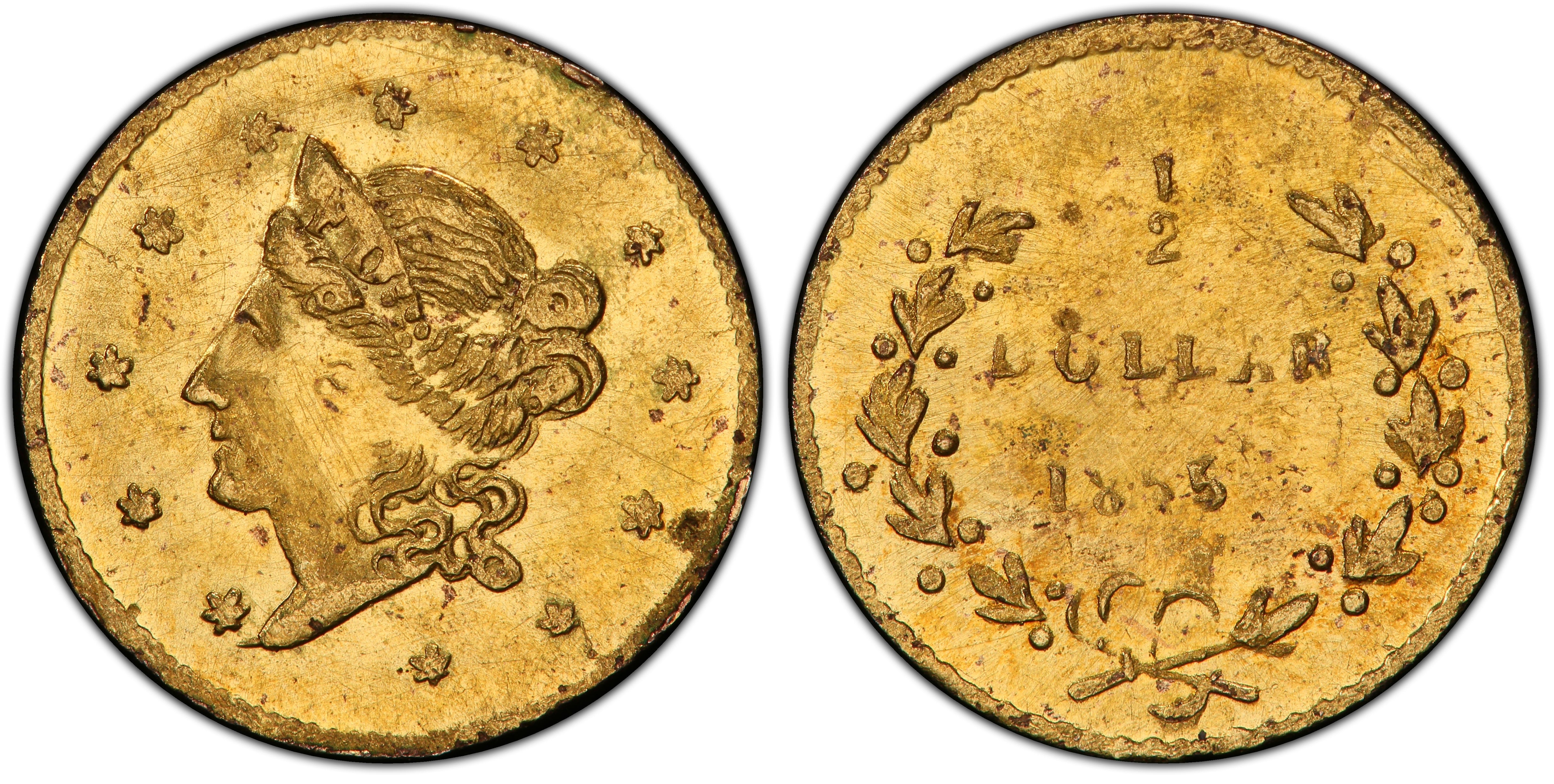
Obverse & Reverse
The 1855 Round Liberty Head Half Dollar, cataloged as Breen-Gillio 405, is a quintessential artifact from the chaotic and economically vibrant era of the California Gold Rush. By 1855, San Francisco was the epicenter of a massive gold-based economy, yet it paradoxically suffered from a severe shortage of small-denomination coinage. Gold dust, the primary medium of exchange, was imprecise and inconvenient for daily transactions. While large-denomination private gold coins and, by 1854, federal issues from the new San Francisco Mint were being produced, the supply of official silver and small gold coins was woefully inadequate to grease the wheels of local commerce. Miners, merchants, and laborers needed coins for everything from a drink at a saloon to paying for daily necessities. Into this void stepped a number of entrepreneurial jewelers and artisans, many of French origin, who began striking their own fractional gold coins in quarter-dollar, half-dollar, and dollar denominations. These 'Period One' issues (1852-1857) were distinct from the later souvenir tokens. They were created with the genuine intent of serving as circulating money, and ample evidence exists of their use in trade, including many surviving examples that show honest wear. The BG-405 was struck in this environment of necessity. While not explicitly marked, the style and timing of its issue are consistent with pieces attributed to firms like Frontier, Deviercy & Co., though definitive attribution remains elusive. The production method was rudimentary, typically employing a screw press or even a hammer to strike gold planchets between hand-engraved dies. This resulted in coins that were often weakly or unevenly struck, with frequent die clashes and other imperfections, which are now considered part of their numismatic charm and character. These private issues were technically illegal but tolerated due to their utility. The federal government's authority was distant, and the local economy's needs were immediate. The eventual increase in production from the San Francisco Mint rendered these private fractionals obsolete by 1857, leading to the end of the Period One issues and preserving them as a fascinating, short-lived chapter in American monetary history.
Associated EventCalifornia Gold Rush
Reason For MintingTo alleviate a severe shortage of small-denomination circulating coinage in San Francisco for daily commercial transactions.
Minter HistoryThe minter of BG-405 is not definitively known, a common trait for many anonymous fractional gold issues. However, scholarship often associates Period One Liberty Head pieces of this style with the San Francisco jewelers of the day, most notably the French partnership of Pierre Frontier and Eugene Deviercy (Frontier, Deviercy & Co.). Active from approximately 1852 to 1856, they were among the most prominent producers of fractional gold, sometimes marking their coins with the initials 'FD'. Even on unmarked pieces, die characteristics and provenance can suggest a link. These jewelers were skilled artisans who adapted their craft to meet a pressing economic need, creating the dies and striking the coins within their own small workshops.
Historical SignificanceThe BG-405 is a tangible representation of private enterprise filling a crucial gap left by the federal government during one of America's most significant economic expansions. As a Period One issue, it stands as a genuine circulating medium of exchange from the Gold Rush, unlike many later fractionals which were made as souvenirs. Its existence highlights the unique monetary challenges of the American frontier and the ingenuity of those who solved them, creating a fascinating and highly collectible numismatic series.
N/A
Denomination50 Cents
Minting Period1855
Assayer/MinterUnknown (Possibly Frontier, Deviercy & Co.)
Geographic OriginSan Francisco, California
Obverse DescriptionA fairly crude but recognizable rendition of the Liberty Head, facing left. The portrait is surrounded by thirteen five-pointed stars, representing the original colonies. The date '1855' is positioned below the bust truncation.
Obverse Inscription1855
Reverse DescriptionA wreath composed of two branches tied by a bow at the bottom. The inscription is arranged within the wreath, with 'HALF' at the top, 'DOL.' below it, and the legend 'CALIFORNIA GOLD' around the periphery, outside the wreath.
Reverse InscriptionCALIFORNIA GOLD / HALF DOL.
CompositionGold
Stated Fineness Actual FinenessVariable, typical for Period One issues, ranging from .583 (14-karat) to over .900.
EdgePlain
Unknown
Survival EstimateFewer than 60 pieces in all grades.
Rarity ScaleR-5 (Very Rare) to Low R-6 (Very Rare)
The BG-405 is highly sought after as a genuine, circulating 'Period One' issue. Its appeal lies in its direct connection to the California Gold Rush, its high rarity, and the charm of its somewhat crude, handmade quality. Collectors of territorial gold and early American coinage prize these pieces as foundational items.
Key VarietiesThe primary variety is the regular business strike. There are no known major sub-varieties from the period of issue, though minor differences may exist due to die states. This coin is well-known for being struck from heavily clashed dies, with evidence of the reverse wreath often visible on the obverse fields around Liberty's portrait. No later-date Proof restrikes or special collector issues are known for this specific variety.
Authentication TipsAuthenticity is paramount. Genuine examples often have a slightly uneven, soft, and satiny luster characteristic of early gold. The strike is almost always weak in areas. Look for the prominent die clash marks, a key diagnostic for this variety. The lettering and stars, while crude, should match the style seen in Breen-Gillio and on certified examples. Counterfeits are common; many are underweight, have a glassy or unnatural luster, or exhibit incorrect design details. Pieces with a bear on the reverse are always modern tokens. Authentication by a reputable third-party grading service is strongly recommended.
Shopping ConsiderationsWhen acquiring a BG-405, focus on surface originality and minimal distractions. A premium quality example for its grade will possess original, uncleaned surfaces, often with a pleasing reddish-gold or mellow straw-gold patina. Given the inherent weakness of the strike, a specimen with above-average sharpness on Liberty's hair and the reverse wreath is highly desirable. Look for the diagnostic die clash, which should be present but not overwhelmingly distracting. Avoid examples that have been harshly cleaned, polished, or used as jewelry, as this severely impacts value. Pay close attention to any evidence of tooling or repairs in the fields, which may have been done to efface marks or the die clash.
A coin's grade is its condition, rated on a 1-70 scale. For rare coins, this is the most critical factor in determining value, as a tiny difference in preservation can mean a huge difference in price.
Relevant Grade TypesAll original 1855 BG-405 coins were struck as business strikes intended for circulation. They are found in Circulated grades (AG-3 to AU-58) and, very rarely, in Mint State (MS-60 to MS-70). The concept of a Proof (PR/PF) striking for collectors did not apply to these utilitarian issues, and no original Proofs are known to exist. Any piece described as a 'Proof' would not be an original 1855 striking.
Mint State CharacteristicsAn uncirculated BG-405 will exhibit full mint luster, which is typically soft and satiny rather than bright and flashy. The strike is characteristically weak, so a coin should not be penalized for a lack of full detail on the highest points, though any example with superior sharpness commands a premium. Due to the rudimentary production and soft gold, even Mint State examples will often show minor planchet flaws, handling marks, or evidence of the heavy die clash. The key is to find a piece with minimal distracting contact marks and vibrant, original luster.
Circulated Wear PatternsWear first appears on the highest points of the design. On the obverse, this includes Liberty's hair above the eye and ear, and the cheekbone. On the reverse, the high points of the wreath's leaves and the letters in 'HALF DOL.' will show the first signs of friction. In lower grades (VG and below), the date and some of the stars may become faint, and the finer details of the wreath will be worn smooth.
Key Factors For ValueFor the BG-405, value is driven by three main factors: grade, surface quality, and eye appeal. A high-grade example (AU or MS) is exponentially more valuable than a circulated one. Within a grade, a coin with original, uncleaned surfaces and a pleasing, consistent patina will sell for a significant premium over a cleaned or abraded specimen. Sharpness of strike is a major consideration; a well-struck example for the issue is always prized. Finally, the presence of a CAC sticker, indicating premium quality for the grade, adds a substantial premium for this rare and coveted issue.
PCGS Price Guide
| Grade | Price | Population |
|---|---|---|
| 40 | $365.00 | 1 |
| 45 | $380.00 | 1 |
| 45+ | $385.00 | N/A |
| 50 | $400.00 | N/A |
| 50+ | $405.00 | N/A |
| 53 | $425.00 | 1 |
| 53+ | $430.00 | N/A |
| 55 | $450.00 | 4 |
| 55+ | $465.00 | N/A |
| 58 | $525.00 | 12 |
| 58+ | $550.00 | N/A |
| 60 | $575.00 | 1 |
| 61 | $600.00 | 1 |
| 62 | $700.00 | 13 |
| 62+ | $850.00 | N/A |
| 63 | $1,250.00 | 4 |
| 63+ | $1,450.00 | N/A |
| 64 | $1,750.00 | 3 |
| 64+ | $2,250.00 | N/A |
| 65 | $3,250.00 | 2 |