1872 25C BG-725 (Regular Strike)
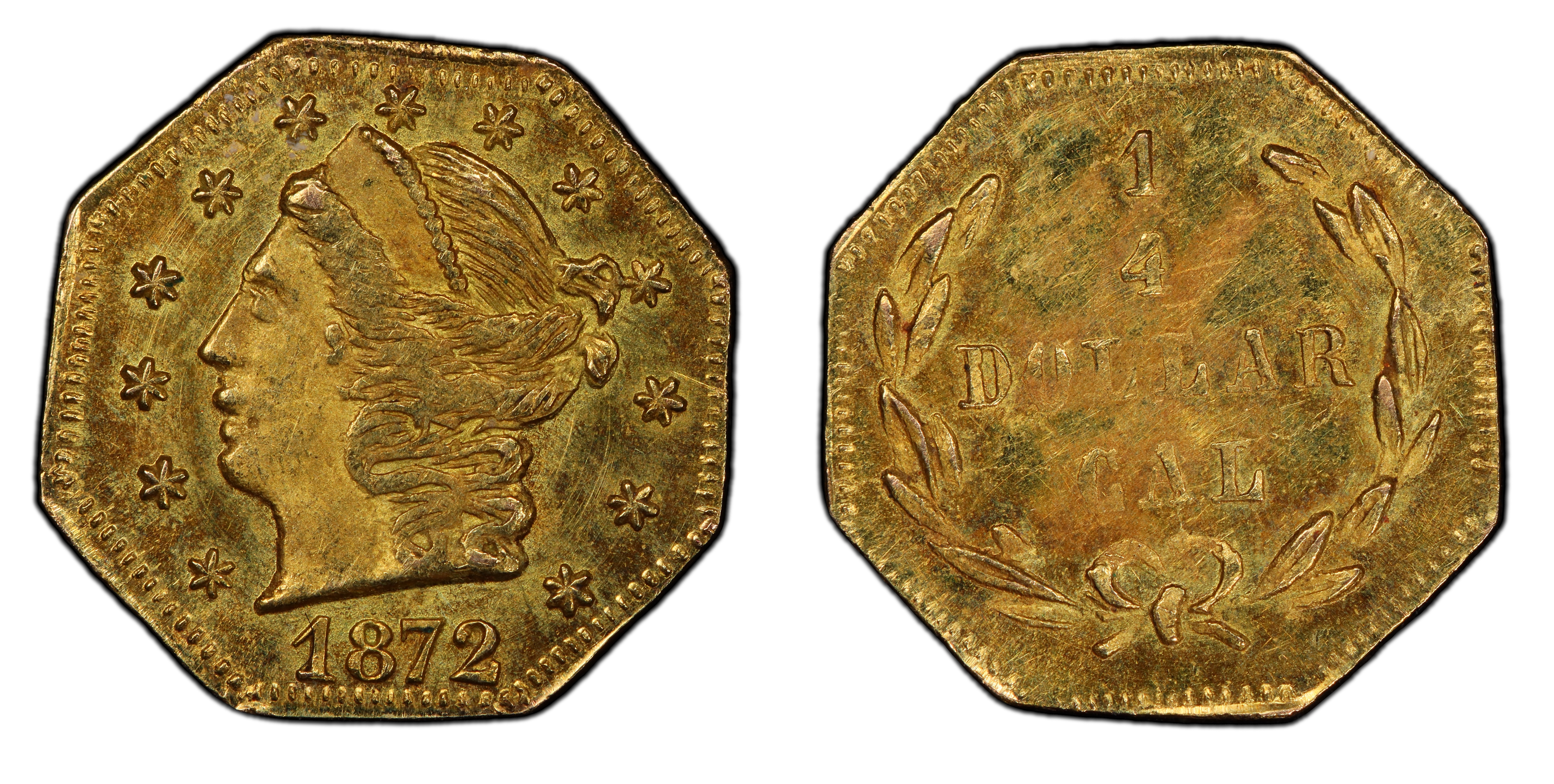
Obverse & Reverse
The 1872 25-cent BG-725 is a product of the second great period of California Fractional Gold production (1858-1882). Unlike the initial 'Period One' issues (1852-1857), which were struck out of a genuine commercial need to alleviate a severe shortage of small-denomination coinage during the Gold Rush, these later pieces were created primarily as souvenirs and keepsakes. By the 1870s, the San Francisco Mint was in full operation, and the acute need for private coinage had subsided. Instead, local jewelers capitalized on the romantic allure of the Gold Rush, producing these miniature gold coins for tourists, merchants, and collectors back East. The BG-725, dated 1872, falls squarely into this era of nostalgia-driven production. These pieces were often struck with less regard for intrinsic value, with gold content varying and sometimes being significantly less than their face value would imply. They were manufactured using the 'hammer method,' where dies were struck by hand, leading to significant variations in strike quality. The passage of the Private Coinage Act of 1864 made such private issues illegal, but the law was not strictly enforced in California until a Secret Service crackdown in 1883, allowing jewelers to continue their profitable souvenir trade for nearly two decades. The BG-725 is a tangible artifact from this fascinating gray area of American numismatic history, representing a transition from utilitarian necessity money to a commercialized memento of the Wild West.
Associated EventPost-Gold Rush Era Souvenir Production
Reason For MintingPrimarily struck as a souvenir or collectible item for the tourist and jewelry trade, not for general circulation.
Minter HistoryThe specific maker of the BG-725 variety is not definitively known or is poorly documented, a common trait for many 'Period Two' California Fractional Gold issues. Production was often carried out by numerous San Francisco jewelers who did not always place an identifying mark on their products. Prominent minters of this era included figures like Robert B. Gray & Co. and Christopher Ferdinand Mohrig, but a direct link to the BG-725 dies has not been established in numismatic literature. These craftsmen operated small-scale minting operations within their jewelry shops, using hand-engraved dies and manual presses or hammers to create the tiny gold pieces.
Historical SignificanceThe BG-725 is significant not as a circulating coin, but as a historical artifact representing the commercialization of the Gold Rush legend. It showcases the continued demand for gold novelties long after the initial fever had passed and demonstrates the lax enforcement of federal coinage laws on the West Coast during the late 19th century. Its high rarity today underscores the small, ephemeral nature of these private jewelry operations.
BG-725
Denomination25C
Minting Period1872
Assayer/MinterUnknown Jeweler
Geographic OriginSan Francisco, California
Obverse DescriptionFeatures a large Liberty Head facing left, with hair tied in the back. The portrait is encircled by thirteen stars representing the original colonies.
Obverse Inscription[None, stars only]
Reverse DescriptionA wreath with no berries is open at the top, encircling the denomination. The date is positioned within the wreath, below the denomination. Some auction descriptions note a peculiar 'kidney-shaped bow' at the base of the wreath on similar varieties.
Reverse Inscription1/4 DOLLAR 1872
CompositionGold
Stated Fineness Actual FinenessVariable, often between .500 and .750 fine, but not consistently documented for this specific variety.
Weight0.25 grams
Diameter9.50 mm
EdgePlain
Unknown
Survival EstimateFewer than 75; likely in the 31-75 range.
Rarity ScaleR-5+
This coin is highly sought after due to its high rarity, octagonal shape, and its connection to the romanticized history of the California Gold Rush. As a 'Period Two' issue, it is more accessible than some of the circulation-era pieces but remains a significant challenge to acquire, especially in high grades.
Key VarietiesThe BG-725 is a specific die marriage. Within the broader 1872 25C octagonal series, there are other Breen-Gillio varieties with different die characteristics (e.g., BG-726). No special collector issues like proofs or restrikes are known from the period of issue; the nature of their production as souvenirs often resulted in some examples having prooflike surfaces from polished dies, but these are not true Proofs.
Authentication TipsGenuine examples often exhibit a slightly crude, hand-made quality. The strike can be uneven, with some areas of weakness opposite well-defined areas. The luster on high-grade pieces is frequently prooflike or deeply reflective. Look for sharp, distinct edges on the octagonal planchet. Counterfeits are common in this series; many are brassy in color, have a soapy or cast-like appearance, incorrect weight, or feature incorrect design details (e.g., bears on the reverse, which do not appear on genuine 19th-century issues). Authentication by a major third-party grading service is highly recommended.
Shopping ConsiderationsFor this issue, a 'premium quality' example is defined by a sharp strike on the Liberty Head's details and the wreath on the reverse. Given their method of manufacture, weakly struck examples are common. Exceptional pieces will have bright, prooflike surfaces with minimal contact marks. Toning can range from a light yellow-gold to a deeper reddish or greenish-gold patina, which is considered attractive by many collectors. Avoid examples that have been harshly cleaned, which strips the original surface, or those that show evidence of being used as jewelry (solder marks, excessive rim damage). A slight buckling of the planchet is not uncommon and may be noted on certified holders; this is less of a concern than surface impairment.
A coin's grade is its condition, rated on a 1-70 scale. For rare coins, this is the most critical factor in determining value, as a tiny difference in preservation can mean a huge difference in price.
Relevant Grade TypesOriginal period issues were business strikes, although intended as souvenirs rather than for circulation. They are found in Circulated (1-58) grades, though this is less common, and more frequently in Mint State (MS, 60-70) grades. True Proofs were not struck. However, due to the use of polished dies by the jeweler-minters, many Mint State examples exhibit prooflike (PL) or deeply prooflike (DPL) surfaces, a characteristic that is highly desirable and often commands a premium.
Mint State CharacteristicsAn uncirculated BG-725 typically exhibits a very bright, almost flashy luster, often with prooflike reflectivity in the fields. The strike is a key variable; many are weakly struck on the stars or the wreath. A superior example will have a bold strike across all central devices. Due to the softness of the gold and the production methods, even high-grade specimens can have minor planchet irregularities or small, scattered contact marks. Original, uncleaned surfaces are paramount.
Circulated Wear PatternsIf circulated, wear would first appear on the high points of Liberty's hair, cheek, and the highest leaves and bow of the reverse wreath. The stars on the obverse, if weakly struck to begin with, would be among the first elements to fade. On lower-grade examples, the legends and date would show significant flattening.
Key Factors For ValueThe primary value drivers for a BG-725 are grade and surface quality. A high Mint State grade (e.g., MS-63 or higher) is a major multiplier. The presence of prooflike or deep prooflike surfaces adds a significant premium. Eye appeal is crucial; examples with original, lustrous surfaces and perhaps attractive toning are prized over cleaned, dull, or heavily marked specimens. Given the prevalence of fakes, certification by a top-tier service like PCGS or NGC is virtually required for any significant transaction, with a CAC sticker adding a further premium for exceptional quality within the assigned grade.
PCGS Price Guide
| Grade | Price | Population |
|---|---|---|
| 55 | $250.00 | 1 |
| 55+ | $255.00 | N/A |
| 58 | $275.00 | N/A |
| 58+ | $280.00 | N/A |
| 60 | $300.00 | N/A |
| 61 | $335.00 | 4 |
| 62 | $420.00 | 2 |
| 62+ | $440.00 | N/A |
| 63 | $600.00 | 14 |
| 63+ | $680.00 | N/A |
| 64 | $850.00 | 16 |
| 64+ | $1,150.00 | N/A |
| 65 | $1,750.00 | 3 |
| 65+ | $2,250.00 | N/A |
| 66 | $2,750.00 | 1 |