1859 G25C BG-701 (Regular Strike)
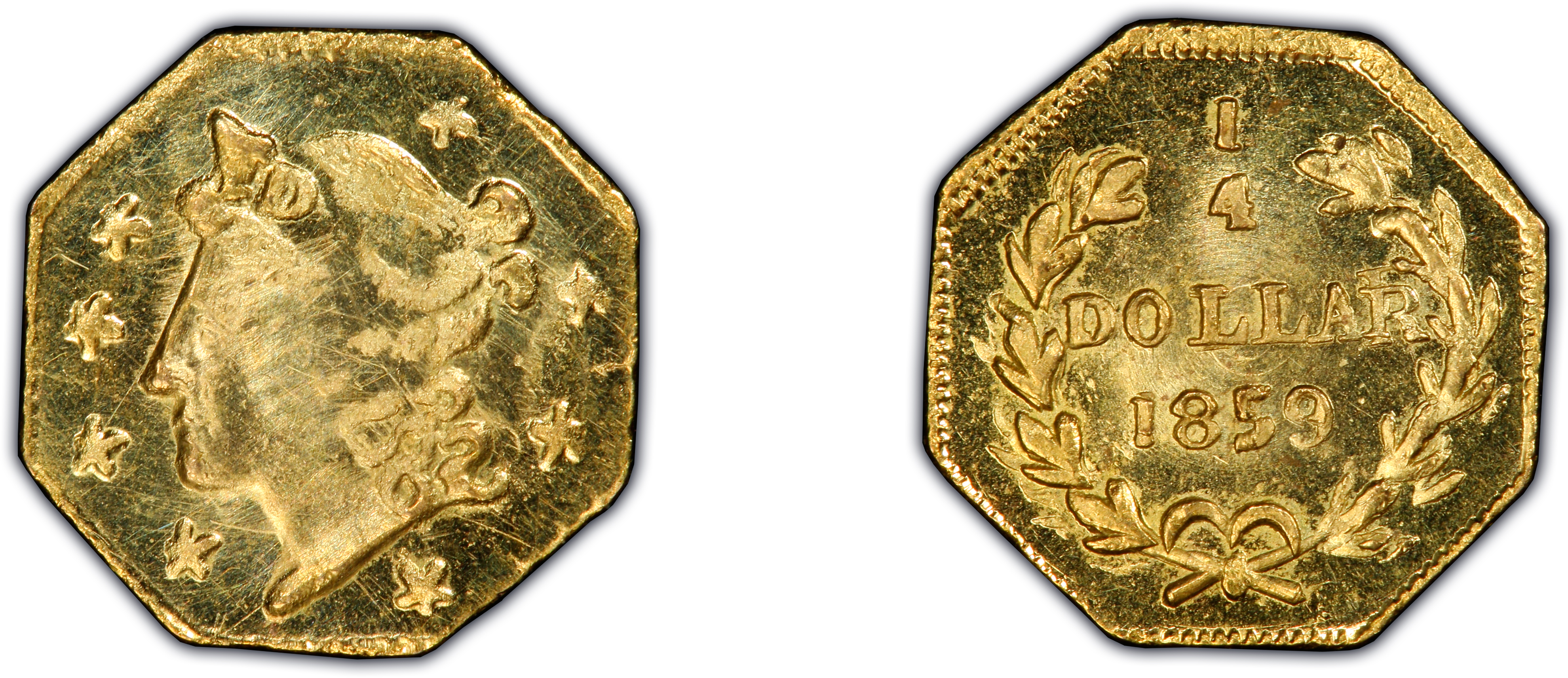
Obverse & Reverse
The 1859 BG-701 25 Cents represents a pivotal transition in the fascinating series of California Fractional Gold. The first period of these issues, from 1852 to roughly 1857, arose from a genuine economic necessity. The massive influx of population during the Gold Rush created a vibrant economy, but a severe shortage of circulating small change made daily transactions cumbersome. Gold dust, while plentiful, was imprecise and prone to theft and fraud. In response, various private jewelers and assayers in San Francisco began striking their own quarter dollar, half dollar, and dollar coins from native gold. These 'Period One' issues, while often underweight, were intended to and did function as a circulating medium of exchange. By 1859, the economic landscape had changed. The San Francisco Mint, which opened in 1854, was in full production, alleviating the small-change shortage with official U.S. silver and gold coinage. The practical need for fractional gold evaporated. However, a new market had emerged. These miniature gold pieces had become popular as souvenirs and keepsakes—mementos of the romantic and adventurous Gold Rush that could be easily mailed or carried back East. This gave rise to the 'Period Two' issues (1859-1882), of which the BG-701 is a prime example. Struck by firms like Frontier, Deviercy & Co., these pieces were not intended for the cash drawer but for the tourist and jewelry trade. As such, their gold content was often less than their stated face value, and production quality could be cruder than the earlier issues, though many were preserved in high grades. The U.S. government viewed these private issues with suspicion, culminating in the Coinage Act of 1864 which made private coinage illegal. The law was not strictly enforced until 1883, allowing jewelers to continue producing these popular 'tokens' for nearly two more decades. The BG-701, a product of this souvenir-driven era, is a tangible link to the enduring legacy of the Gold Rush and the entrepreneurial spirit of the jewelers who adapted their craft from necessity to novelty.
Associated EventCalifornia Gold Rush
Reason For MintingPrimarily struck as a souvenir or for use in the jewelry trade after the initial need for circulating small change in California had subsided.
Minter HistoryFrontier, Deviercy & Co. was a partnership of French jewelers active in San Francisco during the mid-19th century. Pierre Frontier and Eugene Deviercy were prolific producers of 'Period Two' California Fractional Gold. Their work is characterized by a range of artistic styles, sometimes crude but always distinctive. They often used common die punches across different varieties, and their initials, 'FD', are sometimes cleverly concealed within the design, as is the case with the BG-701. The firm, in various configurations, was a key player in the transition of fractional gold from utilitarian currency to commercial keepsakes.
Historical SignificanceThis coin is significant as it represents the second wave of fractional gold production, where the purpose shifted from fulfilling a monetary need to satisfying a commercial demand for souvenirs. It encapsulates the romanticism of the Gold Rush era as perceived by outsiders and tourists, and is a key example of the 'jeweler's issues' that continued until federal intervention in 1883.
N/A
Denomination25 Cents
Minting Period1859
Assayer/MinterFrontier, Deviercy & Co.
Geographic OriginSan Francisco, California
Obverse DescriptionA crudely engraved Liberty Head, facing left, with thirteen five-pointed stars surrounding. The portrait style is distinct from federal issues. The initials 'FD' for Frontier & Deviercy are reportedly concealed near the tip of Liberty's coronet, serving as a 'secret' maker's mark.
Obverse Inscription[Date 1859 below bust]
Reverse DescriptionThe denomination '25 CENTS' is enclosed within a wreath of two olive branches joined at the bottom by a bow. The wreath design is typically full, with multiple berries, characteristic of many Period Two issues.
Reverse Inscription25 CENTS
CompositionGold
Stated Fineness Actual FinenessVariable; Period Two issues are known to be debased and inconsistent, often ranging from 14 to 22 karats.
EdgePlain
Unknown
Survival Estimate13-30 known. NGC and PCGS census data show a combined population of approximately 15-20 graded examples, suggesting a total surviving population consistent with an R-6 rating.
Rarity ScaleR-6
The BG-701 is sought after for its high rarity (R-6), octagonal shape, and its status as a classic 'Period Two' jeweler's issue. The concealed 'FD' maker's mark adds a layer of intrigue and desirability for specialists. As most survivors are in Mint State, it appeals to collectors who appreciate high-grade examples of these historic pieces.
Key VarietiesThe BG-701 is a specific die marriage. No major varieties from the original minting period are known. No special collector restrikes or patterns are recorded for this variety. The primary variations within the broader 1859 octagonal 25C series are the different Breen-Gillio die pairings (e.g., BG-702, BG-703), each with unique engraving characteristics.
Authentication TipsGenuine examples exhibit a characteristically crude but sharp strike from dies, not the soft, pimpled, or tool-marked surfaces of modern cast fakes. The engraving style, though unrefined, should match known genuine specimens. The planchets are typically very thin. A key diagnostic for BG-701 is the presence and location of the faint 'FD' initials near the coronet. Replicas often have incorrect details, weights, or a soapy, non-metallic luster. Any piece appearing to have a bear on the reverse is a 20th-century fantasy piece.
Shopping ConsiderationsSince most BG-701s are found in Mint State, the primary differentiators are surface quality and eye appeal. Look for a well-centered strike, though perfect centering is rare. A premium quality example will be free of distracting marks, carbon spots, or evidence of cleaning. Original, attractive peach-gold or deep yellow-gold toning is highly prized. Many examples come with prooflike or semi-prooflike surfaces, and these command a premium. Avoid examples with planchet flaws, laminations, or significant strike-throughs, though minor weaknesses in the strike are common and acceptable.
A coin's grade is its condition, rated on a 1-70 scale. For rare coins, this is the most critical factor in determining value, as a tiny difference in preservation can mean a huge difference in price.
Relevant Grade TypesOriginal issues of BG-701 were business strikes. However, as they were primarily made for sale to tourists and jewelers rather than for circulation, the vast majority of surviving examples are in Mint State (MS, 60-70) grades. It is exceptionally rare to find a circulated example. No proofs (PR/PF) were struck during the original period of issue, and no later-date collector restrikes are known to exist.
Mint State CharacteristicsUncirculated examples of BG-701 are defined by their luster, strike, and marks. The luster is often vibrant and can be quite reflective, leading to 'Prooflike' (PL) designations. The strike, however, is often crude and can be unevenly impressed due to the hammer-striking process. The Liberty portrait may show some weakness. Small, scattered contact marks are common and must be evaluated carefully, as even a few ill-placed marks can significantly impact the grade and value.
Circulated Wear PatternsOn the rare occasion a circulated example is encountered, wear would first appear on the highest points of the design. For the obverse, this would be Liberty's cheek, the hair just above the ear, and the upper portions of the coronet. On the reverse, the highest leaves and berries of the wreath and the numerals of the denomination '25' would show the first signs of friction and flattening.
Key Factors For ValueFor the BG-701, value is driven by rarity and grade. A high-grade Mint State coin (MS-63 or better) is the standard. Key factors include: 1) Surface Preservation: Clean, mark-free surfaces with original skin command strong premiums. 2) Luster: Coins with deep, prooflike reflectivity are highly desirable and valued above satiny or dull examples. 3) Strike: While some weakness is expected, examples with a bolder-than-average strike on the portrait and wreath are preferred. 4) Eye Appeal: Attractive, original color enhances value. Certification by a top-tier service (PCGS or NGC) is essential for market acceptance, and a CAC sticker for a premium quality example would add a significant premium.
PCGS Price Guide
| Grade | Price | Population |
|---|---|---|
| 55 | $500.00 | 1 |
| 55+ | $515.00 | N/A |
| 58 | $550.00 | N/A |
| 58+ | $565.00 | N/A |
| 60 | $600.00 | N/A |
| 61 | $625.00 | 1 |
| 62 | $700.00 | 6 |
| 62+ | $740.00 | N/A |
| 63 | $900.00 | 9 |
| 63+ | $1,000.00 | N/A |
| 64 | $1,250.00 | 7 |
| 64+ | $1,375.00 | N/A |
| 65 | $2,950.00 | 4 |
| 66 | N/A | 1 |