1853 G25C BG-212 (Regular Strike)
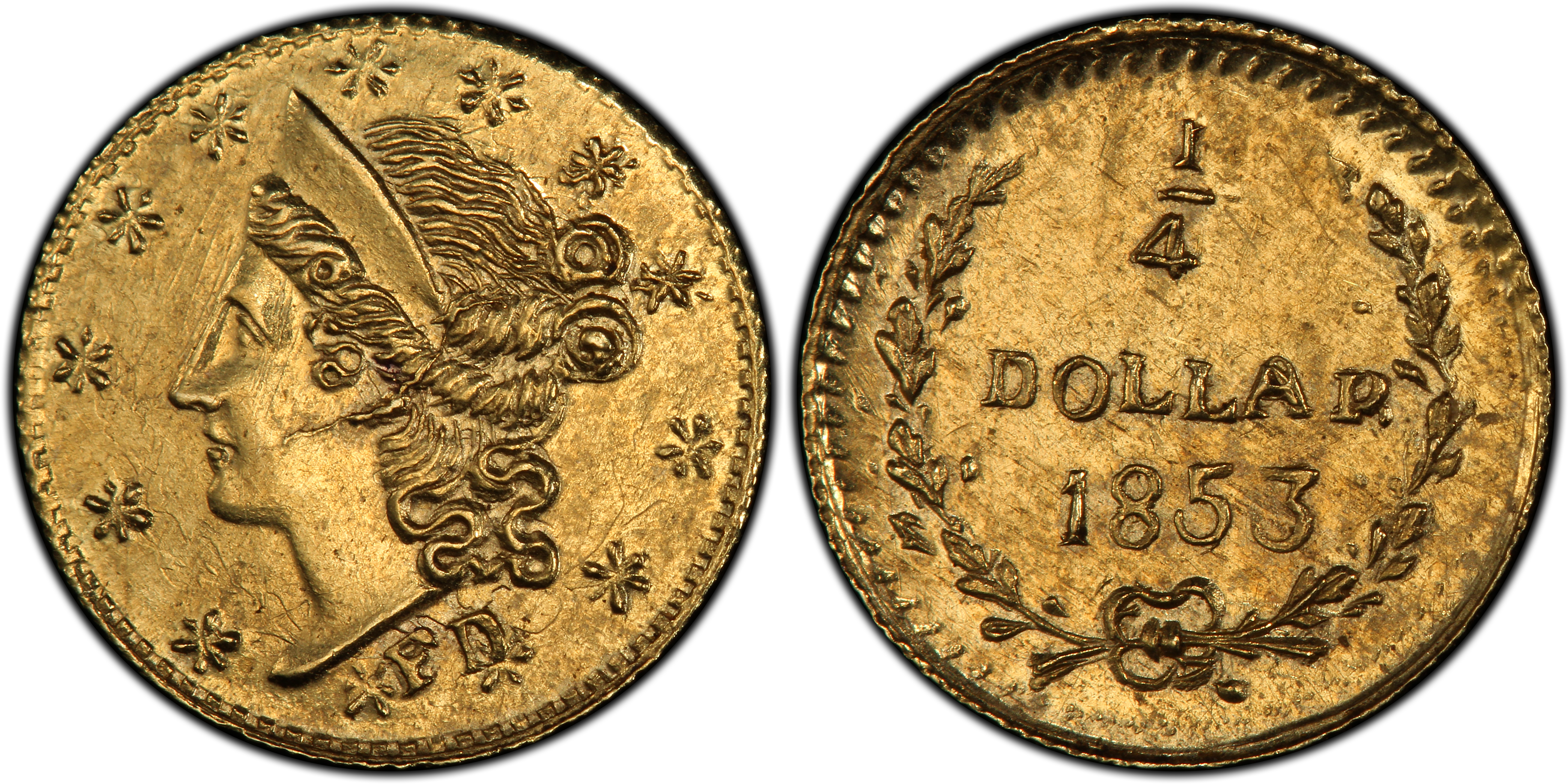
Obverse & Reverse
The 1853 BG-212 Quarter Dollar is a tangible relic from the chaotic, formative years of the California Gold Rush. Following the discovery of gold at Sutter's Mill in 1848, a massive influx of over 300,000 people descended upon California, creating a vibrant but tumultuous economy almost overnight. This explosive growth created an acute and crippling shortage of small-denomination coinage. Commerce was severely hampered; transactions for daily necessities like a meal or a drink were often conducted with pinches of gold dust, a notoriously inaccurate and contentious method. The United States government was slow to respond. While private assayers like Moffat & Co. and the U.S. Assay Office began producing larger denomination coins ($5 to $50), these were useless for everyday purchases. The San Francisco Mint would not be fully operational until 1854, and even then, its initial focus was on larger coins. Into this numismatic vacuum stepped a number of entrepreneurial jewelers and metalsmiths in San Francisco. Between 1852 and 1857 (a period numismatists classify as 'Period One'), these craftsmen began privately striking their own fractional gold coins in 25-cent, 50-cent, and one-dollar denominations. These were not government-authorized coins, but rather tokens of convenience, born of necessity to facilitate trade. The BG-212 is a prime example of these 'Period One' issues, which were distinguished from later souvenir pieces by their higher gold content and genuine intent for circulation. They were crudely manufactured, typically by the hammer method, resulting in inconsistent strike quality. Despite their unofficial status, they gained a degree of acceptance and appear to have circulated, as evidenced by the circulated condition of many surviving examples and their discovery in shipwrecks of the era. By 1856-1857, the San Francisco Mint's production of official U.S. silver and gold coinage finally saturated the region, rendering the private fractionals obsolete. Most were subsequently melted down, contributing to their extreme rarity today. The BG-212 represents the most historically significant period of this fascinating series, a direct link to the desperate need for a functional currency that built the economy of the American West.
Associated EventCalifornia Gold Rush
Reason For MintingTo remedy a severe shortage of small-denomination coinage for daily commercial transactions in Gold Rush-era San Francisco.
Minter HistoryThe specific minter for the BG-212 variety is unknown, a common trait for many Period One California Fractional Gold pieces. The work is attributed to the community of anonymous jewelers and metalsmiths operating in San Francisco in the early 1850s. These individuals, many of whom were French immigrants, possessed the requisite skills for die-sinking and striking small gold planchets. Unlike the more organized private minters of larger bars and coins (e.g., Kellogg & Co., Wass, Molitor & Co.), these fractional producers operated on a smaller, more ad-hoc basis to meet the immediate needs of local commerce. Their work is characterized by artistic simplicity and utilitarian, often crude, manufacturing techniques.
Historical SignificanceThe BG-212 is a historically important piece of 'necessity money' that demonstrates the private sector's response to a failure of government monetary policy on the American frontier. As a 'Period One' issue, it stands as a testament to the coins that were actually intended for and likely used in daily commerce, making it far more significant than the later souvenir issues. Its existence illuminates the primitive economic conditions of one of the most pivotal periods in American history.
BG-212
Denomination25 Cents
Minting Period1853
Assayer/MinterUnknown/Anonymous San Francisco Jeweler
Geographic OriginSan Francisco, California
Obverse DescriptionA fairly crude depiction of a Liberty Head, facing left, with hair tied in a bun. The portrait is surrounded by thirteen six-pointed stars arranged in a circle near the rim. The date '1853' appears below the bust.
Obverse Inscription1853
Reverse DescriptionThe denomination '1/4' appears in the center, above the word 'DOLLAR'. This is enclosed within a simple wreath of leaves and berries. The legend 'CALIFORNIA GOLD' is inscribed in an arc along the upper periphery, outside the wreath.
Reverse InscriptionCALIFORNIA GOLD 1/4 DOLLAR
CompositionGold
Stated Fineness Actual FinenessVariable, but generally higher in Period One issues, often around .800 to .900 fine.
Weight0.25 grams
Diameter10.50 mm
EdgePlain
Unknown, but extremely small.
Survival EstimateFewer than 10; likely in the 3-5 range.
Rarity ScaleR-7 (Very Rare)
This coin is highly sought after as a representative of the 'Period One' issues, which are prized for their historical legitimacy as circulating currency during the Gold Rush. Its extreme rarity, classic Liberty Head motif, and direct connection to the formation of California's economy make it a cornerstone collectible for specialists in Territorial gold.
Key VarietiesThere are no major recognized die varieties of BG-212 itself. As a 'Period One' business strike, there are no known proof versions, restrikes, or special collector issues from the period of minting. The primary variations among surviving examples relate to strike quality and planchet characteristics inherent in the crude, hand-hammered minting process.
Authentication TipsAuthentication is critical. Genuine pieces exhibit a characteristic crudeness; strikes are often soft in areas, lettering can be uneven, and surfaces may show planchet adjustment marks or striations from the preparation of the gold. The style of the lettering and the specific Liberty portrait must be matched exactly to known genuine examples. Modern counterfeits or later-period souvenir tokens often appear too well-made, have incorrect details (like a different style of wreath or lettering), or are made of brass or thinly plated gold. The weight and specific gravity are key diagnostics. All potential purchases should be certified by a major grading service like PCGS or NGC.
Shopping ConsiderationsFor a specimen of this rarity, any example is a major acquisition. A 'premium quality' piece would be one that is well-centered and possesses an unusually sharp strike, particularly on the highest points of Liberty's hair and the leaves of the wreath. Look for original, uncleaned surfaces that may have a slightly reddish or mellowed gold hue. Many surviving fractionals have been damaged from use in jewelry; seek examples that are free of solder, tooling, or harsh cleaning. Even a well-worn but original and undamaged piece is vastly preferable to a higher-grade coin that has been impaired. Given the crudeness of manufacture, some minor planchet flaws are to be expected and do not detract significantly if they are contemporary to the strike.
A coin's grade is its condition, rated on a 1-70 scale. For rare coins, this is the most critical factor in determining value, as a tiny difference in preservation can mean a huge difference in price.
Relevant Grade TypesAll original BG-212 coins were struck as business strikes, intended for circulation. They are found in Circulated grades (AG-3 to AU-58) and, very rarely, in Mint State (MS, 60-70). No proofs were struck during the original minting period, and there are no known authorized restrikes. Any coin described as 'Proof' is either a modern replica or a misattribution of a prooflike business strike.
Mint State CharacteristicsAn uncirculated BG-212 is a great rarity. Quality is defined by the strike and surface preservation. Due to the hammer-striking process, a full strike is almost never encountered; a desirable example will show clear details in Liberty's hair and the wreath's berries. Luster is typically subdued and satiny rather than bright and flashy. Because the planchets were small and the gold soft, even Mint State examples may exhibit small, light contact marks or planchet flaws that are considered normal for the issue.
Circulated Wear PatternsWear first appears on the highest points of the design. On the obverse, this includes Liberty's cheek, the hair just above the ear, and the highest strands of hair in the bun. On the reverse, the high points of the wreath's leaves and berries will show smoothing and loss of detail first. In lower grades (VG and below), the stars, date, and peripheral lettering will become weak and merge with the fields.
Key Factors For ValueFor the BG-212, rarity is the paramount factor, so any authenticated example is valuable. Beyond that, value is driven by: 1) Surface Quality: An example with original, uncleaned surfaces commands a massive premium. 2) Strike: A coin with a bold, well-centered strike is far more desirable than a weakly struck or off-center example. 3) Damage: The absence of any damage (such as from jewelry mounting, harsh cleaning, or tooling) is critical. 4) Eye Appeal: Coins with a pleasing, original color and luster are highly prized. A CAC sticker on a certified coin would provide a significant additional premium, confirming its quality for the assigned grade.
PCGS Price Guide
| Grade | Price | Population |
|---|---|---|
| 55 | $2,350.00 | 1 |
| 55+ | $2,650.00 | N/A |
| 58 | $3,000.00 | 4 |
| 58+ | $3,250.00 | N/A |
| 60 | $4,050.00 | N/A |
| 61 | $5,000.00 | 1 |
| 62 | $7,000.00 | 3 |
| 62+ | $8,500.00 | N/A |
| 63 | $15,000.00 | 2 |