1854 G50C BG-436 Eagle (Regular Strike)
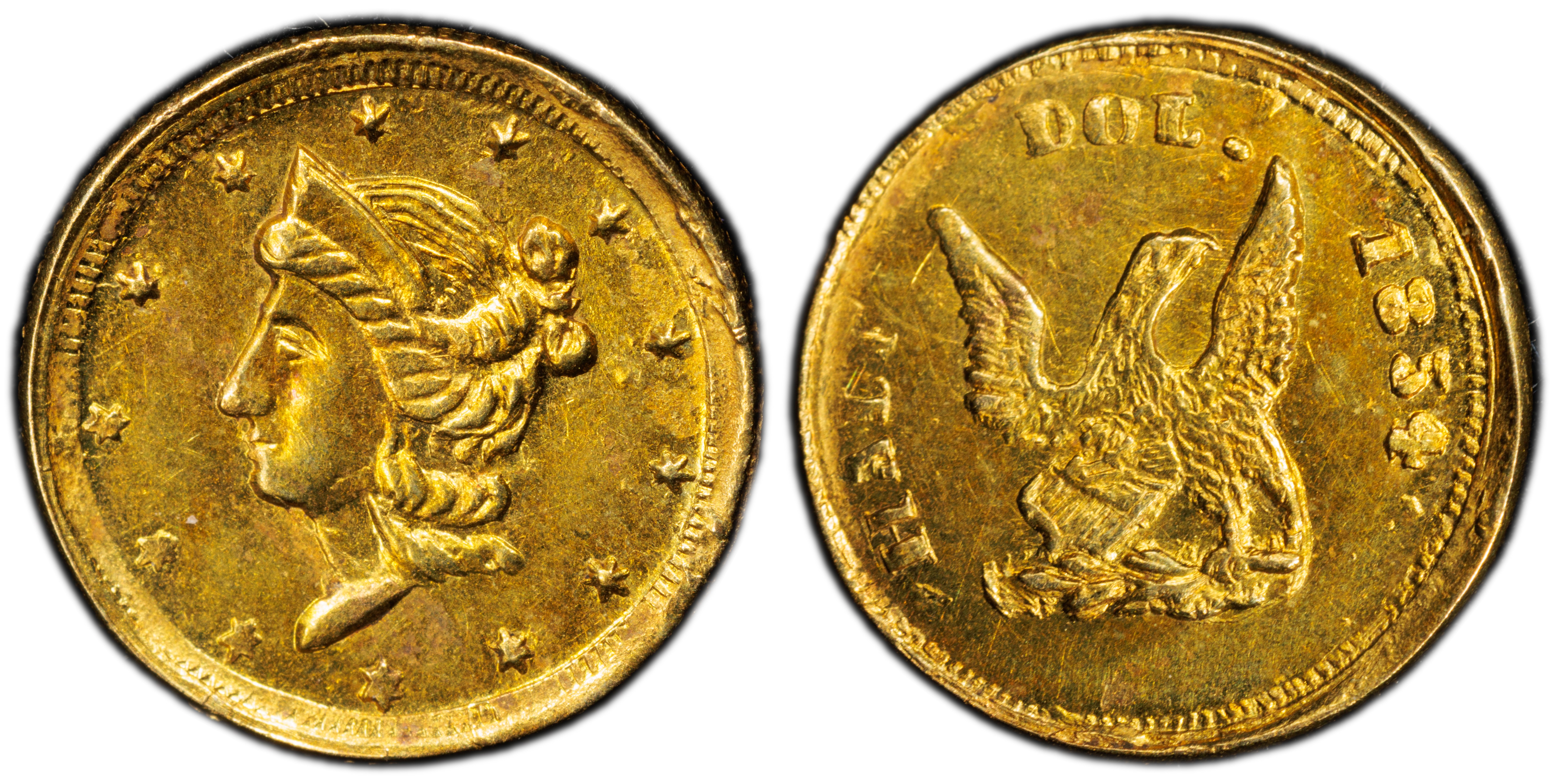
Obverse & Reverse
The California Gold Rush, beginning in 1848, created an unprecedented economic boom on the West Coast, but it also generated a severe and persistent shortage of circulating small change. Federal coinage was scarce, and the smallest denomination gold coin being produced by the U.S. Mint was the gold dollar, a substantial sum for minor daily transactions. To fill this void, private jewelers, engravers, and assayers in San Francisco and other boomtowns began striking their own miniature gold coins in denominations of 25 cents, 50 cents, and one dollar. These pieces, now known as California Fractional Gold, were a vital component of local commerce, facilitating everyday purchases from a loaf of bread to a drink at a saloon. The 1854 Gold 50 Cents, cataloged as Breen-Gillio 436 (BG-436), is a quintessential example of these fascinating and historically significant tokens. Struck from gold dust acquired in the California foothills, these coins were not legal tender but were widely accepted due to the urgent need for a medium of exchange. The quality and gold content of these private issues varied widely, a fact that eventually drew the scrutiny of the U.S. government. In 1864, federal legislation was passed that outlawed all private coinage, bringing an end to the regular production of these fractional gold pieces. Many were subsequently melted down, contributing to their present-day rarity. The BG-436, with its crude yet charming depiction of an eagle, represents a tangible link to the chaotic, entrepreneurial spirit of Gold Rush-era San Francisco. Its existence speaks to a time when private citizens took matters into their own hands to solve a fundamental economic problem, creating a unique and uniquely American numismatic legacy.
Associated EventCalifornia Gold Rush
Reason For MintingTo alleviate a severe shortage of small-denomination coinage for daily commercial transactions in Gold Rush-era California.
Minter HistoryThe specific minter for the BG-436 variety is not definitively known, a common trait for many California Fractional Gold issues. However, stylistic similarities in die work, particularly the punches used for the lettering and stars, lead numismatic researchers like Robert D. Leonard Jr. and Walter Breen to attribute this piece and others in its family (BG-435 through BG-438) to Antoine Louis Nouizillet. Nouizillet was a French-born jeweler and engraver active in San Francisco during this period. He is believed to have produced a significant number of different fractional gold varieties, characterized by a somewhat naive but distinctive artistic style. Lacking official records, these attributions are based on careful numismatic detective work comparing known examples.
Historical SignificanceThe BG-436, like all California Fractional Gold, is a direct artifact of the economic chaos and ingenuity of the Gold Rush. It demonstrates how private enterprise stepped in to fulfill a basic governmental function—the supply of currency—in a frontier economy. Its significance lies in its role as a practical tool of commerce and its representation of a period of unregulated, private minting that is unique in U.S. history.
N/A
Denomination50 Cents
Minting Period1854
Assayer/MinterUnknown, possibly Antoine Louis Nouizillet
Geographic OriginSan Francisco, California
Obverse DescriptionA rather crude depiction of a federal-style eagle with outstretched wings, facing left. The eagle holds no arrows or olive branch. It is surrounded by thirteen six-pointed stars, which are often unevenly spaced and weakly struck.
Obverse Inscription(No lettering, only stars and eagle design)
Reverse DescriptionThe denomination '1/2' is centrally located. Above it is the inscription 'GOLD,' and below is the date '1854.' The legend 'CALIFORNIA' encircles the design along the upper rim.
Reverse InscriptionCALIFORNIA GOLD 1/2 1854
CompositionGold
Stated Fineness Actual FinenessVaries, typically between .800 and .900 fine, often lower than federal standards.
Weight0.25 grams
Diameter10.00 mm
EdgePlain
Unknown
Survival Estimate50-75
Rarity ScaleR-5
This coin is highly sought after for its direct connection to the California Gold Rush, its primitive and artistic charm, and its status as a popular type coin within the extensive California Fractional Gold series. Its affordability relative to larger territorial gold issues makes it an accessible entry point for collectors interested in the era.
Key VarietiesThe primary issue is the business strike (Regular Strike) BG-436. There are no known original-period Proofs. However, the fractional gold series is notorious for later restrikes and counterfeit issues. Collectors should be aware of a large family of 'backdated' souvenir tokens made in the late 19th and early 20th centuries, which are not contemporary to the Gold Rush. The BG-436 itself is not known to have been officially restruck, but its design was mimicked by later souvenir makers.
Authentication TipsGenuine BG-436 examples exhibit specific die characteristics. Look for a distinctive die crack that often develops on the reverse from the rim through the 'C' in CALIFORNIA. The lettering and stars often show a slightly soft, uneven impression typical of the primitive minting equipment used. The gold color should be consistent with known genuine examples, often a slightly brassy yellow. Modern counterfeits are often overweight, have a soapy or prooflike surface, and exhibit tool marks or casting bubbles. Authentication by a major third-party grading service (PCGS or NGC) is highly recommended.
Shopping ConsiderationsA premium quality example for this issue will exhibit a bold strike, particularly on the eagle's feathers and the numbers of the date, which are often weak. Original, uncleaned surfaces with some remaining mint luster command significant premiums. Look for coins that have not been used as jewelry, avoiding examples with solder marks, holes, or excessive rim damage. The 'skin' of the coin is paramount; a specimen with a pleasing, original reddish-gold patina is far more desirable than a brightly dipped or cleaned one, even if the latter is technically in a higher grade. Check for planchet flaws or laminations, which are common on these privately minted pieces but should be noted.
A coin's grade is its condition, rated on a 1-70 scale. For rare coins, this is the most critical factor in determining value, as a tiny difference in preservation can mean a huge difference in price.
Relevant Grade TypesOriginal issues of BG-436 were business strikes intended for circulation and are found in Circulated (AU-58 and below) and Mint State (MS-60 to MS-70) grades. No original Proofs from 1854 are known to exist. Any piece described as a 'Proof' is almost certainly a later-date souvenir, restrike, or fantasy piece and should not be confused with the original Gold Rush-era coin.
Mint State CharacteristicsUncirculated examples of BG-436 are rare. A true Mint State specimen will display full, unbroken mint luster, often with a slightly frosty or satiny texture. Due to the primitive nature of their manufacture, they are seldom perfectly struck. Expect to see some weakness in the centers, particularly on the eagle's breast and the '1/2' on the reverse. Small planchet flaws or adjustment marks are not uncommon and are generally accepted for the issue. The key is distinguishing bag marks from circulation wear.
Circulated Wear PatternsWear first appears on the highest points of the design. On the obverse, look for friction on the eagle's head, the upper portion of its wings, and its breast. On the reverse, the fraction '1/2' and the digits of the date '1854' will show the first signs of flattening. In lower grades (VG and below), the eagle becomes a partial outline and the peripheral lettering on the reverse starts to merge with the rim.
Key Factors For ValueFor the BG-436, the primary value drivers are grade and surface quality. An example with original, undisturbed surfaces and a strong strike will command a significant premium over a cleaned, weakly struck, or damaged coin of the same numerical grade. Eye appeal is crucial; collectors pay more for coins with a pleasing, honest appearance. Certification by a top-tier grading service is essential for market acceptance and value realization, and a CAC sticker, indicating premium quality for the grade, adds a further, often substantial, premium.
PCGS Price Guide
| Grade | Price | Population |
|---|---|---|
| 55 | $4,000.00 | 2 |
| 55+ | $4,200.00 | N/A |
| 58 | $4,500.00 | 3 |
| 58+ | $4,750.00 | N/A |
| 60 | $5,250.00 | 2 |
| 61 | $6,000.00 | 3 |
| 62 | $8,000.00 | 2 |
| 62+ | $9,500.00 | N/A |
| 63 | $17,500.00 | 5 |