1853 G50C BG-303 "Peacock" (Regular Strike)
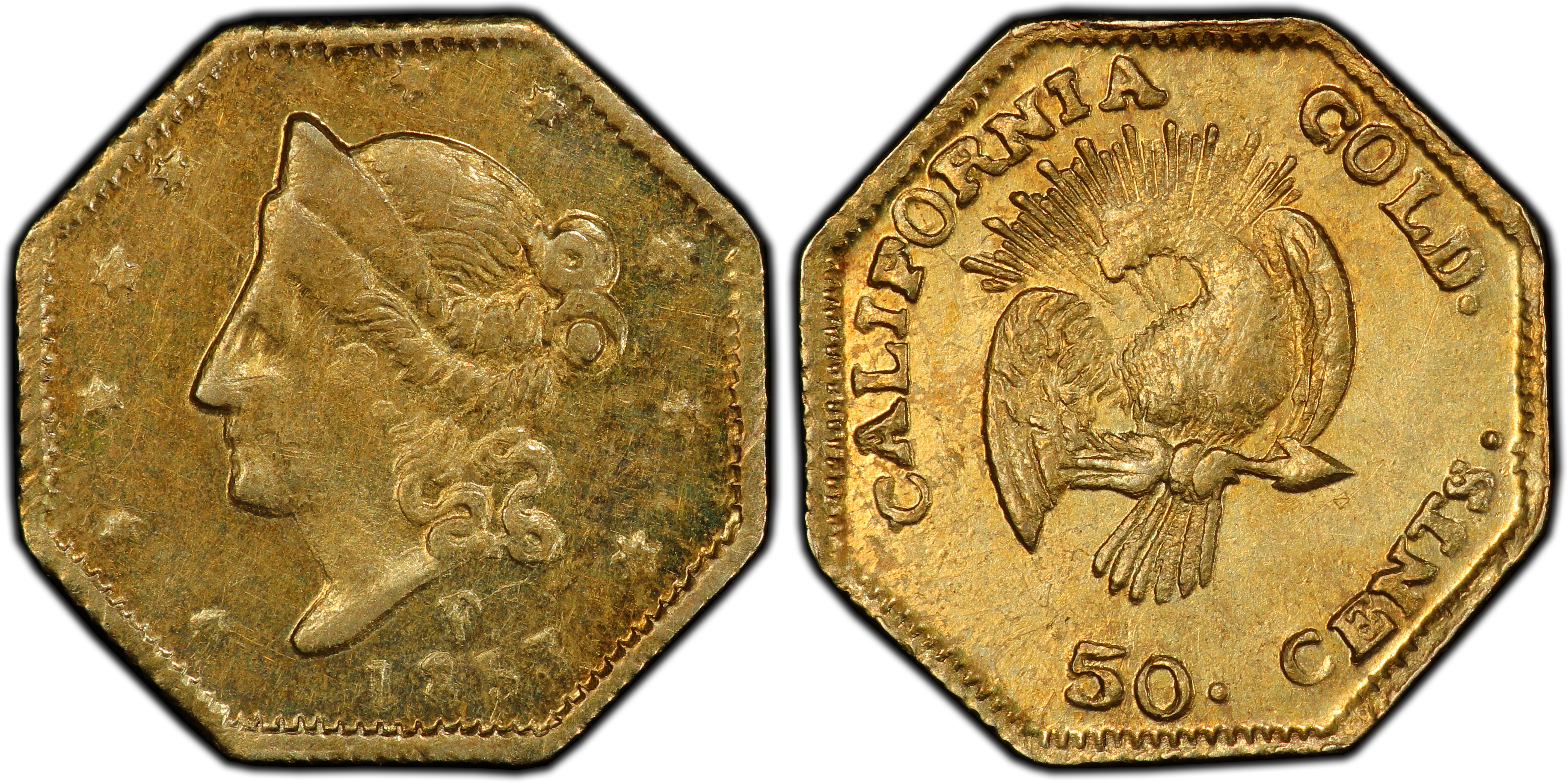
Obverse & Reverse
The 1853 G50C BG-303 'Peacock' Half Dollar is a quintessential artifact of the California Gold Rush, born from a severe and persistent crisis of small change. Following the discovery of gold at Sutter's Mill in 1848, a massive influx of over 300,000 people descended upon California, creating a vibrant but chaotic economy. While private assayers like Moffat & Co. and Kellogg & Co. adeptly converted raw gold dust and nuggets into large denomination slugs and coins ($5 to $50), the everyday commerce of the 'Forty-Niners' was crippled by the lack of fractional currency. Miners and merchants were forced to rely on awkward pinches of gold dust, a system rife with inaccuracy and theft, or a confusing mix of foreign silver coins of uncertain value. The U.S. government was slow to respond; the San Francisco Mint would not be fully operational until 1854, and even then, its initial focus was not on small coinage. Into this monetary vacuum stepped enterprising San Francisco jewelers, many of them French immigrants, who possessed the skills and equipment for fine metalwork. Pierre Frontier and Eugene Deviercy were prominent among these craftsmen. Seeing a clear market need, they began striking their own small-denomination gold coins in 1852. These 'Period One' issues, including the BG-303, were not mere tokens but were intended to and did circulate as a vital medium of exchange. They were struck by hand, using a hammer to force an upper die onto a planchet resting on a lower die set in an anvil, a method that accounts for their often crude and inconsistent strikes. The BG-303, with its distinctive 'Peacock' reverse, was part of a series (BG-301 to BG-303) that became popular and recognizable in commerce. Public acceptance was practical; despite being underweight compared to federal issues, their convenience in the bullion-rich, coin-poor California economy outweighed their intrinsic deficiency. This period of legitimate private coinage was short-lived. By 1856, with the San Francisco Mint in full production, the necessity for these fractional pieces waned, and their production ceased. Later issues by other jewelers (Period Two) were largely created as souvenirs. The BG-303 remains a tangible link to the height of the Gold Rush, representing a private, entrepreneurial solution to a government failure and a fascinating chapter in American monetary history.
Associated EventCalifornia Gold Rush
Reason For MintingTo alleviate a severe shortage of small-denomination coinage for daily commerce in Gold Rush-era San Francisco.
Minter HistoryPierre Frontier and Eugene Deviercy were French jewelers and watchmakers who operated in San Francisco during the Gold Rush. They formed a partnership that became one of the most prolific private minters of Period One California fractional gold. Their firm produced a variety of octagonal and round quarter dollar, half dollar, and dollar pieces between 1852 and 1855. Their makers mark, 'F.D.', can be found on some of their issues, though the BG-303 is identified by its distinctive dies rather than initials. Like other private minters, their coinage operations ceased around 1856 as the new U.S. Branch Mint in San Francisco ramped up production of official federal coinage, eliminating the need for private issues.
Historical SignificanceThe BG-303 is a historically significant 'Period One' issue, meaning it was struck for actual circulation to facilitate commerce, unlike later souvenir pieces. It represents a fascinating period of private coinage that arose out of necessity and highlights the chaotic but functional economy of Gold Rush California before federal services were fully established. The 'Peacock' design is one of the most iconic and sought-after motifs in the entire fractional gold series.
BG-303
DenominationG50C (Gold 50 Cents)
Minting Period1853
Assayer/MinterFrontier & Deviercy
Geographic OriginSan Francisco, California
Obverse DescriptionA fairly crude Liberty Head facing left, her hair tied in a bun. The portrait is surrounded by thirteen five-pointed stars, often weakly struck or indistinct.
Obverse Inscription Reverse DescriptionAn eagle with outstretched wings perched on an arrow, with rays or a 'glory' above. The eagle's stance and fanned tail feathers give it an appearance popularly likened to a peacock, hence the nickname. The date is below the eagle.
Reverse Inscription1853
CompositionGold
Stated Fineness Actual FinenessTypically 14 to 22 karats; Period One issues were generally of higher fineness than later souvenir pieces, but still inconsistent.
Weight0.50 grams
Diameter10.00 mm
EdgePlain
Unknown; likely a few thousand at most.
Survival EstimateFewer than 20 known examples.
Rarity ScaleR-7 (4-12 known)
The BG-303 is highly coveted for its extreme rarity, its status as a circulating Period One issue, its popular and iconic 'Peacock' reverse design, and its direct connection to the peak of the California Gold Rush.
Key VarietiesThe 'Peacock' reverse die was used for three distinct varieties: BG-301 (dated 1852), BG-302 (dated 1853, with a different obverse die), and BG-303 (dated 1853, paired with this specific crude obverse). The primary difference between BG-302 and BG-303 is the obverse die; the BG-303 features a cruder Liberty head with less defined features. No proof restrikes or special collector issues are known to exist for this specific variety.
Authentication TipsAuthenticity is paramount. Genuine examples exhibit a specific die state of the reverse, often showing die cracks or polishing marks cataloged in the Breen-Gillio reference. The strike is typically somewhat crude and uneven, a hallmark of the hand-hammering process; modern replicas often appear too sharp and uniform. The gold color should be consistent with native California gold, which has a higher silver content, giving it a slightly lighter yellow hue. Compare weight and diameter carefully, as many fakes are the wrong size or are merely gold-plated base metal. Certification by a top-tier grading service (PCGS or NGC) is highly recommended.
Shopping ConsiderationsFor a coin of this rarity, any example is a major acquisition. A 'premium quality' example would be one that is well-centered and shows a relatively bold strike for the issue, particularly on the date and the eagle's details. Original, uncleaned surfaces with some remaining luster are highly desirable and command a significant premium. Look for attractive, honest wear; avoid examples that have been harshly cleaned, polished, or mounted in jewelry, as was common. Scratches, rim bumps, and planchet flaws are common but should be factored into the price. Given the inconsistent strikes, eye appeal is a critical factor; an even, balanced strike makes a coin far more desirable than a higher-grade but off-center or weakly defined piece.
A coin's grade is its condition, rated on a 1-70 scale. For rare coins, this is the most critical factor in determining value, as a tiny difference in preservation can mean a huge difference in price.
Relevant Grade TypesOriginal period issues were business strikes intended for circulation, found in Circulated (1-58) and Mint State (MS, 60-70) grades. Due to their practical use, most survivors are in circulated grades (VF to AU). No Proof (PR/PF) examples of the BG-303 were struck during the original minting period, and no later-date restrikes are known.
Mint State CharacteristicsA true Mint State example of BG-303 is exceptionally rare. Quality is defined by the strength and evenness of the hand-hammered strike. Even on an uncirculated piece, some weakness in the stars or on the high points of Liberty's hair and the eagle's breast is expected. Luster would be satiny and subdued, not deeply frosty or prooflike. Due to the softness of the gold and rudimentary handling, even Mint State examples will likely exhibit some minor planchet flaws or handling marks.
Circulated Wear PatternsWear first appears on the highest points of the design. On the obverse, check for flatness on Liberty's cheek, the hair bun, and the coronet. On the reverse, the high points of the eagle's head, breast, and the upper edges of the wings will show wear first. In lower grades (below VF), the finer details of the feathers and the rays above the eagle will become indistinct, and the stars on the obverse will begin to merge with the fields.
Key Factors For ValueRarity is the primary driver. For a given grade, value is determined by surface quality and eye appeal. An example with original, undisturbed surfaces and a warm, reddish-gold patina is far more valuable than a cleaned or polished specimen. The sharpness and centering of the strike are critical; a well-struck coin where the date and key design elements are clear is highly prized. Any example, even a damaged one, is significant, but problem-free coins with CAC verification will command the absolute highest prices.
PCGS Price Guide
| Grade | Price | Population |
|---|---|---|
| 45 | $4,500.00 | N/A |
| 45+ | $5,000.00 | N/A |
| 50 | $6,000.00 | 2 |
| 50+ | $6,250.00 | N/A |
| 53 | $6,500.00 | N/A |
| 53+ | $6,750.00 | N/A |
| 55 | $7,750.00 | 2 |
| 55+ | $8,750.00 | N/A |
| 58 | $10,250.00 | 1 |
| 58+ | $11,000.00 | 1 |
| 60 | $12,500.00 | N/A |
| 61 | $14,000.00 | 2 |
| 62 | $16,500.00 | 2 |