1872 G25C BG-724, Washington (Regular Strike)
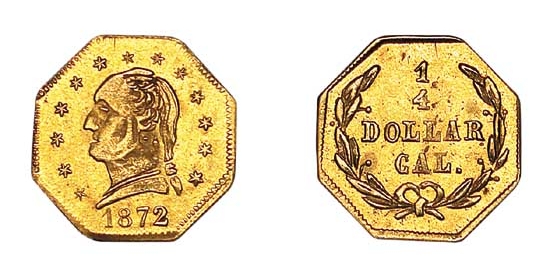
Obverse & Reverse
The 1872 octagonal 25-cent piece, cataloged as Breen-Gillio 724, is a quintessential example of a 'Period Two' California Fractional Gold coin. These pieces emerged from a unique economic environment decades after the initial 1849 Gold Rush. By the 1870s, the acute shortage of small change that spurred the creation of the first fractional gold ('Period One') had largely been resolved by the output of the San Francisco Mint. However, the allure of California gold and the romance of the Gold Rush had created a robust market for souvenirs and keepsakes. Jewelers, primarily in San Francisco, stepped in to meet this demand by producing vast quantities of these diminutive gold pieces. Unlike their Period One predecessors, which were intended to and did circulate to some extent, Period Two issues were almost exclusively created for the tourist and gift trade. They were typically underweight for their face value, a fact well understood at the time, and their legality was dubious. The Coinage Act of 1864 had prohibited private coinage, but enforcement was lax until the U.S. Secret Service began a crackdown in the late 1870s and early 1880s. Many jewelers producing these pieces were deliberately anonymous to avoid legal trouble, which is why the minter of BG-724 remains unknown. The use of George Washington's portrait was a popular and patriotic motif, distinguishing it from the more common Liberty Head designs and adding to its appeal as a memento of American enterprise. The octagonal shape was a nostalgic nod to the massive $50 'slugs' produced by private assayers in the early 1850s, further enhancing its historical charm for buyers. Today, BG-724 is prized by collectors not as a coin that fueled the Gold Rush economy, but as a tangible link to the commercial and social history of post-Gold Rush California.
Associated EventCalifornia Gold Rush Aftermath & Souvenir Trade
Reason For MintingPrimarily struck to be sold as souvenirs and keepsakes to tourists and locals, capitalizing on the legacy of the Gold Rush.
Minter HistoryThe minter of BG-724 is unknown, which is common for 'Period Two' California Fractional Gold. These pieces are often referred to as 'jeweler's issues' as they were manufactured by various San Francisco jewelers who typically did not sign their work. This anonymity was likely a deliberate choice to avoid scrutiny from federal authorities, as the private issuance of coinage had been outlawed by the Coinage Act of 1864. The craftsmanship suggests a skilled artisan familiar with die cutting and striking small gold planchets.
Historical SignificanceThis piece is significant not as a circulating medium of exchange, but as an artifact of the robust souvenir trade that flourished in California in the decades following the Gold Rush. It represents the commercialization of the Gold Rush legend and the transition of private gold pieces from a monetary necessity to a popular collectible and jewelry item.
N/A
Denomination25 Cents
Minting Period1872
Assayer/MinterUnknown Jeweler
Geographic OriginSan Francisco, California
Obverse DescriptionA right-facing bust of George Washington, modeled after the classic artistic renderings. The portrait is encircled by thirteen stars representing the original colonies.
Obverse Inscription[None, design only]
Reverse DescriptionThe denomination '1/4' appears in the center, surrounded by an ornamental wreath. The wreath on this specific variety is noted for having berries. The inscription 'CALIFORNIA GOLD' is outside the wreath, with the date '1872' below.
Reverse InscriptionCALIFORNIA GOLD / 1/4 / 1872
CompositionGold
Stated Fineness Actual FinenessVariable, but typically lower than Period One issues. Usually around .500 to .800 fine.
Weight0.25 grams
Diameter9.00 mm
EdgePlain
Unknown
Survival Estimate13-30 coins
Rarity ScaleHigh R-6
The BG-724 is highly sought after due to its rare Washington Head design, which is far less common than the ubiquitous Liberty Head motif. Its octagonal shape and high rarity (High R-6) make it a key prize for advanced collectors of California Fractional Gold.
Key VarietiesThe primary variety is the BG-724 itself, described as the 'Small Date' Washington Head type. No major sub-varieties, patterns, or official restrikes are known to exist from the period of issue. All known examples are considered business strikes intended for the souvenir market. Later modern replicas and copies are common but are not considered numismatic varieties.
Authentication TipsAuthentic pieces should be compared to high-resolution images in the Breen-Gillio reference or from major auction archives. Look for sharp, albeit sometimes crude, details in Washington's hair and the leaves of the wreath. The numerals in the date should match the known die style. Period Two pieces often have a lower gold purity, resulting in varied coloration. Counterfeits are rampant; many are brassy, have a soapy or cast-like appearance, incorrect weight, or feature a bear on the reverse (a fantasy element). Third-party certification by PCGS or NGC is highly recommended for authentication.
Shopping ConsiderationsA premium quality example for its grade will exhibit a sharp strike, particularly on the high points of Washington's hair and the wreath's berries. Original, undisturbed surfaces with some remaining luster command a significant premium. Many survivors were previously used in jewelry, so look carefully for evidence of solder, tooling, or harsh cleaning. A smooth, even planchet free of significant distracting marks enhances eye appeal. Given the high rarity, any certified, problem-free example is a significant acquisition.
A coin's grade is its condition, rated on a 1-70 scale. For rare coins, this is the most critical factor in determining value, as a tiny difference in preservation can mean a huge difference in price.
Relevant Grade TypesOriginal period issues were business strikes intended for the souvenir trade, not circulation, and are found in both Circulated (1-58) and Mint State (MS, 60-70) grades. No Proofs were struck during the original minting period, and no known later-date official restrikes exist. Coins advertised as 'Prooflike' (PL) are business strikes with highly reflective surfaces from polished dies, but are not true Proofs.
Mint State CharacteristicsUncirculated examples of BG-724 are defined by the presence of original mint luster. The quality of this luster can range from frosty to semi-prooflike. The strike can be variable; some pieces are sharply detailed, while others may show weakness on Washington's cheek or the highest points of the wreath. Due to the softness of the gold and their handling as souvenirs, even Mint State examples often exhibit small, scattered contact marks.
Circulated Wear PatternsWear first appears on the highest points of the design. On the obverse, friction will first dull the luster and then flatten the details on Washington's hair above his ear and on his cheekbone. On the reverse, the high points of the wreath leaves and the fraction '1/4' will show initial wear. In lower grades (VF and below), the stars on the obverse and the lettering in 'CALIFORNIA GOLD' will begin to lose their sharpness and merge towards the fields.
Key Factors For ValueFor the BG-724, rarity is the primary value driver. Beyond that, a sharp, well-centered strike is paramount. Surface quality is critical; coins with original, uncleaned 'skin' and minimal distracting marks are prized. Eye appeal, including attractive original toning (often a coppery-gold hue), adds a significant premium. Problem-free coins certified by PCGS or NGC will always realize the highest prices. A CAC sticker on a certified coin indicates premium quality for the grade and will further increase its value.
PCGS Price Guide
| Grade | Price | Population |
|---|---|---|
| 55 | $1,650.00 | 2 |
| 55+ | $1,750.00 | N/A |
| 58 | $2,000.00 | 2 |
| 58+ | $2,100.00 | N/A |
| 60 | $2,400.00 | N/A |
| 61 | $2,600.00 | N/A |
| 62 | $3,000.00 | 3 |
| 62+ | $3,250.00 | N/A |
| 63 | $4,000.00 | 2 |
| 63+ | $4,250.00 | N/A |
| 64 | $5,000.00 | 3 |