1871 25C BG-717A (Regular Strike)
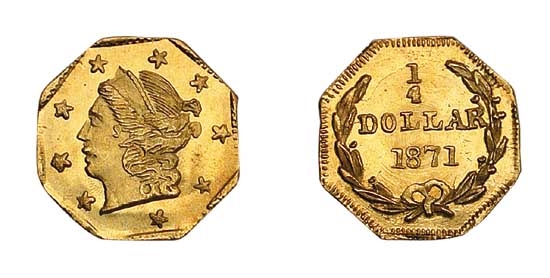
Obverse & Reverse
The 1871 BG-717A 25 Cent piece emerges from the second major phase of California's private gold coinage, a period numismatists designate as 'Period Two' (1859-1882). Unlike the earlier 'Period One' issues, which were struck with substantial intrinsic value to alleviate a critical shortage of small change during the Gold Rush, the Period Two coins were a different breed. By the 1870s, the United States Mint in San Francisco was in full operation, and the acute need for circulating coinage had subsided. However, the allure of California gold remained potent, both as a symbol and a commodity. Enterprising jewelers and merchants in San Francisco began producing these small-denomination gold pieces, which were lighter and contained less gold than their face value suggested. These were not intended to be a robust circulating medium in the same vein as their predecessors, but rather served as popular souvenirs, keepsakes for tourists, and items for use in jewelry. The BG-717A, dated 1871, is a quintessential example of these 'jeweler's issues.' Its creation reflects a transitioning Californian economy, one moving from the chaotic, bullion-based commerce of the Gold Rush to a more mature state where the romance of gold itself became a marketable product. These miniature coins captured the public's imagination, serving as tangible, affordable mementos of the great Western adventure. The United States government took a dim view of these private issues, viewing them as a violation of federal coining authority, and periodic crackdowns by the Secret Service eventually curtailed their production by the early 1880s, marking the end of a fascinating and uniquely American numismatic chapter.
Associated EventPost-Gold Rush Economic Development in California
Reason For MintingPrimarily created as popular souvenirs and for use in the jewelry trade, rather than to alleviate a coinage shortage.
Minter HistoryThe specific minter for the BG-717A variety is unrecorded, a common characteristic for many Period Two California Fractional Gold pieces. Production was dominated by a community of private manufacturers, many of whom were French immigrant jewelers located in San Francisco. These craftsmen used their skills to create a wide array of intricate and often artistic designs on these tiny gold planchets. Their operations were typically small-scale, and since the pieces were often underweight and legally questionable, anonymity was a prudent business practice. Firms like Deriberpe & Nouizillet (D.N.) and Frontier & Deviercy (F.D.) are known from earlier periods, but the makers of the 1870s issues are largely lost to history.
Historical SignificanceThe BG-717A is historically significant not as a circulating coin, but as a cultural artifact representing the commercialization of the Gold Rush legend. It marks the shift from functional necessity to nostalgic commerce, embodying the enduring mystique of California gold in a form accessible to the general public and tourists. Its existence highlights a period of ambiguous federal monetary oversight and the persistent entrepreneurial spirit of the American West.
BG-717A
Denomination25C
Minting Period1871
Assayer/MinterUnknown private minter, likely a San Francisco jeweler.
Geographic OriginSan Francisco, California
Obverse DescriptionA crudely rendered Liberty Head facing left, often described as a 'broad head'. The portrait features an indistinct, often incomplete, nose. It is surrounded by thirteen disproportionately rendered stars. The date '1871' is below the bust.
Obverse Inscription1871
Reverse DescriptionThe denomination '1/4' is centered within a wreath composed of two branches tied by a bow at the bottom. The inscription 'CALIFORNIA GOLD' encircles the wreath. A key diagnostic for the BG-717 variety is a large, prominent berry attached to the inside of the wreath near the center of the 'R' in 'GOLD'.
Reverse InscriptionCALIFORNIA GOLD 1/4
CompositionGold
Stated Fineness Actual FinenessVariable, but typically lower than official U.S. coinage of the era, consistent with Period Two issues.
EdgePlain
Unknown
Survival Estimate76-125
Rarity ScaleR-4
This variety appeals to collectors for its distinct, albeit crude, design and its specific Breen-Gillio attribution. As a Period Two issue, it is more affordable than its Period One counterparts, making it an accessible entry point into the fascinating world of California Fractional Gold. High-grade examples with prooflike surfaces are particularly prized for their visual appeal.
Key VarietiesBG-717A is itself a major variety within the BG-717 attribution. The 'A' designation signifies a specific die state or minor die variation from the primary BG-717. No known patterns, trial pieces, or special restrikes are recorded for this specific variety. Collectors focus on die states and identifying the specific diagnostics of the BG-717A dies.
Authentication TipsAuthenticity is paramount. Look for sharp, albeit crude, details consistent with a genuine strike, not the soft, soapy look of many cast counterfeits. Key diagnostics for BG-717 include the broad head with an incomplete nose on the obverse and the large berry inside the wreath by the 'R' on the reverse. Period Two pieces often have a slightly brassy or alloyed gold color compared to purer Period One issues. Weight and specific gravity tests are crucial, as many contemporary counterfeits were merely gold-plated base metal.
Shopping ConsiderationsA premium quality example for its grade will exhibit a sharp, well-centered strike, which is not always the case with these pieces. Seek out coins with minimal contact marks, as the small size makes any imperfection prominent. The highest quality specimens often possess deeply prooflike or semi-prooflike fields, sometimes with attractive cameo contrast between the devices and the fields. Avoid examples that have been harshly cleaned, which strips the original surface and drastically reduces value. Any piece that has been used in jewelry, showing evidence of soldering or harsh polishing, should be priced significantly lower.
A coin's grade is its condition, rated on a 1-70 scale. For rare coins, this is the most critical factor in determining value, as a tiny difference in preservation can mean a huge difference in price.
Relevant Grade TypesOriginal period issues of BG-717A were business strikes, although many were struck with polished dies giving them a Prooflike (PL) or Deep Mirror Prooflike (DMPL) appearance. They are found in Circulated grades (1-58) and, more commonly for this souvenir-type issue, in Mint State (MS, 60-70). No true Proofs were struck during the original period of issue, and there are no known later-date Proof restrikes for this specific variety. Any piece graded 'Proof' would be highly suspect.
Mint State CharacteristicsIn uncirculated condition, the BG-717A often displays a strong, satiny luster. The highest-grade examples are characterized by reflective, mirror-like fields. The strike is often somewhat weak on the high points of Liberty's hair and the leaves of the wreath. Due to the rudimentary manufacturing process, small planchet flaws or die polishing lines are common and should not be confused with post-strike damage. Bag marks, while present, are less common than on larger circulating coins, as these were often purchased and saved as keepsakes.
Circulated Wear PatternsWear first appears on the highest points: Liberty's cheek, hairline, and the leaves and bow of the wreath on the reverse. On moderately circulated examples, the finer details of the hair and the individual leaves will merge. In lower grades (Fine and below), the date and stars will begin to weaken, and the reverse inscriptions can become faint, starting with the delicate '1/4' fraction.
Key Factors For ValueThe primary driver of value is the certified grade. Beyond the number, surface quality is critical; coins with clean, original surfaces and no evidence of cleaning command significant premiums. Strike sharpness is a key differentiator, with well-struck examples being more desirable. Eye appeal, driven by factors like deep prooflike fields, attractive original gold toning, and a lack of distracting marks, can add a substantial premium. A CAC sticker for this issue is highly sought after as it validates the quality and originality of the coin's surfaces for the assigned grade.
PCGS Price Guide
| Grade | Price | Population |
|---|---|---|
| 66 | $32,500.00 | 1 |