1854 G$1 BG-529 (Regular Strike)
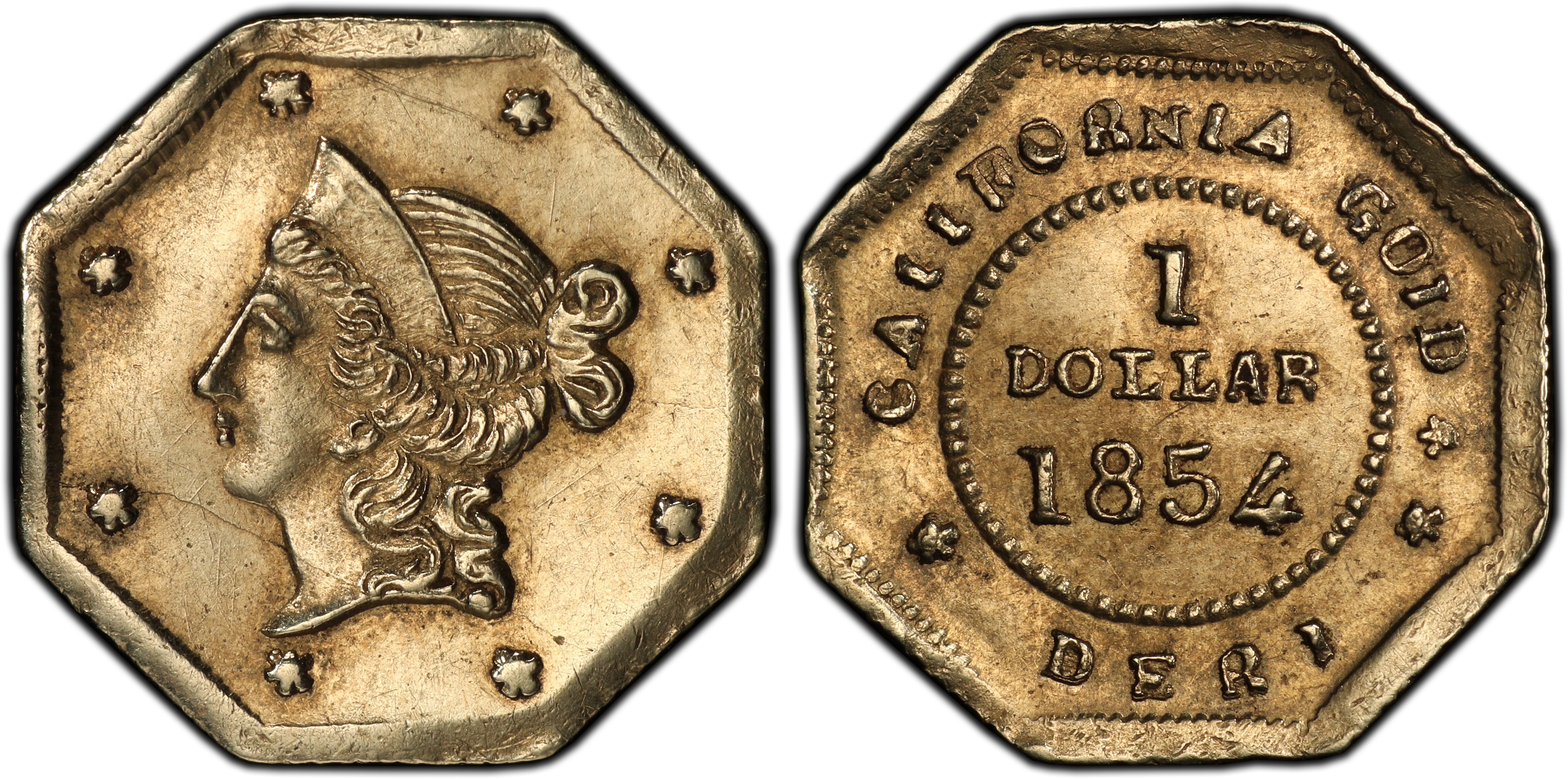
Obverse & Reverse
The 1854 Octagonal Gold Dollar, cataloged as BG-529 in the Breen-Gillio reference, stands as a testament to the chaotic and entrepreneurial spirit of the California Gold Rush. In the early 1850s, the massive influx of population to California created a booming economy, yet the region suffered from a chronic shortage of circulating small-denomination coinage. Gold dust and nuggets were plentiful, but impractical for daily transactions. While the U.S. government was slow to respond—the San Francisco Mint would not open until 1854 and its initial production of small coins was minuscule—private jewelers and metalsmiths stepped into the breach. These artisans, many of whom were French immigrants like M. Deriberpie, leveraged their skills to meet a desperate commercial need. They began striking fractional gold pieces in quarter-dollar, half-dollar, and dollar denominations. These 'Period One' issues (1852-1857) were not official U.S. tender but were generally accepted in local commerce due to the dire currency situation. The BG-529 was one such issue, crudely but effectively manufactured by the 'hammer method,' where dies were struck by hand with a sledgehammer. This process resulted in inconsistent strike quality and imparted a unique, rustic character to each piece. The octagonal shape was a common feature, likely used to distinguish these private issues from the round, official federal gold dollars. The intrinsic value of these coins was often less than their face value, making them a highly profitable venture for their makers and technically a form of token coinage. The BG-529 is of paramount numismatic importance due to its extreme rarity and its connection to other Deriberpie issues. Recent discoveries of die-linked varieties, such as BG-526a and BG-529a, have allowed numismatic scholars to piece together the operational timeline of Deriberpie's small mint, revealing a more complex story of die usage and production sequences than previously understood. For example, the discovery of BG-526a, which pairs an 1853-dated obverse die with the BG-529 reverse die, proves that the BG-529 was struck earlier in 1854 than other Deriberpie dollars of the same year, like BG-527 and BG-528. This tiny gold piece is more than just a coin; it is a tangible artifact from a time when private enterprise directly solved a failure of government monetary policy on the American frontier.
Associated EventCalifornia Gold Rush
Reason For MintingTo alleviate a severe shortage of small denomination coinage for daily commerce in Gold Rush-era California.
Minter HistoryM. Deriberpie was a San Francisco-based jeweler and one of the prominent private minters of 'Period One' California Fractional Gold. Like many of his contemporaries in the trade, such as Antoine Louis Nouzillet and the firm Frontier, Deviercy & Co., he was likely a French immigrant who brought his metallurgical skills to the booming frontier city. His name, often abbreviated to 'DERI' on his coinage, is associated with a series of octagonal and round dollars and half dollars struck between 1853 and 1854. The number of distinct die varieties attributed to him suggests a relatively active, albeit brief, minting operation. Little else is known about his personal history, a common fate for many of these small-scale artisans who, despite their important economic role, left a scant historical record beyond the rare gold pieces they created.
Historical SignificanceThe BG-529 is a prime example of privately issued coinage filling a critical economic void. Its existence highlights the challenges of commerce on the American frontier and the ingenuity of local artisans. As one of the rarest territorial coins, it serves as a key piece for understanding the die sequences and production history of its enigmatic minter, M. Deriberpie.
K-N/A
Denomination$1
Minting Period1854
Assayer/MinterM. Deriberpie
Geographic OriginSan Francisco, California
Obverse DescriptionA Coronet-type Liberty Head facing left, similar in style to the contemporary federal gold coinage. The head is surrounded by eight five-pointed stars.
Obverse Inscription Reverse DescriptionThe central device is a beaded inner circle containing the denomination '1' above 'DOLLAR' and the date '1854' below. Surrounding this is the legend 'CALIFORNIA GOLD' at the top and the minter's abbreviated name, 'DERI', at the bottom. Uniquely, two five-pointed stars flank the space between 'GOLD' and 'DERI' on this variety.
Reverse InscriptionCALIFORNIA GOLD / 1 / DOLLAR / 1854 / DERI
CompositionGold
Stated Fineness Actual FinenessVaries, but Period One issues generally range from 14 to 22 karats.
Weight1.10 grams
Diameter12.20 mm
EdgePlain
Unknown, but exceedingly small.
Survival Estimate4-5 known specimens.
Rarity ScaleR-8 (Very Rare, 4-7 known)
The BG-529 is a classic American numismatic rarity, sought after for its connection to the California Gold Rush, its octagonal shape, extreme scarcity, and its status as a key die variety for specialists in the fractional gold series. It represents the pinnacle of collecting Period One issues.
Key VarietiesThe BG-529 itself is a distinct variety. Importantly, collectors should be aware of two related varieties that share one of its dies: 1. **BG-526a**: A recently discovered unique variety that pairs an 1853-dated obverse (BG-526) with the reverse die of BG-529. This established a critical timeline for Deriberpie's work. 2. **BG-529a**: Another recently discovered variety that uses the same reverse die as BG-529 but is paired with a completely different obverse die, distinguished by the placement of the Liberty head and stars. No later-date restrikes or proof strikings of BG-529 are known to exist.
Authentication TipsAuthentication requires expert examination. Genuine examples exhibit a crude, hand-struck appearance, often with misaligned dies and uneven strike depth. The planchets are typically thin and may show file marks or other preparation evidence. The lettering and stars are often softly defined and not as sharp as on federal issues. The key diagnostic for the BG-529 reverse is the presence of the two stars between 'GOLD' and 'DERI'. Counterfeits are common in this series; they often appear too well-made, have a soapy or cast-like texture, incorrect weight, or are merely gold-plated base metal.
Shopping ConsiderationsFor a coin of this rarity, any example offered should be considered a major acquisition. A 'premium quality' specimen would be one free of significant impairments such as bending, harsh cleaning, or tooling. Given the crude hammer-striking process, a relatively sharp strike on the central Liberty head and the reverse date would be highly desirable. Look for pleasing, original surfaces that show some remnant of mint luster, often with a slightly reddish or coppery-gold toning. Most known examples are in AU grades, with only one known in Mint State. A pedigree to a major collection (like the Jay Roe collection, where one was discovered) adds significant value and desirability. Given the stakes, third-party certification by PCGS or NGC is an absolute necessity for any transaction involving a genuine BG-529.
A coin's grade is its condition, rated on a 1-70 scale. For rare coins, this is the most critical factor in determining value, as a tiny difference in preservation can mean a huge difference in price.
Relevant Grade TypesAll original examples of BG-529 were struck as business strikes intended for commerce, though they quickly became curiosities. They are found in Circulated (AU-50 to AU-58) and, exceptionally, Mint State (MS, 60-70) grades. No proofs were struck during the original minting period, and no later-date Proof restrikes are known to exist for this variety.
Mint State CharacteristicsThe single finest known example is graded MS-61. An uncirculated BG-529 would be defined by the absence of wear and the presence of original mint luster, which is typically soft and satiny rather than bright and flashy. Strike weakness is characteristic of the issue; even a Mint State example is not expected to be fully struck, with softness likely on the highest points of Liberty's hair and the reverse lettering. Bag marks or handling marks, even on a mint state piece, are to be expected due to the softness of the gold and the crude production methods.
Circulated Wear PatternsWear first appears on the highest points of the design. On the obverse, this includes Liberty's hair above the eye and ear, her cheekbone, and the coronet. On the reverse, the highest points of the '1' in the denomination and the wreath-like beaded circle will show the first traces of friction. In lower grades (VF and below, though none are known), the stars and peripheral lettering would begin to merge with the fields.
Key Factors For ValueWith only 4-5 examples known, sheer existence is the primary value driver. Beyond that, value is determined by grade, surface quality, and eye appeal. An example with minimal marks, no evidence of cleaning or tooling, and attractive original color will command a significant premium. A clear, well-centered strike, even if not perfectly sharp, is also highly desirable. The presence of a CAC sticker on a certified example would provide additional assurance of quality and would likely increase its value among sophisticated collectors.
PCGS Price Guide
| Grade | Price | Population |
|---|---|---|
| 50 | $25,000.00 | 1 |
| 58 | $37,500.00 | N/A |
| 58+ | $45,000.00 | 1 |
| 60 | $50,000.00 | N/A |
| 61 | $60,000.00 | N/A |