1853 G$1 BG-523 (Regular Strike)
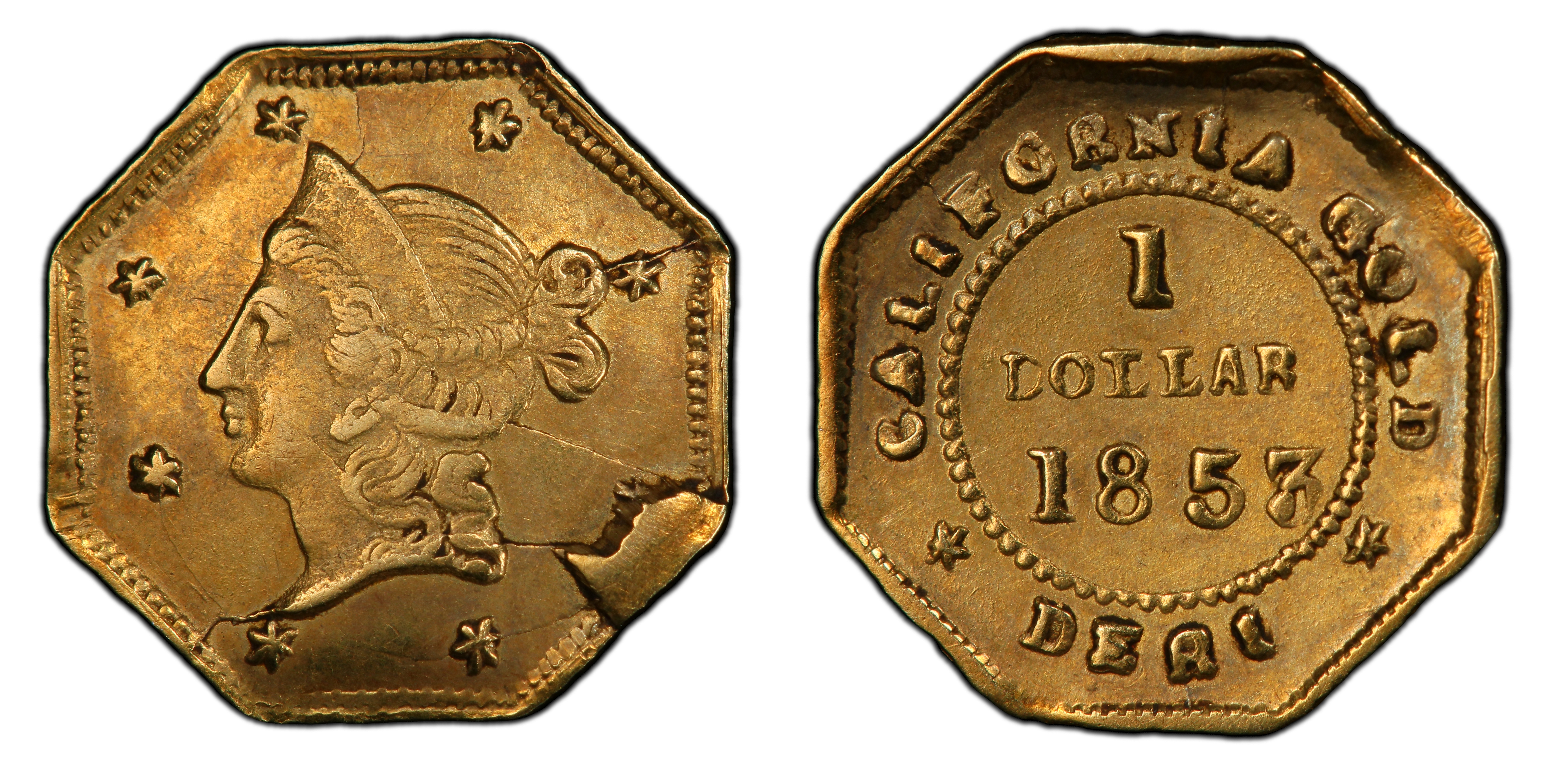
Obverse & Reverse
The 1853 BG-523 octagonal gold dollar is a tangible relic from the zenith of the California Gold Rush, a period of frantic economic expansion and acute monetary chaos. Following the discovery of gold at Sutter's Mill in 1848, a massive influx of prospectors and merchants descended upon California, creating booming commercial centers virtually overnight. This rapid growth, however, was not matched by an adequate supply of federal coinage. Gold dust, a cumbersome and often inequitable medium of exchange, initially filled the void, but its use was fraught with issues of inconsistent weight and purity. The U.S. government was slow to respond; the San Francisco Mint would not open until 1854, and even then, its initial output of small denomination coins was woefully insufficient. Into this monetary vacuum stepped a number of enterprising private jewelers and assayers. Operating in San Francisco, these craftsmen began striking their own small-denomination gold coins to facilitate everyday transactions. The BG-523 is a prime example of these 'Period One' issues (1852-1857), which are distinguished from the later, souvenir-oriented 'Period Two' pieces by their genuine intent to circulate as currency. The minter, M. Deriberpe, was one of several French jewelers active in San Francisco who applied their skills to this new trade. These fractional pieces, though often slightly underweight, were readily accepted in commerce, serving as the lifeblood of the region's economy for several years. They were typically produced by the 'hammer method,' where a gold planchet was placed between two dies on an anvil and struck with a sledgehammer, a process accounting for the frequent variations in strike quality. The passage of the private coinage act in 1864 eventually rendered these issues illegal, and most were subsequently melted. The few that survive, like the BG-523, are prized by numismatists not just for their rarity, but as direct links to the turbulent and inventive economy of Gold Rush California.
Associated EventCalifornia Gold Rush
Reason For MintingTo alleviate a severe shortage of small-denomination federal coinage for daily commerce in Gold Rush-era San Francisco.
Minter HistoryM. Deriberpe was a San Francisco-based jeweler active during the early 1850s. Like several of his contemporaries, many of whom were French immigrants, he leveraged his metallurgical and engraving skills to meet the region's desperate need for circulating coinage. The pieces attributed to him, often identified by the mark 'DERI' or 'DERIB' on related varieties, are characteristic of the 'Period One' California fractional gold issues. These coins were produced before the establishment of the San Francisco Mint provided a stable supply of federal money, and are considered true circulation pieces rather than later souvenir tokens.
Historical SignificanceAs a 'Period One' issue, the BG-523 represents a crucial, privately-issued monetary solution that enabled the burgeoning economy of Gold Rush California to function. It is a testament to the ingenuity of private enterprise in the American West and serves as a primary artifact from a period of profound economic transformation before federal institutions were fully established on the Pacific coast.
BG-523
Denomination$1
Minting Period1853
Assayer/MinterM. Deriberpe
Geographic OriginSan Francisco, California
Obverse DescriptionFeatures a Liberty Head portrait facing left, her hair tied in a bun at the back. The portrait is encircled by eight six-pointed stars, with a beaded border along the octagonal rim.
Obverse Inscription Reverse DescriptionA simple wreath of two branches tied with a bow at the bottom encircles the denomination. A small, five-pointed star is centered above the denomination, between the tips of the wreath branches. The date is located below the bow.
Reverse Inscription1 DOLLAR 1853
CompositionGold
Stated Fineness Actual FinenessTypically .800 to .885, consistent with unrefined native California gold which contained a high percentage of silver.
Diameter11.00 mm
EdgePlain
Unknown
Survival Estimate31-75
Rarity ScaleR-5
The BG-523 is highly sought after as a scarce, octagonal one-dollar issue from the desirable 'Period One' of California fractional gold. Its connection to the heart of the Gold Rush and its clear intent for circulation make it a historically significant and foundational piece for specialists.
Key VarietiesThe BG-523 is a specific die marriage and has no major varieties from its original minting period. No known patterns, trial pieces, or later-date restrikes exist for this variety. Collectors should focus on die states, as early strikes will show sharper details than later examples from worn dies.
Authentication TipsGenuine BG-523 examples have a distinct die 'signature.' The style of the Liberty portrait, the specific shape of the stars, and the reverse lettering punch should be carefully compared to high-resolution images of certified examples. Many contemporary counterfeits and modern replicas exist; fakes often have a soapy, cast-like appearance, incorrect weight, or a brassy color. Authentic pieces were struck, not cast, and should exhibit some evidence of die flow lines under magnification. The lettering and numerals, while sometimes crude, should not appear mushy.
Shopping ConsiderationsA premium quality BG-523 for its grade will exhibit a bold strike, particularly on the high points of Liberty's hair and the leaves of the reverse wreath. Look for smooth, lustrous surfaces that have not been harshly cleaned or polished; original 'skin' with a dusky, reddish-gold toning is highly desirable. Common problems for the issue include planchet flaws, weak strikes in certain areas due to the hammer minting process, and evidence of having been mounted in jewelry. Carefully inspect the rims for tooling marks or repairs from jewelry removal. Scratches on the delicate gold surfaces are common, but deep, distracting marks will significantly impact the value and eye appeal.
A coin's grade is its condition, rated on a 1-70 scale. For rare coins, this is the most critical factor in determining value, as a tiny difference in preservation can mean a huge difference in price.
Relevant Grade TypesAll original 1853 BG-523 dollars are business strikes intended for circulation and are found in Circulated (1-58) and Mint State (MS, 60-70) grades. No Proof examples were struck during the original minting period, and no later-date Proof restrikes are known to exist for this variety.
Mint State CharacteristicsAn uncirculated BG-523 will display uninterrupted mint luster, though the quality of this luster can vary from satiny to semi-prooflike depending on the planchet preparation and die state. Due to the rudimentary hammer-striking process, even high-grade Mint State examples can show some weakness of strike, particularly in the center of the reverse. Small, scattered contact marks are typical and should be expected, but large or deep abrasions on the primary focal points, such as Liberty's cheek, will detract from the grade.
Circulated Wear PatternsWear first appears on the highest points of the design. On the obverse, look for flattening on the hair above Liberty's eye and ear, and on her cheekbone. On the reverse, the high points of the wreath's leaves and the bow will show initial friction and loss of detail. On lower grade examples (VF and below), the stars on the obverse will begin to lose their points and the fine details of the wreath will merge.
Key Factors For ValueFor the BG-523, value is driven by a combination of grade and eye appeal. A sharply struck coin with minimal marks and original, uncleaned surfaces will command a significant premium over a weakly struck or cleaned example of the same numerical grade. Coins with attractive, original reddish-gold or deep orange toning are highly prized by advanced collectors. A CAC sticker, indicating premium quality for the grade, adds a substantial premium to this and other 'Period One' fractional gold issues.
PCGS Price Guide
| Grade | Price | Population |
|---|---|---|
| 30 | $450.00 | 1 |
| 35 | $475.00 | 1 |
| 40 | $550.00 | N/A |
| 45 | $600.00 | 4 |
| 45+ | $650.00 | N/A |
| 50 | $725.00 | 2 |
| 50+ | $765.00 | N/A |
| 53 | $800.00 | 4 |
| 53+ | $850.00 | N/A |
| 55 | $900.00 | 7 |
| 55+ | $925.00 | N/A |
| 58 | $1,000.00 | 8 |
| 58+ | $1,200.00 | N/A |
| 60 | $2,000.00 | 2 |
| 61 | $2,200.00 | 3 |
| 62 | $2,500.00 | 3 |
| 62+ | $2,750.00 | N/A |
| 63 | $3,250.00 | 2 |