1856 G$1 BG-512 (Regular Strike)
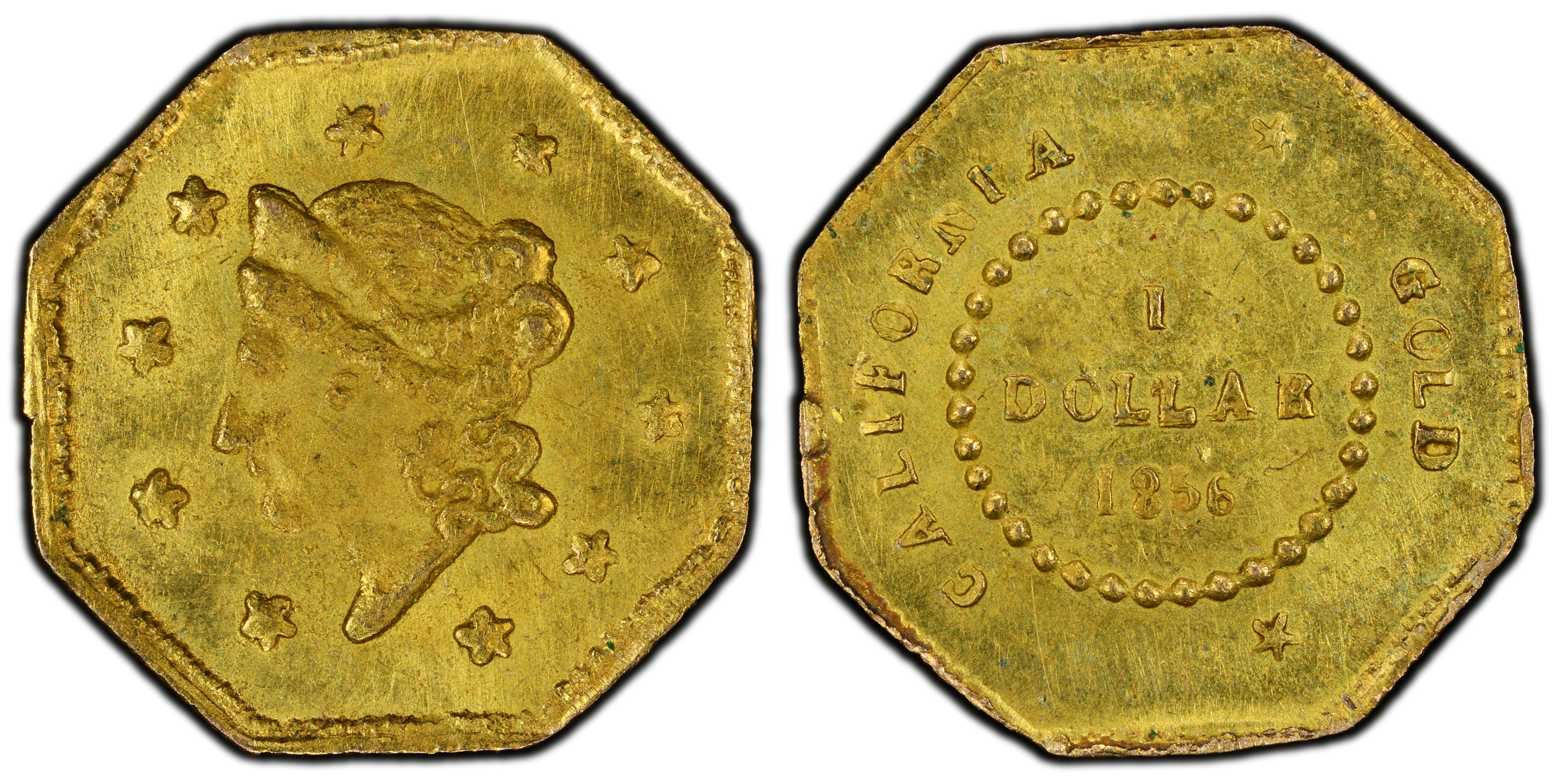
Obverse & Reverse
The 1856 Octagonal Gold Dollar, cataloged as Breen-Gillio 512, is a quintessential artifact from the first phase of private coinage during the California Gold Rush. This period, now known to numismatists as 'Period One' (1852-1856), was a direct response to a severe and persistent shortage of circulating small-denomination currency. The massive influx of over 300,000 people to California following the 1848 discovery of gold at Sutter's Mill created a booming economy, but the United States Mint was slow to respond. The new San Francisco Mint, which opened in 1854, focused on larger denominations and produced an entirely inadequate supply of smaller coins, with most silver coinage being hoarded or exported. Daily commerce was crippled; a pinch of gold dust, an inherently imprecise and chaotic medium of exchange, was often used for minor transactions like buying a drink. To fill this critical monetary void, numerous private individuals, primarily jewelers and assayers in San Francisco, began striking their own coins. These 'California Fractional Gold' pieces, denominated in 25 Cents, 50 Cents, and $1, became the lifeblood of local commerce. The BG-512 was struck by Antoine Louis Nouizillet, a French jeweler who was one of the most prolific and skilled producers of these miniature coins. His pieces are noted for their relatively consistent quality and standardized designs, which emulated federal coinage to inspire public confidence. These coins were not official government issues but were generally accepted at face value due to the urgent need for a medium of exchange and the reputation of their makers. Most were produced by the hammer method, where a planchet was placed on an anvil die and struck with a sledgehammer bearing the obverse die, leading to variations in strike quality. The passage of a federal law in 1864 made private coinage illegal, but enforcement was lax, and production continued until the early 1880s. The BG-512, as a Period One issue, represents the purest motivation for this coinage—fulfilling a genuine economic necessity before the pieces transitioned into souvenirs and jewelry items in later periods.
Associated EventCalifornia Gold Rush
Reason For MintingTo alleviate a severe shortage of small-denomination coinage for daily commercial transactions in Gold Rush-era California.
Minter HistoryAntoine Louis Nouizillet was a French jeweler and one of the most significant private minters of California Fractional Gold. Active primarily during the critical 'Period One' (1852-1856), his workshop in San Francisco produced a wide array of quarter, half, and one-dollar gold pieces. Unlike some of his contemporaries whose work was crude, Nouizillet's issues are characterized by their relatively high-quality engraving and consistent design elements, often featuring a standardized Liberty head motif surrounded by stars. He sometimes worked in partnership with other jewelers, such as Deriberpe (D.N.) and Routhier (N.R.), and his initials or insignia are key attribution markers on many fractional varieties. His contributions were vital to the functioning of San Francisco's early economy, providing the small change necessary for everyday life that the federal government had failed to supply.
Historical SignificanceThe BG-512 is a tangible link to the chaotic and entrepreneurial economy of the California Gold Rush. As a 'Period One' issue, it stands as a testament to the private enterprise that solved a critical failure in the nation's currency supply, allowing commerce to flourish in the West. Its existence highlights a unique chapter in American monetary history when private citizens minted the coins of the realm out of necessity.
N/A
Denomination$1
Minting Period1856
Assayer/MinterAntoine Louis Nouizillet
Geographic OriginSan Francisco, California
Obverse DescriptionA head of Liberty facing left, her hair tied in a bun. She is surrounded by thirteen five-pointed stars, representing the original colonies. The date 1856 is below. The portrait style is typical of Nouizillet's work from this period.
Obverse Inscription1856
Reverse DescriptionThe denomination '1 DOLLAR' is centered within a beaded circle or simple wreath. The legend 'CALIFORNIA GOLD' appears around the periphery.
Reverse InscriptionCALIFORNIA GOLD 1 DOLLAR
CompositionGold
Stated Fineness Actual FinenessVariable, typically lower than federal issues, often around .800 to .880.
Weight0.50 grams
Diameter11.50 mm
EdgePlain
Unknown, but extremely small
Survival EstimateFewer than 12 known
Rarity ScaleR-7
The BG-512 is highly sought after as a Period One octagonal dollar, a very popular format. Its extreme rarity (R-7), direct connection to the height of the Gold Rush, and the allure of private territorial coinage make it a trophy piece for advanced collectors of California fractional gold or U.S. pioneer coinage.
Key VarietiesThere are no major varieties of the BG-512 itself. As these were hand-struck, minor die state variations and striking eccentricities exist on every specimen. No known restrikes or patterns of this specific variety were made. Collectors should be aware that the broader California Fractional Gold series includes many 'Period Two' and 'Period Three' issues, as well as souvenir tokens from later years, which are distinct from original, circulating Period One coins like the BG-512.
Authentication TipsAuthenticity is paramount. Look for the correct die markers, including the specific shape and placement of the date numerals and letters. Genuine examples often have a slightly crude, hand-made appearance but with sharp details in protected areas. The luster should be soft and satiny, not the hard, prooflike brilliance of modern copies. Counterfeits are common and may be cast (showing pitting and a soft, soapy feel) or struck from modern dies (exhibiting tool marks and incorrect design details). Weight can be a key diagnostic; many fakes are underweight or made of brass.
Shopping ConsiderationsWhen acquiring a BG-512, focus on surface quality and strike. A premium quality example will have minimal distracting marks and a bold, centered strike. It is common for these pieces to be weakly struck in the centers or peripheries due to the hammer-striking process, so a well-balanced strike commands a significant premium. Look for original, uncleaned surfaces, often showing a lovely reddish-gold or deep yellow-gold patina. Avoid examples that have been harshly cleaned, polished, or used as jewelry, as this drastically reduces their value. Third-party certification from PCGS or NGC is virtually required for a transaction involving a coin of this rarity and value.
A coin's grade is its condition, rated on a 1-70 scale. For rare coins, this is the most critical factor in determining value, as a tiny difference in preservation can mean a huge difference in price.
Relevant Grade TypesOriginal period issues of BG-512 were business strikes intended for circulation and are found in Circulated (1-58) and Mint State (MS, 60-70) grades. Due to their extreme rarity, any example, even heavily worn, is a major prize. No Proofs were struck during the original minting period, and there are no known later-date Proof restrikes for this specific Breen-Gillio number.
Mint State CharacteristicsAn uncirculated BG-512 will exhibit soft, satiny luster. The strike is often somewhat weak in the center of the obverse (Liberty's hair) or on the corresponding area of the reverse due to the nature of hammer striking. Contact marks, even on Mint State examples, are to be expected due to the softness of the gold and the casual handling of the era. The key to a high grade is the quality of the luster, lack of significant detracting marks, and superior strike for the issue.
Circulated Wear PatternsWear first appears on the highest points of the design. On the obverse, check for flatness on Liberty's cheek, the hair bun, and the tips of the stars. On the reverse, the highest points of the letters in 'DOLLAR' and the wreath details will show initial friction. In lower grades (VG and below), the date and legends will become soft and may start to merge with the fields.
Key Factors For ValueFor the BG-512, value is driven by rarity above all. After that, grade and eye appeal are paramount. An example with original, uncleaned surfaces and a strong strike will sell for multiples of a cleaned or weakly struck specimen in the same numerical grade. Coins with a rich, undisturbed antique gold patina are highly prized. A CAC sticker indicating premium quality for the grade would add a significant premium, as it confirms the coin's superior eye appeal and originality in a series where such attributes are rare.
PCGS Price Guide
| Grade | Price | Population |
|---|---|---|
| 45 | $4,000.00 | 1 |
| 45+ | $4,200.00 | N/A |
| 50 | $4,500.00 | N/A |
| 50+ | $4,700.00 | N/A |
| 53 | $5,000.00 | N/A |
| 53+ | $5,250.00 | N/A |
| 55 | $6,000.00 | 2 |
| 55+ | $6,500.00 | N/A |
| 58 | $7,000.00 | 2 |
| 58+ | $7,250.00 | N/A |
| 60 | $7,500.00 | N/A |
| 61 | $8,000.00 | 1 |
| 62 | $8,500.00 | N/A |
| 62+ | $9,000.00 | N/A |
| 63 | $11,500.00 | N/A |
| 63+ | $12,000.00 | N/A |
| 64 | $14,500.00 | 2 |
| 64+ | $16,000.00 | N/A |
| 65 | $17,500.00 | 1 |