1852 G50C BG-401 (Regular Strike)
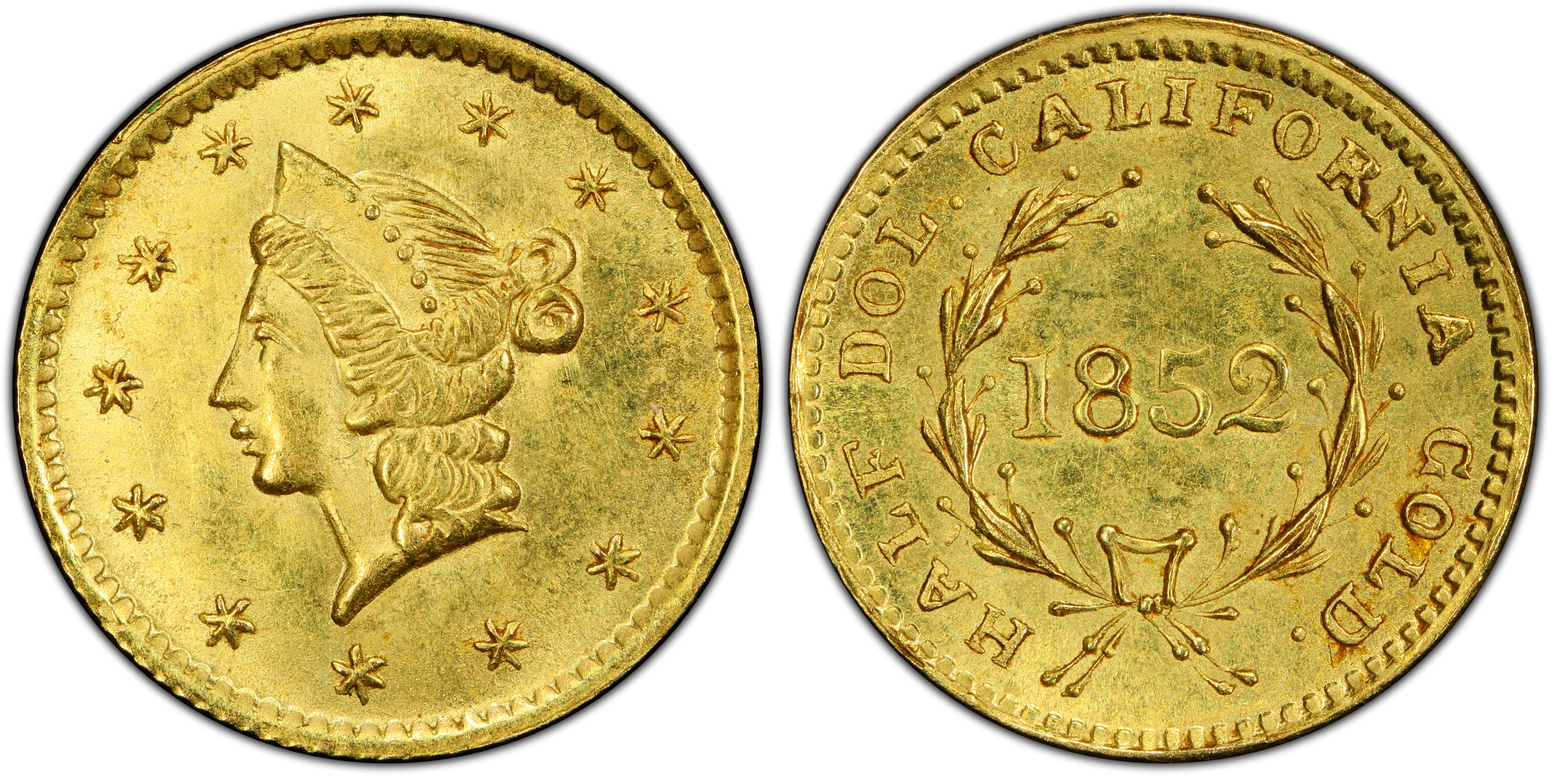
Obverse & Reverse
The 1852 'Arms of California' Gold Half Dollar, cataloged as Breen-Gillio 401 (BG-401), stands as a tangible relic of the chaotic and dynamic early years of the California Gold Rush. Following the discovery of gold at Sutter's Mill in 1848, a massive influx of prospectors and merchants descended upon California, creating a vibrant but unstable economy. The fundamental problem was a severe shortage of circulating coinage. Gold dust and nuggets served as the primary medium of exchange, but this was inefficient, prone to waste, and susceptible to fraud. The U.S. government was slow to establish an official branch mint in the West (the San Francisco Mint would not open until 1854), creating a vacuum that private minters eagerly filled. These private issues, ranging from assay bars to denominated coins, provided a crucial service by converting raw gold into a more uniform and convenient form of money. Amidst this flurry of private coinage, a need arose for small-denomination coins to facilitate everyday transactions, as even the smallest federal coin, the silver three-cent piece, was scarce. Into this environment came the jewelers and engravers who produced California Fractional Gold. These tiny coins, in denominations of 25 cents, 50 cents, and one dollar, were not sanctioned by the government but were widely accepted out of sheer necessity. The BG-401 is one of the earliest of these issues, struck in the pivotal year of 1852. While the identity of the minter is not definitively proven, numismatic scholarship, particularly the research of Robert D. Leonard, Jr. and Walter Breen, strongly points to Antoine Louis Nouizillet, a French-born jeweler and engraver working in San Francisco. Nouizillet's style, particularly the crudely rendered yet charming design elements, links this piece to others of the period. The coin itself, with its depiction of the California State Seal, was a bold assertion of local identity and economic independence. These coins circulated freely in commerce, though their intrinsic value was often slightly less than their face value, a common trait of private issues. Their small size made them easy to lose, a factor contributing to their modern-day rarity. The era of private gold coinage began to wane with the opening of the San Francisco Mint, and federal laws in 1864 further curtailed their production, cementing their status as a fascinating but short-lived chapter in American monetary history.
Associated EventCalifornia Gold Rush
Reason For MintingTo alleviate a severe shortage of small-denomination coinage for daily commerce in Gold Rush-era California.
Minter HistoryAntoine Louis Nouizillet was a French jeweler and engraver who arrived in San Francisco around 1851. Like many skilled craftsmen of the era, he saw opportunity in the burgeoning Gold Rush economy. While not a large-scale assayer like Moffat & Co. or Kellogg & Co., Nouizillet applied his trade to the production of much-needed small-denomination gold coins. His work is characterized by a somewhat naive or primitive engraving style, which is evident in the details of the BG-401. He is believed to be responsible for several early 'Period One' (1852-1857) California Fractional Gold issues, which are prized by collectors today for their historical importance and distinctive artistry. His operations were small, and records are scarce, but his contribution represents the entrepreneurial spirit that defined the private minting era in California.
Historical SignificanceThe BG-401 is significant as one of the first privately issued gold coins of a denomination less than one dollar in the United States. It represents a grassroots solution to a critical economic problem—the lack of circulating small change—and embodies the independent spirit of Gold Rush California before the establishment of federal minting operations. Its existence highlights the monetary chaos of the period and the ingenuity of private entrepreneurs in creating a functional, localized economy.
N/A
Denomination50 Cents (Half Dollar)
Minting Period1852
Assayer/MinterProbably Antoine Louis Nouizillet
Geographic OriginSan Francisco, California
Obverse DescriptionThe obverse features a simplified rendition of the Great Seal of the State of California. A seated figure of Minerva (representing California's birth as a state without being a territory) is shown with a spear and shield. To her left is a grizzly bear, and in the background are mountains and a ship on water. A circle of 13 stars surrounds the central vignette.
Obverse InscriptionCALIFORNIA GOLD.
Reverse DescriptionThe reverse features the denomination '50 CENTS' prominently in the center, enclosed within a wreath of two oak branches tied together with a ribbon at the bottom.
Reverse Inscription50 CENTS
CompositionGold
Stated FinenessNo fineness is stated on the coin.
Actual FinenessTypically around .850 to .900 fine, though it can vary.
Weight1.63 grams
Diameter13.90 mm
EdgePlain
Unknown
Survival Estimate50-75
Rarity ScaleR-6 (Very Rare)
The BG-401 is highly coveted as a foundational piece of the California Fractional Gold series. Its appeal lies in its early 1852 date, its direct connection to the peak of the Gold Rush, its historically significant 'Arms of California' design, and its high rarity. It is considered a classic and essential type for advanced collectors of territorial gold.
Key VarietiesThe primary variety is the regular business strike, BG-401. No known proof strikings or major die varieties from the original minting period exist. Collectors should be aware of contemporary counterfeits made of gilded brass, as well as modern replicas. The key is to acquire an original 1852 striking. There are no known later-date restrikes of this specific variety.
Authentication TipsAuthentic examples have a distinctive, somewhat crude engraving style. The stars on the obverse are often weakly struck and may appear as simple dots or blobs. The details on Minerva and the bear are typically soft. The planchet is often slightly irregular. Counterfeits may appear overly sharp or have incorrect lettering fonts. Gilded brass counterfeits will have the wrong specific gravity and a 'soapy' or unnatural luster. Comparing the coin to high-resolution images of certified examples is the most effective authentication method.
Shopping ConsiderationsWhen acquiring a BG-401, originality of the surfaces is paramount. Many survivors have been harshly cleaned, polished, or used as jewelry. A premium quality example for the grade will exhibit minimal surface impairments and retain some of its original, satiny luster, often with a deep, reddish-gold toning. The strike is almost universally weak on these pieces; a coin with above-average sharpness in the central details (Minerva, the bear, the wreath) is highly desirable and commands a significant premium. Look closely for evidence of tooling in the fields to 'improve' scratches, or for filled areas. Given the coin's value and the prevalence of counterfeits, purchasing a specimen certified by a major grading service (PCGS or NGC) is strongly recommended.
A coin's grade is its condition, rated on a 1-70 scale. For rare coins, this is the most critical factor in determining value, as a tiny difference in preservation can mean a huge difference in price.
Relevant Grade TypesOriginal 1852 issues of BG-401 were business strikes intended for circulation. They are found in Circulated grades (AG-3 to AU-58) and, very rarely, in Mint State grades (MS-60 to MS-70). No genuine Proof (PR/PF) examples were struck during the original period of issue, as these were utilitarian pieces. Any coin described as a 'Proof' of this issue is either a modern replica or a misattribution.
Mint State CharacteristicsAn uncirculated BG-401 is exceedingly rare. Such a specimen would exhibit full, unbroken mint luster, which is typically soft and satiny rather than deeply frosty. The strike is a key issue; even on Mint State examples, some softness is expected, particularly on the highest points of the design like Minerva's head, the bear's shoulder, and the stars. Contact marks are common due to the softness of the gold and the primitive handling practices of the time; a high-grade example will have minimal and well-placed marks that do not detract from the overall eye appeal.
Circulated Wear PatternsWear first becomes evident on the highest points of the design. On the obverse, check for flatness on Minerva's head, knee, and shield, as well as on the back of the grizzly bear. The circle of stars will also quickly fade. On the reverse, the highest points of the wreath's leaves and the ribbon bow will show the first signs of friction. In lower grades (VG and below), the central details will be significantly flattened, and the inscriptions will start to merge with the fields.
Key Factors For ValueFor the BG-401, the primary value drivers are grade and surface quality. An example with original, uncleaned 'skin' is far more valuable than a cleaned or polished coin of the same technical grade. Strike quality is a major factor; a specimen with a sharper-than-average strike, especially on the complex obverse, will sell for a substantial premium. Eye appeal, encompassing attractive original color and minimal distracting marks, is critical. Finally, certification by PCGS or NGC is almost a prerequisite for a major transaction, and a CAC sticker, indicating premium quality for the grade, adds a significant layer of value and desirability for this rare issue.
PCGS Price Guide
| Grade | Price | Population |
|---|---|---|
| 45 | $240.00 | 2 |
| 45+ | $240.00 | N/A |
| 50 | $250.00 | 5 |
| 50+ | $260.00 | N/A |
| 53 | $275.00 | 2 |
| 53+ | $300.00 | N/A |
| 55 | $350.00 | 18 |
| 55+ | $375.00 | N/A |
| 58 | $400.00 | 44 |
| 58+ | $425.00 | N/A |
| 60 | $450.00 | 5 |
| 61 | $475.00 | 16 |
| 62 | $500.00 | 36 |
| 62+ | $550.00 | N/A |
| 63 | $675.00 | 33 |
| 63+ | $750.00 | N/A |
| 64 | $825.00 | 13 |
| 64+ | $1,050.00 | 1 |
| 65 | $2,000.00 | 3 |
| 65+ | $2,250.00 | N/A |
| 66 | $2,750.00 | N/A |
| 66+ | $3,000.00 | N/A |
| 67 | $3,750.00 | N/A |