1853 G50C BG-429 (Regular Strike)
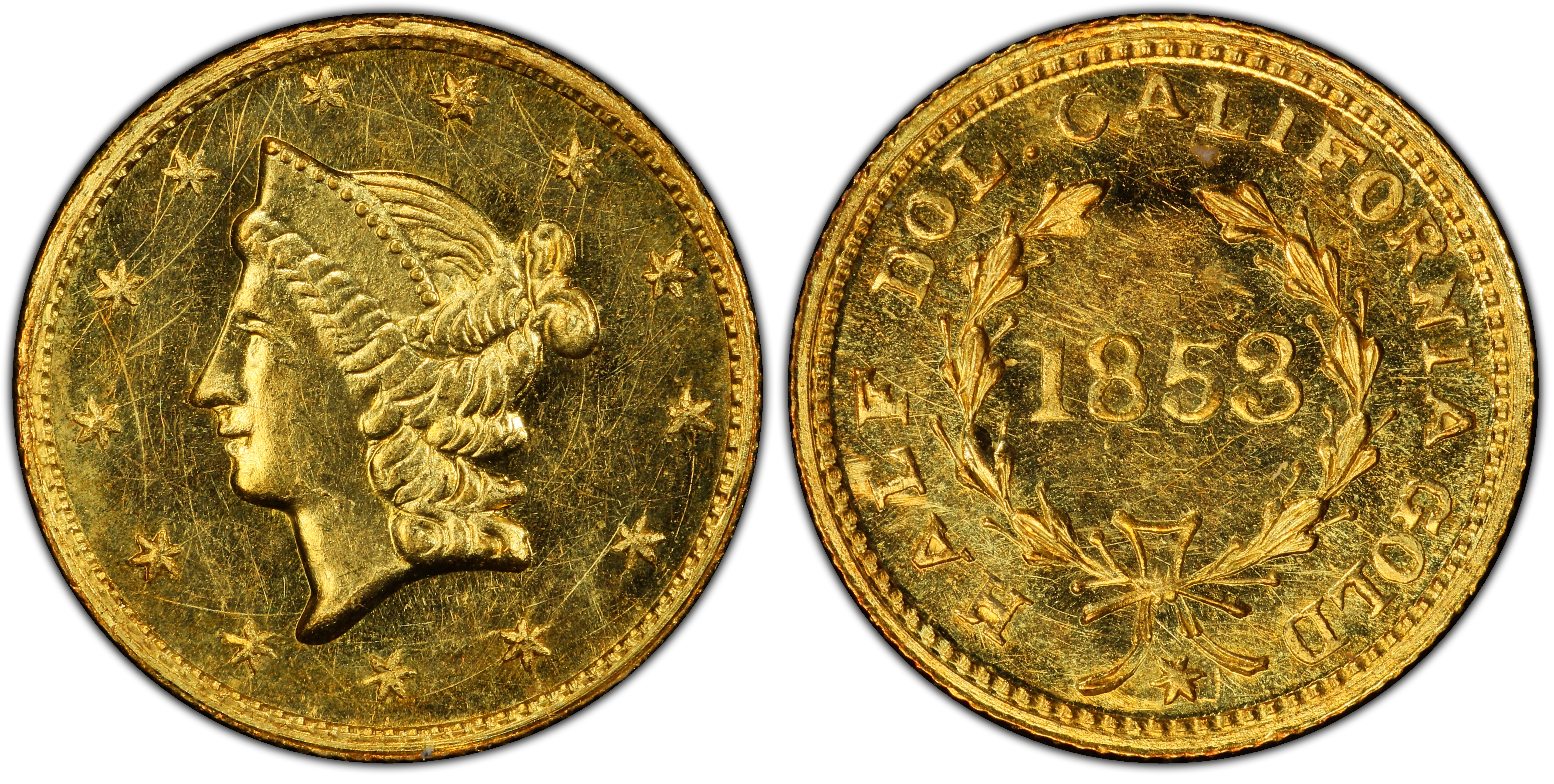
Obverse & Reverse
The 1853 Fifty Cents, cataloged as Breen-Gillio 429, stands as a tangible relic from the chaotic and economically volatile heart of the California Gold Rush. Following the discovery of gold at Sutter's Mill in 1848, a massive wave of over 300,000 fortune-seekers descended upon California. This unprecedented influx of population created booming cities like San Francisco virtually overnight, but it also generated a severe, crippling shortage of small-denomination coinage. With the nearest U.S. Mint in Philadelphia—a perilous and months-long journey away—and private assayers focused on converting raw dust into large-denomination ingots and coins ($5 and up), daily commerce was grinding to a halt. Transactions for simple goods and services were often conducted with a 'pinch' of gold dust, an inaccurate and contentious system ripe for dispute. Into this monetary vacuum stepped a number of enterprising jewelers and metallurgists, who saw both a public need and a business opportunity. One such figure was Antoine Nouizillet, a French jeweler operating in San Francisco. Between 1852 and 1856, a period numismatists classify as 'Period One' of California Fractional Gold, these private minters produced fractional-denomination gold coins—25 cents, 50 cents, and dollars—that were intended for and saw actual circulation. The BG-429 is a prime example of these necessary and widely used coins. Struck from native California gold, which characteristically contained a high percentage of silver, these pieces were often slightly underweight compared to their federal counterparts but were accepted in trade out of sheer necessity. Their existence was a direct rebuke to the federal government's inability to service the new West Coast economy. These tiny gold pieces circulated freely until the San Francisco Mint, which opened in 1854, finally ramped up production of sufficient federal coinage by 1856-1857, rendering the private issues obsolete. The BG-429's survival in any grade is a testament to its journey through the pockets and purses of Gold Rush pioneers.
Associated EventCalifornia Gold Rush
Reason For MintingTo alleviate a severe shortage of small-denomination coinage for everyday commercial transactions in Gold Rush-era California.
Minter HistoryAntoine Louis Nouizillet was a French jeweler and one of the most prolific private minters of Period One California Fractional Gold. Operating in San Francisco during the early 1850s, he, along with contemporaries like M. Deriberpe, created the dies for and struck a significant variety of the fractional gold pieces that were essential to the region's economy. His work is characterized by the Liberty Head motif, closely mimicking the design of the U.S. gold dollar to foster public acceptance. Nouizillet eventually sold his business to Robert B. Gray & Co. around 1859, who continued to use some of his existing dies.
Historical SignificanceThe BG-429 is a quintessential example of a Period One fractional gold coin, a series that represents a critical, privately-driven solution to a major economic failure during the United States' westward expansion. It is numismatic evidence of the real-world monetary struggles faced by pioneers and the ingenuity of local artisans in a frontier economy. Its existence demonstrates a brief but vital period where private coinage was not a novelty, but a necessity for daily life.
BG-429
Denomination50 Cents
Minting Period1853
Assayer/MinterAntoine Nouizillet
Geographic OriginSan Francisco, California
Obverse DescriptionA representation of the head of Liberty, facing left, with 'LIBERTY' inscribed on her coronet. Her hair is tied in the back, with some curls flowing down her neck. She is surrounded by 13 six-pointed stars, representing the original colonies.
Obverse InscriptionLIBERTY
Reverse DescriptionThe denomination '50 CENTS' is enclosed within a wreath of two olive branches tied together at the bottom with a bow. Above the denomination, but within the wreath, is the date '1853'.
Reverse Inscription1853 50 CENTS
CompositionGold
Stated Fineness Actual FinenessVariable, typically .800 to .880 fine, consistent with unrefined native California gold containing a natural silver alloy.
Weight0.82 grams
Diameter11.00 mm
EdgePlain
Unknown
Survival Estimate76-200
Rarity ScaleR-4 (Low)
The BG-429 is highly sought after as a representative 'Period One' issue, meaning it was struck for actual circulation out of necessity, unlike later souvenir issues. Its classic Liberty Head design, direct connection to the Gold Rush, and verifiable scarcity make it a cornerstone piece for collectors of Territorial and private gold.
Key VarietiesThe BG-429 is itself a specific die marriage and has no major, intentional varieties from its original minting period. As a 'Period One' business strike, there are no known contemporary proofs, patterns, or official restrikes. The primary variation for collectors is in die state, with earlier strikes showing sharper details and later strikes exhibiting minor die fatigue or cracks.
Authentication TipsAuthentic Period One pieces like the BG-429 are characteristically very thin, almost like a business card. Counterfeits are often thicker and have a more brassy or coppery color. A genuine piece must have a denomination (e.g., 'CENTS' or 'DOLLAR'); replicas often have a bear on the reverse or omit the denomination entirely. The strike on genuine examples is often uneven, with some areas of weakness, particularly in the center; modern fakes are typically unnaturally sharp and uniform. The surfaces of authentic pieces often show a slightly wavy, unstruck quality in the fields due to the crude hammer-striking process.
Shopping ConsiderationsFor a premium quality example, look for a bold strike on Liberty's hair details and the numbers in the date. While some central softness is common, a coin with well-defined peripheral stars and wreath leaves commands a higher price. Original, uncleaned surfaces with a hint of reddish-gold or greenish-gold luster from the natural alloy are highly desirable. Avoid examples that are holed, bent, or exhibit harsh cleaning, as these issues dramatically reduce value. Pay close attention for evidence of tooling in the fields or re-engraving on the design elements, which are sometimes used to hide damage or weakness.
A coin's grade is its condition, rated on a 1-70 scale. For rare coins, this is the most critical factor in determining value, as a tiny difference in preservation can mean a huge difference in price.
Relevant Grade TypesAll original examples of BG-429 are business strikes, intended for circulation. They are found in Circulated grades (AG-3 to AU-58) and, very rarely, in Mint State (MS-60 to MS-70). No Proof (PR/PF) examples were struck during the original period of issue, and no official later-date Proof restrikes are known to exist. Any piece described as a 'Proof' is almost certainly a modern replica or fantasy item.
Mint State CharacteristicsAn uncirculated BG-429 typically exhibits a soft, satiny luster rather than a hard, frosty one, a result of the native gold alloy and striking methods. Strike is a key issue; many Mint State examples will show some softness on the highest points of Liberty's hair above the eye and on the knot of the bow on the reverse. Planchet quality can be irregular, with minor striations or 'crinkles' being common and not necessarily detrimental unless they are severe. Due to the softness of the gold, even high-grade specimens are expected to have some light contact marks from handling and storage.
Circulated Wear PatternsWear first appears on the highest points of the design. On the obverse, this includes Liberty's cheek, the hair bun at the back of her head, and the strands of hair above her ear and forehead. On the reverse, the high points of the wreath's leaves and the bow's knot will show friction first. In lower grades (VG and below), the word 'LIBERTY' on the coronet becomes indistinct, and the date and stars begin to merge with the fields.
Key Factors For ValueBeyond the numerical grade, the primary drivers of value for a BG-429 are surface quality and strike. An example with original, undisturbed skin and attractive luster will always be worth more than a cleaned or polished coin of the same grade. A sharp strike that brings up the details of the hair and wreath is highly prized and carries a significant premium. Eye appeal is paramount; coins with a pleasing, original color and minimal distracting marks will always be in the highest demand. A CAC sticker for this issue is a significant value-add, confirming that the coin is of premium quality for its assigned grade.
PCGS Price Guide
| Grade | Price | Population |
|---|---|---|
| 45 | $265.00 | 1 |
| 45+ | $265.00 | N/A |
| 50 | $270.00 | 2 |
| 50+ | $270.00 | N/A |
| 53 | $275.00 | 5 |
| 53+ | $275.00 | N/A |
| 55 | $280.00 | 16 |
| 55+ | $285.00 | N/A |
| 58 | $325.00 | 33 |
| 58+ | $340.00 | N/A |
| 60 | $360.00 | 7 |
| 61 | $375.00 | 11 |
| 62 | $475.00 | 51 |
| 62+ | $550.00 | N/A |
| 63 | $700.00 | 10 |
| 63+ | $800.00 | N/A |
| 64 | $1,475.00 | 3 |
| 64+ | $1,850.00 | N/A |
| 65 | $3,150.00 | 1 |
| 65+ | $3,500.00 | N/A |
| 66 | $4,250.00 | N/A |