1855/4 G$1 BG-511 (Regular Strike)
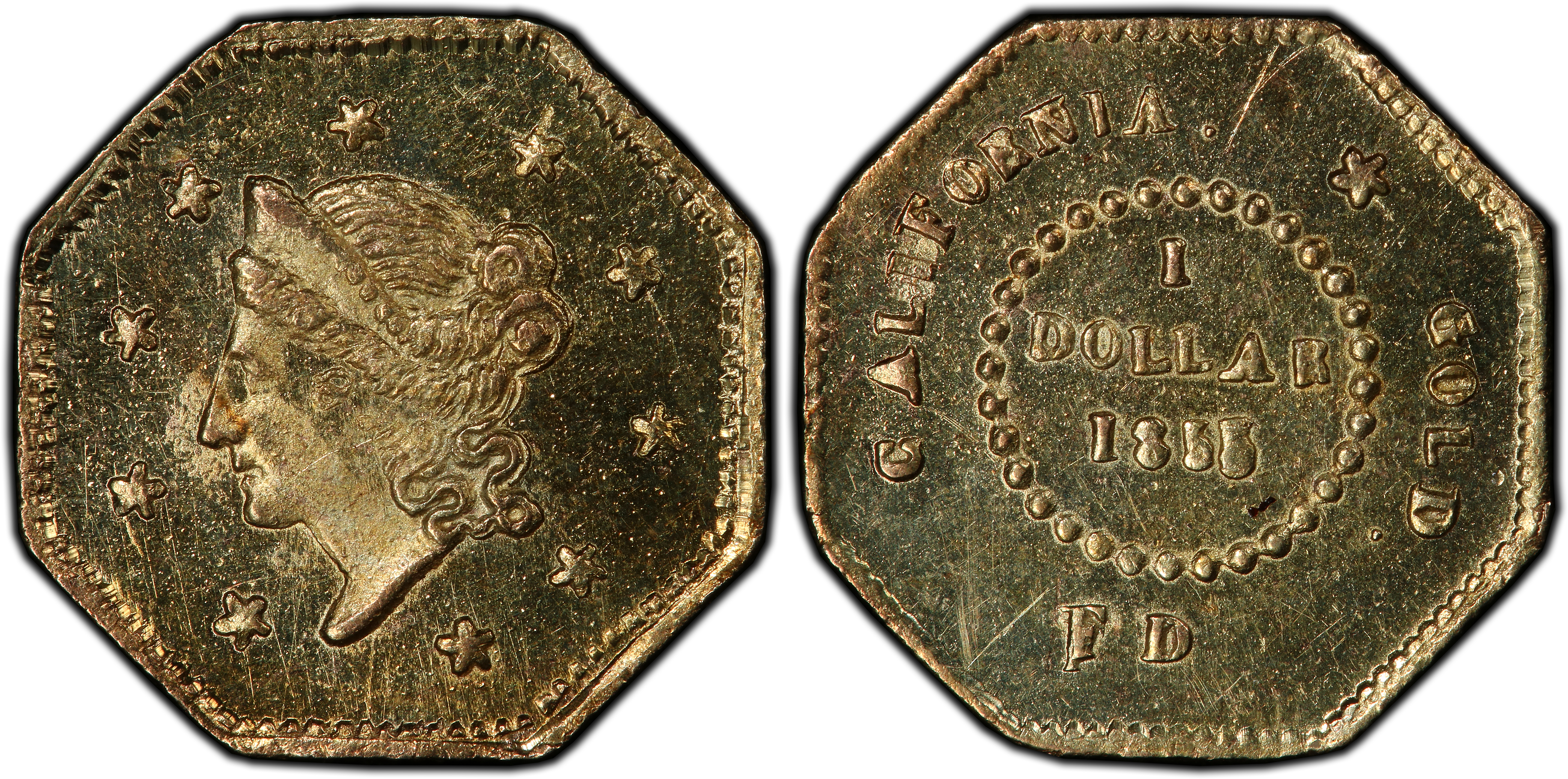
Obverse & Reverse
The 1855/4 G$1, cataloged as Breen-Gillio 511, is a quintessential artifact from the first phase of California's private gold coinage. This period, now known to numismatists as 'Period One' (1852-1856), was born of profound necessity. The California Gold Rush, which began in earnest in 1849, had attracted a population of over 300,000 to the territory by the mid-1850s. This massive and rapid migration created a vibrant, chaotic, and cash-starved economy. Gold dust, the primary medium of exchange, was imprecise and inconvenient for small, daily transactions. While the U.S. government authorized a Branch Mint in San Francisco in 1852, its doors did not open until 1854, and its initial production focused heavily on larger denominations, leaving a severe drought of small change. In 1855, the San Francisco mint produced no gold dollars at all, exacerbating the problem. Into this numismatic void stepped enterprising jewelers and metallurgists, many of French origin, who saw a commercial opportunity. The firm of Frontier, Deviercy & Co. was among the most prominent of these private minters. Operating in San Francisco, they produced fractional gold coins—in quarter dollar, half dollar, and dollar denominations—that were generally of good quality and intended to genuinely facilitate commerce. The BG-511 is a prime example of their work. Struck on an octagonal planchet, its design mimics the federal Liberty Head gold dollar, a clear attempt to inspire public confidence. The '1855/4' date signifies an overdate, where a die from the previous year was re-punched with the new date, a common practice in an era of scarce resources. These tiny gold pieces circulated freely, used to buy a drink, a meal, or other daily necessities in the boomtowns of Northern California. Their existence was eventually rendered obsolete by an increased supply of federal coinage, and the Coinage Act of 1864 made all private currency illegal. Today, the BG-511 is a cherished relic, representing a time of immense economic upheaval and the resourceful, entrepreneurial spirit that defined the American West.
Associated EventCalifornia Gold Rush
Reason For MintingTo alleviate a severe shortage of small denomination coinage for daily commerce in California, a problem the new San Francisco Mint had not yet solved.
Minter HistoryFrontier, Deviercy & Co. was a partnership of San Francisco jewelers, Pierre Frontier and Eugene Deviercy, active during the height of the Gold Rush. They were significant producers of 'Period One' California fractional gold from approximately 1852 to 1856. Like many of their contemporaries, they were skilled artisans who applied their knowledge of metallurgy to meet a critical economic need. Their coinage is typically identified by the initials 'F.D.' punched into the dies, as seen on the reverse of the BG-511 below the beaded circle. Their work is characterized by a relatively high standard of quality for the time, with designs that consciously emulated federal issues to promote acceptance in circulation. The firm was associated with other prominent French jewelers in the city, such as Alexandre Dubois, and represents a key part of the intertwined community of private minters who provided California with its essential pocket change in its formative years.
Historical SignificanceThe BG-511 is a tangible link to the chaotic and energetic economy of Gold Rush California. It represents a period of quasi-legal, private minting that was essential for the region's commercial development before federal institutions could catch up with the explosive growth. As a 'Period One' issue, it stands apart from the later, often debased souvenir tokens, representing a genuine attempt to create a circulating medium of exchange. Its existence underscores the theme of improvisation and private enterprise that built the American West.
N/A
DenominationG$1
Minting Period1855
Assayer/MinterFrontier, Deviercy & Co.
Geographic OriginSan Francisco, California
Obverse DescriptionA Diademed Liberty Head facing left, similar in style to the contemporary U.S. gold dollar designed by James B. Longacre. The head is surrounded by thirteen stars representing the original colonies.
Obverse Inscription[No Inscription, only stars]
Reverse DescriptionThe denomination '1' and the word 'DOLLAR' are enclosed within a beaded circle. Outside the circle is the legend 'CALIFORNIA GOLD' and the date '1855'. The initials of the minters, 'F.D.', are located below the beaded circle.
Reverse InscriptionCALIFORNIA GOLD / 1 / DOLLAR / 1855
CompositionGold
Stated Fineness Actual FinenessPeriod One issues are generally accepted to be of a high, but not standardized, fineness, often containing a natural alloy of silver from the native California gold.
EdgePlain
Unknown
Survival EstimateFewer than 100 known
Rarity ScaleR-6+
This coin is highly sought after as a genuine 'Period One' circulating issue from a known maker, Frontier & Deviercy. The octagonal shape, clear overdate (5 over 4), and direct connection to the peak of the Gold Rush make it a cornerstone piece for specialists in territorial and fractional gold.
Key VarietiesThe primary variety is the 1855/4 overdate, which defines the BG-511 attribution. A silver trial piece (BG-511a) is also known to exist and is exceedingly rare. No proof restrikes or later collector issues were made of this specific variety.
Authentication TipsGenuine BG-511 examples exhibit specific die characteristics. Look for the distinct remnants of a '4' under the final '5' in the date. The 'F.D.' initials on the reverse should be sharp and correctly formed. Be wary of modern replicas, which are often thicker, have a soapy or cast-like appearance, incorrect weight, and may feature a bear on the reverse—a motif never used on genuine circulating Period One fractionals. Weak strikes are common on authentic pieces, whereas fakes are often sharply and evenly struck. Genuine pieces are very thin.
Shopping ConsiderationsA premium quality BG-511 will show a bold strike, particularly on Liberty's hair and the stars on the obverse, and on the date and legends on the reverse. The overdate should be clearly visible under magnification. Original, uncleaned surfaces with some remaining luster command a significant premium. Circulated examples are the norm, so finding one in About Uncirculated or Mint State is a major prize. Check carefully for common problems such as tooling in the fields to hide marks, smoothing, or evidence of having been previously mounted in jewelry. Eye appeal is paramount; seek out examples with a pleasing, original reddish-gold or yellow-gold patina.
A coin's grade is its condition, rated on a 1-70 scale. For rare coins, this is the most critical factor in determining value, as a tiny difference in preservation can mean a huge difference in price.
Relevant Grade TypesAll original examples of BG-511 were struck as business strikes intended for commerce and are found in Circulated (1-58) and Mint State (MS, 60-70) grades. No Proofs were struck during the original period of issue, and no later-date Proof restrikes are known to exist for this variety.
Mint State CharacteristicsUncirculated examples of BG-511 are rare. A typical Mint State piece often shows some weakness in the strike, particularly on the highest points of Liberty's hair and the stars. The planchets were not always perfectly prepared, so minor natural imperfections may be present. Luster is typically satiny rather than deeply prooflike. Due to the small size and handling, even high-grade specimens may show tiny planchet flaws or contact marks, but these should not be overly distracting.
Circulated Wear PatternsWear first appears on the highest points: the hair above Liberty's eye and ear, and the cheekbone. On the reverse, the numeral '1' and the letters in 'DOLLAR' will show initial friction and loss of detail. On more heavily worn examples (VF and below), the stars on the obverse will begin to merge with the fields, and the date and peripheral legends on the reverse will become soft and eventually illegible.
Key Factors For ValueFor the BG-511, value is driven by several key factors. Firstly, the grade is paramount. Secondly, surface preservation is critical; an example with original, uncleaned 'skin' is far more valuable than a cleaned or polished one of the same grade. Thirdly, the strength of the strike and the clarity of the 5/4 overdate are major value drivers. Finally, overall eye appeal, including attractive original toning, can add a significant premium. Certification by a top-tier grading service (PCGS or NGC) is essential for market acceptance, and a CAC sticker for this issue indicates premium quality for the grade and will result in a substantial price increase.
PCGS Price Guide
| Grade | Price | Population |
|---|---|---|
| 40 | $450.00 | 2 |
| 45 | $525.00 | 3 |
| 45+ | $535.00 | N/A |
| 50 | $550.00 | 5 |
| 50+ | $575.00 | N/A |
| 53 | $625.00 | 2 |
| 53+ | $700.00 | N/A |
| 55 | $800.00 | 10 |
| 55+ | $850.00 | N/A |
| 58 | $1,150.00 | 16 |
| 58+ | $1,200.00 | N/A |
| 60 | $1,350.00 | 4 |
| 61 | $1,450.00 | 6 |
| 62 | $1,650.00 | 19 |
| 62+ | $1,750.00 | N/A |
| 63 | $2,400.00 | 9 |
| 63+ | $2,600.00 | N/A |
| 64 | $3,000.00 | 5 |
| 64+ | $3,500.00 | N/A |
| 65 | $4,750.00 | N/A |