1857 G$1 BG-607 (Regular Strike)
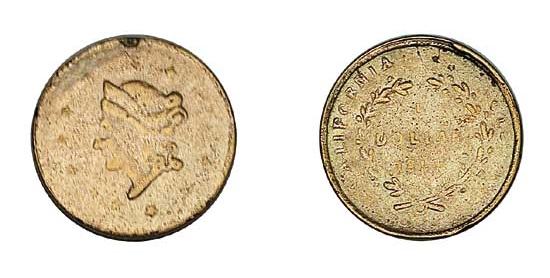
Obverse & Reverse
The 1857 BG-607 one dollar piece represents the zenith and conclusion of the initial phase of private fractional gold coinage in California. Struck at the very end of what numismatists classify as 'Period One' (1852-1857), this coin emerged from a crucible of economic necessity unique to Gold Rush California. In the early and mid-1850s, the immense influx of gold dust failed to translate into a practical medium for daily transactions. Federal coinage was scarce, particularly in small denominations, and the smallest privately-issued gold coins were typically $5. This created a chaotic commercial environment where a 'pinch' of gold dust, an imprecise and often unfair measure, was used for minor purchases. San Francisco jewelers, many of French origin, astutely identified this monetary vacuum. Leveraging their metallurgical skills, they began striking denominated quarter-dollar, half-dollar, and one-dollar pieces from native California gold. These 'fractionals' were not officially sanctioned but were tolerated and widely accepted in local commerce to facilitate trade. Antoine Louis Nouizillet was one of the most prominent and skilled of these private minters. Operating as a jeweler, he produced a variety of fractional denominations that were respected for their quality. However, by 1857, the landscape was changing. The San Francisco Mint, which opened in 1854, was finally striking sufficient quantities of federal silver and gold coinage, alleviating the acute shortage of small change. Consequently, the practical need for privately-issued fractionals dwindled, and their production ceased almost entirely. The BG-607 is the only dollar variety attributed to 1857 from this 'Period One' series, marking it as a final, fleeting issue of this fascinating monetary experiment before fractional gold transitioned into a souvenir and jewelry-focused industry ('Period Two,' 1858-1882). Its profound rarity, with only two examples known to exist, suggests it may have been a trial or pattern issue, or that its production was cut short as the market for circulating private coinage evaporated. Today, the BG-607 stands as a ghost of the Gold Rush, a testament to the ingenuity of private enterprise in the face of monetary chaos and a relic from the very moment that era of quasi-official private money came to a close.
Associated EventCalifornia Gold Rush
Reason For MintingTo alleviate a severe shortage of small-denomination circulating coinage for daily commercial transactions in Gold Rush-era California.
Minter HistoryAntoine Louis Nouizillet was a French jeweler and one of the most significant private manufacturers of Period One California fractional gold. Based in San Francisco during the 1850s, he was a skilled die-sinker and metallurgist who produced a wide range of quarter, half, and one-dollar gold pieces. His work is noted for its relatively high quality and standardized designs, often featuring a Liberty head motif similar to federal issues. He sometimes worked in partnership with other jewelers, such as M. Deriberpe (D.N. mintmark) and F. Routhier (N.R. mintmark). As the economic need for fractional gold waned, Nouizillet sold his business, including his dies and punches, to another jeweler, Robert B. Gray & Co., around 1859. Gray would later use some of Nouizillet's old dies to strike Period Two souvenir pieces.
Historical SignificanceThe BG-607 is the only known one-dollar variety from the final year of the 'Period One' era of circulating fractional gold, making it a critical transitional piece. Its extreme rarity suggests a very limited striking, possibly a pattern, encapsulating the end of privately issued coinage for commerce before the genre shifted entirely to souvenirs.
K-Unlisted; BG-607
Denomination$1
Minting Period1857
Assayer/MinterAntoine Louis Nouizillet
Geographic OriginSan Francisco, California
Obverse DescriptionFeatures a small, somewhat crudely rendered head of Liberty facing left, surrounded by thirteen stars. The date '1857' is positioned below the bust.
Obverse Inscription1857
Reverse DescriptionA simple wreath surrounds the denomination '1 DOLLAR' which is rendered in two lines.
Reverse Inscription1 DOLLAR
CompositionGold
Stated Fineness Actual FinenessTypically varied for Period One issues, often between .800 and .900, using native California gold which contained a high percentage of silver.
EdgePlain
Extremely low, likely less than 10.
Survival Estimate2 known specimens.
Rarity ScaleR-8 (Breen-Gillio)
As an R-8 'Period One' dollar and the only variety known for the transitional year of 1857, the BG-607 is a landmark rarity in American numismatics. It appeals to the most advanced collectors of Territorial gold and represents a pinnacle of completeness for a California fractional gold collection.
Key VarietiesThere are no known varieties of the BG-607 itself. It is a unique variety within the broader series. No restrikes or special collector issues are known to exist.
Authentication TipsGiven the extreme rarity, any example offered should be considered suspect until authenticated by a top-tier grading service (PCGS or NGC) with a documented pedigree. General tips for Period One fractionals apply: verify the presence of a denomination ('DOLLAR'), which is absent on many later souvenirs. The style of the Liberty head and lettering should be compared to the known genuine examples. Unlike many genuine fractionals which can be weakly struck, modern fakes are often sharp and possess unnatural surface characteristics. The planchets of genuine issues are often thin and crude.
Shopping ConsiderationsAcquisition is a major event, likely only possible via the sale of a significant, long-held collection at a major auction. The concept of 'premium quality' for this issue is secondary to its very existence; any example, regardless of grade or condition issues (such as planchet flaws, weak strike, or post-striking damage), would be a centerpiece of a major collection. The Jay Roe collection specimen, graded VF20 with noted imperfections, is one of the two known examples, setting the benchmark for the issue's typical state of preservation.
A coin's grade is its condition, rated on a 1-70 scale. For rare coins, this is the most critical factor in determining value, as a tiny difference in preservation can mean a huge difference in price.
Relevant Grade TypesAll original examples of BG-607 were business strikes intended for circulation and would be graded on the Circulated (AG-3 to AU-58) or Mint State (MS-60 to MS-70) scales. Given that only two circulated examples are known, finding a Mint State specimen is highly improbable. No proofs were struck during the original minting period, and no later-date Proof restrikes are known to exist for this specific variety.
Mint State CharacteristicsA theoretical Mint State BG-607 would be evaluated on its luster, which for Nouizillet's issues is typically soft and satiny. The strike would be a key factor, as fractional gold is notoriously poorly struck; a well-centered strike with full details on Liberty's hair and the wreath would be exceptional. Given the crude manufacturing process, even a high-grade example would likely display some planchet roughness or adjustment marks. Contact marks would be expected, as the small coins were handled together.
Circulated Wear PatternsFor Period One Liberty Head gold dollars in general, wear first appears on the high points of Liberty's hair, cheek, and the bow in the wreath on the reverse. As wear progresses, the stars on the obverse and the letters in the denomination will become soft and eventually merge with the fields. On the known VF20 example, significant flatness is seen on the highest points of the design, consistent with this wear pattern.
Key Factors For ValueFor an ultimate rarity like the BG-607, the primary factor for value is simply its existence and authenticity. Pedigree is paramount. Beyond that, the grade and any detrimental surface issues (cleaning, polishing, solder, damage) will heavily influence value. An example with original, unmolested surfaces, even in a low grade, would be prized far more than a higher grade but impaired specimen. Eye appeal, driven by factors like a clean strike and attractive original color, would command a significant premium, but any opportunity to acquire one of the two known examples would transcend typical quality considerations.
PCGS Price Guide
| Grade | Price | Population |
|---|---|---|
| 63 | $42,500.00 | 1 |