1860 G25C BG-730 (Regular Strike)
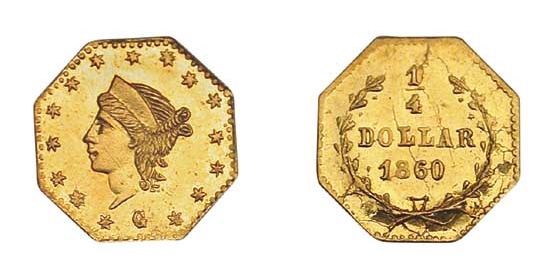
Obverse & Reverse
The 1860 25 Cents, cataloged as Breen-Gillio 730 (BG-730), is a quintessential example from the second period of California Fractional Gold production (1859-1882). This era of private coinage arose from the unique economic conditions of post-Gold Rush California. While the San Francisco Branch Mint, opened in 1854, addressed the need for larger denomination federal coinage by converting raw gold dust and nuggets into official U.S. coins, a severe shortage of small change persisted. The smallest federal coin in regular circulation on the West Coast was the silver quarter dollar, which had a high purchasing power, making everyday transactions for items like a drink or a newspaper cumbersome. Miners' gold dust, though plentiful, was impractical for small purchases due to the difficulty of accurately measuring small quantities. This created a fertile environment for private minters to fill the void. Jewelers and engravers, primarily in San Francisco, began striking their own small-denomination gold coins, first in Quarter, Half, and Dollar denominations, starting in 1852. These pieces, often called 'tokens' or 'charms' by detractors but used as currency out of necessity, were immensely popular. The BG-730, struck in 1860, features a design often attributed to the French-born engraver Antoine Louis Nouizillet, who was active in San Francisco during this period. The coins of this second period are generally of higher quality and more standardized in appearance than the cruder issues of the early 1850s. However, their legality was always dubious. Federal legislation in 1864 explicitly outlawed the private coining of money, which significantly curtailed the production of these fractional pieces. Despite the law, production continued clandestinely for years, with manufacturers often backdating their coins to pre-1864 dates to circumvent the law, although the 1860 date on this piece is considered contemporary. These coins circulated actively in the American West until sufficient quantities of federal small change finally saturated the regional economy in the 1870s and 1880s.
Associated EventCalifornia Gold Rush Aftermath
Reason For MintingA chronic shortage of circulating small-denomination coinage for everyday transactions in California prompted private minters to produce fractional gold pieces.
Minter HistoryThe specific minter for BG-730 is unconfirmed, as was common for many California Fractional Gold producers who operated in a legally grey area. However, stylistic analysis of the engraving, particularly the distinctive Indian Head motif, strongly suggests the work of Antoine Louis Nouizillet. Nouizillet, a talented French die-sinker, immigrated to the United States and was active in San Francisco from roughly 1856 to 1861. He is credited with engraving dies for several fractional gold issuers, and his work is characterized by a higher artistic quality compared to many of his contemporaries. His name does not appear on the coins, a prudent measure to avoid legal repercussions for private minting.
Historical SignificanceThe BG-730 and other California Fractional Gold coins are tangible relics of the economic growing pains of the American West. They represent a grassroots, private-sector solution to a government failure in supplying adequate currency for a booming frontier economy. Their existence highlights the autonomy and unique challenges of the region during a pivotal period of American expansion, serving as a physical link to the daily commercial life of miners, merchants, and citizens in Gold Rush-era California.
N/A
Denomination25 Cents
Minting Period1860
Assayer/MinterUnknown, possibly Antoine Louis Nouizillet
Geographic OriginSan Francisco, California
Obverse DescriptionA beaded border surrounds a depiction of a Liberty head facing left, adorned with a feathered headdress. Thirteen stars encircle the portrait.
Obverse Inscription(No text inscription)
Reverse DescriptionA decorative wreath of leaves and berries, tied with a ribbon at the bottom, encircles the denomination and date. The date '1860' is located within the wreath, just above the bow. The denomination '25 CENTS' is positioned in the center.
Reverse Inscription25 CENTS 1860
CompositionGold
Stated Fineness Actual FinenessVaries, typically 14 to 21 karats.
Weight0.25 grams
Diameter9.80 mm
EdgePlain
Unknown
Survival Estimate50-75
Rarity ScaleR-6
BG-730 is highly sought after due to its classic 'Indian Princess' design, its status as a genuine circulating artifact of the Old West, and its relative affordability compared to earlier period fractionals. Its clear date and denomination within the wreath make it a popular type coin for collectors entering the complex field of California Fractional Gold.
Key VarietiesThe BG-730 is a specific die marriage (Obverse 7 / Reverse 30). There are no major varieties of this specific catalog number from the original period. No known period proofs, restrikes, or patterns exist for this variety. Collectors should be aware of contemporary counterfeits and modern replicas, which are not considered varieties.
Authentication TipsGenuine examples of BG-730 exhibit sharp details for the grade, particularly in the feathers and the wreath. The numerals in the date '1860' have a distinct style. A key diagnostic is the presence of a faint die crack often seen running from the rim through the top of the 'S' in CENTS. Many modern replicas are brassy in color, have a soapy or cast-like appearance, and incorrect weight. Authentication by a major third-party grading service (PCGS or NGC) is highly recommended.
Shopping ConsiderationsA premium quality example for its grade will possess a sharp, well-centered strike, especially on the high points of the feathers and the numerals of the date. Look for coins with minimal distracting marks and original, uncleaned surfaces, which often display a pleasing, slightly reddish-gold patina. Avoid examples that have been harshly cleaned, which will appear unnaturally bright and exhibit hairline scratches, or those that have been used as jewelry, indicated by solder marks or rim damage. Strong eye appeal and a CAC sticker for this issue command significant premiums.
A coin's grade is its condition, rated on a 1-70 scale. For rare coins, this is the most critical factor in determining value, as a tiny difference in preservation can mean a huge difference in price.
Relevant Grade TypesOriginal period issues of BG-730 were business strikes intended for circulation and are found in Circulated grades (AG-3 to AU-58) and Mint State (MS-60 to MS-70). The vast majority of surviving examples are circulated. No proofs were struck during the original period of issue, and there are no known later-date collector restrikes for this specific die marriage.
Mint State CharacteristicsUncirculated examples of BG-730 typically exhibit a soft, satiny luster. The strike can be somewhat variable, with some weakness possible on the highest points of the feathers and the center of the wreath. Due to the small size and softness of the gold, even Mint State examples will often show minor handling marks or 'tick' marks acquired from contact with other coins shortly after minting. A truly choice MS example will have a bold strike, vibrant luster, and virtually mark-free surfaces.
Circulated Wear PatternsWear first appears on the highest points of the design. On the obverse, check for flatness on the cheek, the hair just above the ear, and the tips of the feathers in the headdress. On the reverse, the highest points of the wreath's leaves and the bow of the ribbon will show initial wear. In lower grades (VG and below), the individual feathers will begin to merge, and the numerals in the date will become weak.
Key Factors For ValueThe primary drivers of value for an 1860 BG-730 are grade and surface preservation. An example with original, uncleaned surfaces commands a significant premium over a harshly cleaned or polished coin of the same technical grade. Strike quality is also critical; a sharply struck coin with full details is always preferred. Eye appeal, which includes factors like attractive toning and a lack of distracting marks, plays a major role. Finally, certification by a top-tier service (PCGS or NGC), and especially with additional approval from CAC, provides buyers with confidence and significantly enhances the coin's market value.
PCGS Price Guide
| Grade | Price | Population |
|---|---|---|
| 55 | $450.00 | 1 |
| 55+ | $465.00 | N/A |
| 58 | $480.00 | 2 |
| 58+ | $500.00 | N/A |
| 60 | $525.00 | N/A |
| 61 | $575.00 | 2 |
| 62 | $625.00 | 5 |
| 62+ | $675.00 | N/A |
| 63 | $1,250.00 | 3 |
| 63+ | $1,450.00 | N/A |
| 64 | $2,150.00 | 2 |