1854 G50C BG-422A (Regular Strike)
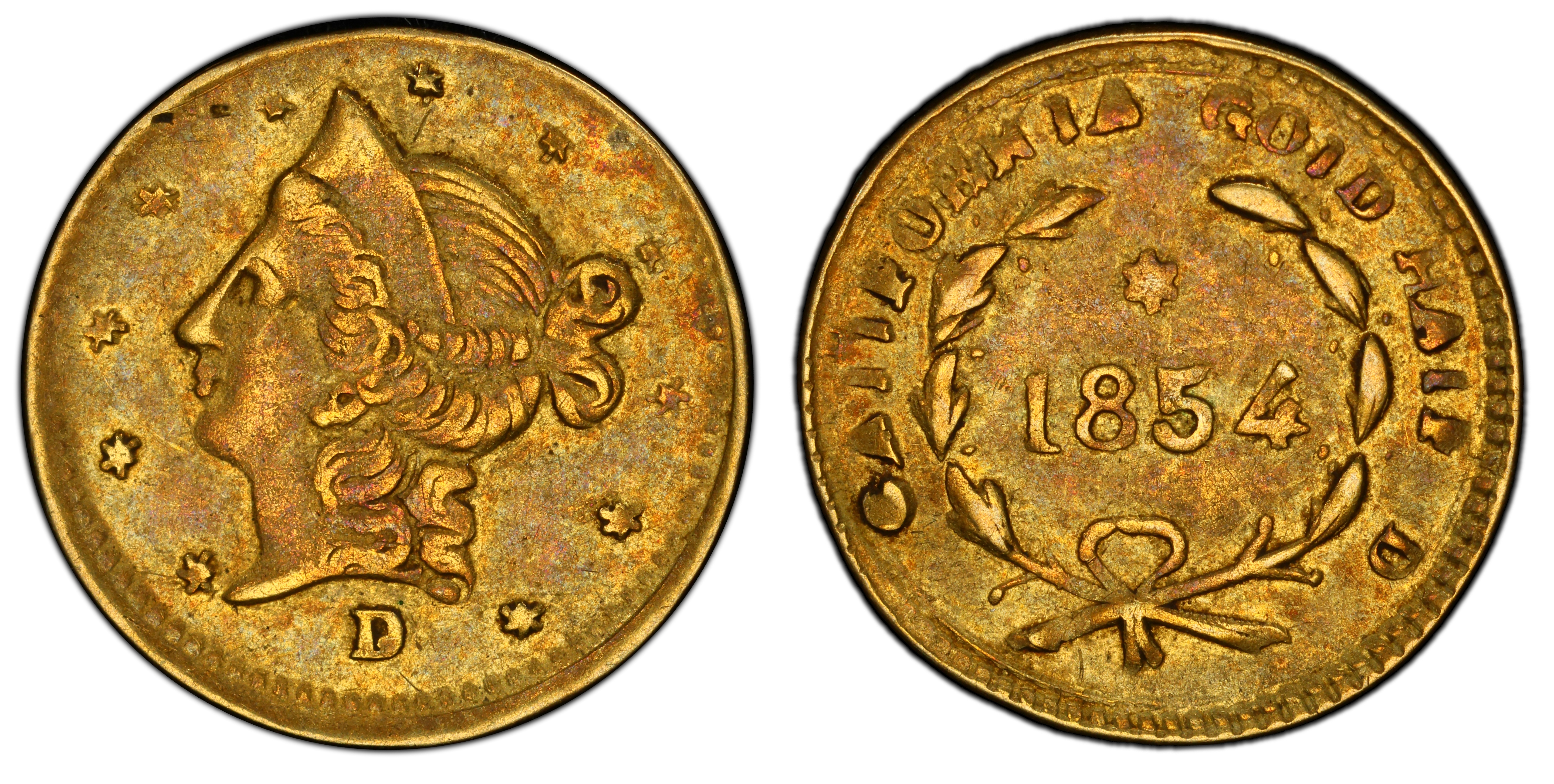
Obverse & Reverse
The 1854 Gold 50 Cents, cataloged as BG-422A, is an artifact of pure necessity born from the chaotic, economically volatile environment of the California Gold Rush. Following the discovery of gold at Sutter's Mill in 1848, a massive influx of prospectors and merchants descended upon California, creating a booming economy almost overnight. This rapid growth, however, far outpaced the supply of official United States coinage. With the nearest federal mint over a thousand miles away in New Orleans, and the San Francisco Mint not beginning its own coinage operations until 1854, a severe shortage of small-denomination currency paralyzed daily commerce. Transactions for everyday goods and services were often conducted with gold dust, an imprecise and fraud-prone method, or with foreign coins of varying reliability. Into this monetary vacuum stepped a number of private minters, primarily jewelers and metallurgists in San Francisco. Between 1852 and 1857, a period numismatists classify as 'Period One,' these artisans began striking their own fractional gold coins in quarter dollar, half dollar, and dollar denominations. These pieces were not government-sanctioned but were tolerated as a crucial lubricant for the local economy. The BG-422A is a 'Period One' issue, meaning it was produced with the genuine intent to circulate and alleviate the coin shortage. These early issues were typically made from native California gold, which often contained a significant amount of silver, giving them a lighter color than federal issues. They were crudely struck by hand using hammer presses, resulting in inconsistent quality and frequent die breaks, features which now serve as diagnostic markers for collectors. As the San Francisco Mint ramped up production of federal silver and gold coins by 1856-1857, the need for these private issues waned, and most were withdrawn from circulation, melted down, or lost. The extreme rarity of the BG-422A variety today, with only three examples believed to exist, is a testament to this high rate of attrition and its presumably very small initial mintage.
Associated EventCalifornia Gold Rush
Reason For MintingTo alleviate a severe shortage of small-denomination coinage for daily commerce in Gold Rush-era California.
Minter HistoryThe specific minter of BG-422A is unconfirmed, which is common for many Period One California Fractional Gold varieties. The coins from this era were produced by various jewelers and metallurgists located in San Francisco who responded to the region's desperate need for circulating coinage. These private minters, such as M. Deriberpe, Antoine Louis Nouizillet, and the firm Frontier & Deviercy, operated without direct government oversight. They created their own dies and struck coins using manual hammer presses. Their primary business was jewelry and assaying, with coinage being a profitable and necessary sideline. The workmanship on these small pieces varied from crude to surprisingly refined, reflecting the skill of the individual die-sinker.
Historical SignificanceThe BG-422A, as part of the broader series of Period One California Fractional Gold, represents a critical, albeit temporary, solution to a major economic problem on the American frontier. It is a tangible link to the daily life of miners, merchants, and settlers during one of the most dynamic periods in U.S. history. The series demonstrates private enterprise stepping in to fulfill a role the federal government was not yet equipped to handle in its rapidly expanding western territories. The eventual suppression of these private issues after the San Francisco Mint became fully operational marks a key step in the standardization of American currency.
BG-422A
Denomination50 Cents
Minting Period1854
Assayer/MinterUnknown Private Minter
Geographic OriginSan Francisco, California
Obverse DescriptionFeatures a Liberty Head portrait facing left, stylistically similar to the contemporary federal gold coinage of James B. Longacre. The head is surrounded by thirteen six-pointed stars representing the original colonies. The date, 1854, is positioned below the bust truncation.
Obverse Inscription1854
Reverse DescriptionA simple wreath of two branches tied with a ribbon at the bottom encircles the denomination. Within the wreath, the denomination is expressed as '1/2'. The legend 'CALIFORNIA GOLD' appears above the wreath, along the upper rim.
Reverse InscriptionCALIFORNIA GOLD 1/2
CompositionGold
Stated Fineness Actual FinenessTypically .800 to .880, containing a natural alloy of silver.
Weight0.86 grams
Diameter10.50 mm
EdgePlain
Extremely Low; Unknown
Survival Estimate3 Known (per PCGS Population Report as of 2024)
Rarity ScaleR-8 (Very Rare)
This coin is a paramount rarity in the California Fractional Gold series. Its appeal lies in its direct connection to the Gold Rush, its status as a 'Period One' circulating issue, and its extreme scarcity, with only three known survivors. It represents one of the ultimate challenges for the advanced specialist in private and territorial gold.
Key VarietiesThe BG-422A is itself a unique die marriage and has no known major varieties from its original minting period. No later-date restrikes or special collector issues of the BG-422A die pair are known to exist. The primary varieties within the broader series are the hundreds of different die pairings (BG numbers) produced by various minters.
Authentication TipsAuthentic Period One fractionals like BG-422A are struck on thin planchets. Weight and diameter should be close to the specified norms. The strike will often appear slightly crude or uneven, a hallmark of hammer striking. The surfaces should not exhibit a modern, proof-like finish. Replicas and tokens often lack a denomination (e.g., '1/2 DOLLAR' or '50 CENTS'), omit the word GOLD, or feature a California grizzly bear, a motif never used on genuine circulating issues. Due to its high rarity and value, third-party certification from PCGS or NGC is essential for authentication.
Shopping ConsiderationsFor a coin of this rarity, any available example is a major acquisition. A 'premium quality' example would be one that is problem-free, without holes, tooling, or harsh cleaning. Given that only three are known, the primary consideration is simply availability. A buyer should look for sharp details for the grade, particularly on Liberty's hair and the wreath leaves. Original, unmolested surfaces with the characteristic lighter reddish-gold color of native California gold are highly desirable. Comparing any potential purchase to the images of the known, certified examples is a critical step in verifying its authenticity and quality.
A coin's grade is its condition, rated on a 1-70 scale. For rare coins, this is the most critical factor in determining value, as a tiny difference in preservation can mean a huge difference in price.
Relevant Grade TypesOriginal BG-422A issues were business strikes intended for circulation and are found in Circulated (1-58) and Mint State (MS, 60-70) grades. Given their utilitarian purpose, circulated examples are the norm for the series, but the few known specimens of BG-422A are in Mint State. No Proof (PR/PF) examples were struck during the original minting period, and no later-date Proof restrikes are known.
Mint State CharacteristicsAn uncirculated BG-422A would be judged on the quality of its strike and the preservation of its surfaces. These were hammer-struck, so a fully sharp strike across all elements would be unusual and highly prized. Luster is typically soft and satiny rather than deeply reflective. Due to the softness of the gold and primitive handling, even Mint State examples are expected to have some minor contact marks or planchet imperfections. The die state is also crucial, as any diagnostics like die cracks or clashes can help confirm authenticity.
Circulated Wear PatternsOn this design, wear would first appear on the highest points: Liberty's cheek, ear, and the hair curls above her ear on the obverse. On the reverse, the high points of the wreath's leaves and the bow of the ribbon would show the first signs of friction. In lower grades (e.g., VF and below), the stars on the obverse would begin to merge with the fields, and the finer details of the wreath would become flattened.
Key Factors For ValueWith only three known examples, the primary factor for value is simply its existence and availability on the market. Beyond that, the specific numerical grade (e.g., MS62 vs. MS61) would be the most significant value determinant. Surface quality is paramount; an example with clean fields and minimal distracting marks will command a substantial premium. Eye appeal, driven by a sharp strike and original, attractive coloration, is also a key factor. A CAC sticker on a coin of this caliber would provide significant validation of its quality for the grade and would likely result in a much higher auction realization.
PCGS Price Guide
| Grade | Price | Population |
|---|---|---|
| 45 | N/A | 1 |
| 55 | $13,500.00 | 1 |
| 55+ | $15,000.00 | N/A |
| 58 | $17,500.00 | N/A |
| 58+ | $20,000.00 | N/A |
| 60 | $27,500.00 | 1 |