1853 G50C BG-413 Eagle (Regular Strike)
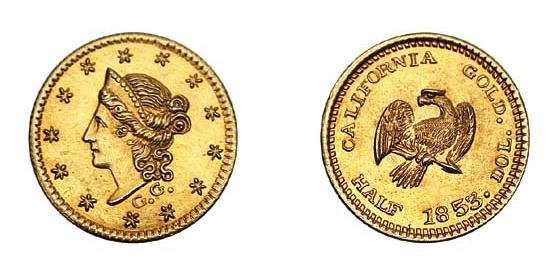
Obverse & Reverse
The 1853 G50C BG-413 is a quintessential artifact from the chaotic, formative years of the California Gold Rush. Following the discovery of gold at Sutter's Mill in 1848, a massive influx of prospectors and merchants descended upon California, creating a vibrant but tumultuous economy. This new society was flush with gold dust and nuggets, but critically deficient in circulating small-denomination coinage. Daily transactions for necessities like food, lodging, and tools were severely hampered. A 'pinch' of gold dust was an inexact and often contentious method of payment. While the U.S. Assay Office and, later, private firms like Moffat & Co. produced larger denomination coins, the need for small change remained acute. Into this numismatic void stepped a number of jewelers and artisans, primarily in San Francisco. Between 1852 and 1857 (a period now designated 'Period One' by numismatists), these private minters began striking their own quarter dollar, half dollar, and dollar coins from native California gold. These were not government-sanctioned coins but were accepted in commerce out of sheer necessity. The BG-413 is a prime example of these emergency issues. Struck in 1853, just as San Francisco was rapidly evolving from a makeshift camp into a bustling city, it was created to facilitate everyday trade. The coins were crudely but effectively produced, often by hand-hammering dies onto gold planchets. Their intrinsic value was often slightly less than their face value, but in the inflated Gold Rush economy, their utility far outweighed any minor deficiency. These 'Period One' fractionals circulated until the San Francisco Mint began full-scale production of federal coinage in 1856-1857, which finally satisfied the regional demand for small change and rendered the private issues obsolete. Most were subsequently melted, contributing to the extreme rarity of surviving examples like the BG-413 today. Its existence is a direct testament to the ingenuity and pragmatism of frontier economics, a tangible link to a time when commerce was conducted on an ad-hoc basis, backed by the raw gold being pulled from the nearby hills.
Associated EventCalifornia Gold Rush
Reason For MintingTo alleviate a severe shortage of small-denomination coinage for daily commercial transactions in Gold Rush-era California.
Minter HistoryThe specific minter or jeweler who produced the dies for BG-413 is unknown. During 'Period One' (1852-1857), many San Francisco jewelers, including French immigrants like Antoine Louis Nouizillet and M. Deriberpe, struck fractional gold pieces. However, most, like the creator of BG-413, did not sign their work, leaving attribution to numismatic analysis of die characteristics and style. The workmanship on the BG-413, particularly its distinctive 'Peacock' eagle reverse, links it stylistically to a small group of other varieties, suggesting they may be the work of a single, yet-to-be-identified artisan.
Historical SignificanceAs a 'Period One' issue, the BG-413 is a genuine circulating coin of the California Gold Rush, not a later souvenir piece. It represents a solution to a critical economic problem and is a direct physical link to the commerce of the '49ers. Its immense rarity underscores the ephemeral nature of these privately-issued coins, most of which were destroyed after federal coinage became plentiful.
K-Unlisted
Denomination50 Cents
Minting Period1853
Assayer/MinterUnknown private minter
Geographic OriginSan Francisco, California
Obverse DescriptionA slightly crude rendering of the Liberty Head, facing left. The portrait is surrounded by thirteen stars of varying quality. The date '1853' is positioned below the truncation of the neck.
Obverse Inscription1853
Reverse DescriptionFeatures a distinct eagle with its head turned to the right and wings spread. The eagle clutches an olive branch and arrows in its talons. This particular die is known for its stylized eagle, which collectors have nicknamed the 'Peacock' or 'Defiant' eagle due to its proud posture and fanned tail feathers, a characteristic shared with varieties BG-410 through BG-412.
Reverse InscriptionCALIFORNIA GOLD HALF DOL.
CompositionGold
Stated Fineness Actual FinenessVariable, typically 0.800 to 0.880, consistent with unrefined native California gold which contained a high percentage of silver.
Weight0.80 grams
Diameter11.50 mm
EdgePlain
Unknown, but extremely small.
Survival Estimate4 to 6 known
Rarity ScaleR-7 (Very Rare)
The BG-413 is highly coveted as a 'Period One' circulating issue of extreme rarity. Its appeal is heightened by the distinctive and artistic 'Peacock' eagle reverse, making it a key variety for specialists. As one of the rarest of all California fractional half dollars, its acquisition is a major event in numismatics.
Key VarietiesThe BG-413 is a unique die marriage. There are no major varieties from the original minting period, and no known restrikes, patterns, or trial pieces. Its primary association is with the other 'Peacock' eagle varieties (BG-410, BG-411, BG-412), which were likely made by the same hand.
Authentication TipsAuthentication requires expert examination. Key diagnostics include the precise shape of the Liberty head, the specific arrangement and shape of the 13 obverse stars, and the unique details of the 'Peacock' eagle on the reverse. The lettering style and placement are also critical. Most counterfeits are cast or are modern brass tokens; genuine examples have a soft, lustrous gold surface consistent with the period's metallurgy. The planchet should be thin and slightly irregular, characteristic of hand production.
Shopping ConsiderationsFor a specimen of this rarity, any example that is not holed or severely damaged is a major prize. A premium quality example would be one that is well-centered and sharply struck for the issue, with minimal marks. Look for evidence of original luster in the protected areas around the devices and lettering. Most known examples are in circulated grades (VF to AU); a Mint State specimen would be a landmark piece. Avoid examples that have been harshly cleaned, which will appear unnaturally bright and exhibit hairline scratches. Tooling or smoothing in the fields to hide marks is also a concern. Given the rarity, any example will command a very strong price, and certification by a top-tier grading service (PCGS or NGC) is essential for market acceptance.
A coin's grade is its condition, rated on a 1-70 scale. For rare coins, this is the most critical factor in determining value, as a tiny difference in preservation can mean a huge difference in price.
Relevant Grade TypesAll original BG-413 examples are business strikes intended for circulation. They are found in Circulated grades (AG-3 to AU-58) and, exceptionally rarely, in Mint State (MS-60 and above). No proofs were struck during the original period of issue, and there are no known later-date Proof restrikes.
Mint State CharacteristicsA true Mint State BG-413 would be a phenomenal rarity. Strike is often incomplete on these handmade pieces, so a well-struck example with full detail on Liberty's hair and the eagle's feathers would be considered superior. Luster would be a soft, satiny type, characteristic of early California gold, often with a slightly reddish or greenish-gold hue due to the natural alloy. Being very small and soft, even uncirculated examples are expected to have some minor contact marks from handling and storage with other coins.
Circulated Wear PatternsWear first appears on the highest points: Liberty's cheek, hair, and the stars on the obverse. On the reverse, the eagle's head, breast, and the high points of the wings will show the first signs of friction. On moderately circulated examples (Fine to Very Fine), much of the fine feather detail will be lost, and the legends will begin to merge with the fields. In lower grades, the date and key design elements will be faint but should still be identifiable.
Key Factors For ValueRarity is the primary driver of value for the BG-413. Beyond that, the key factors are surface preservation and eye appeal. An example with minimal marks, no distracting damage, and traces of original luster will command a significant premium over a cleaned or damaged piece in the same grade. The sharpness of the strike, particularly on the eagle, is a critical determinant of quality. Given the importance of originality, a CAC sticker signifying premium quality for the grade would add a substantial premium for this specific issue.
PCGS Price Guide
| Grade | Price | Population |
|---|---|---|
| 50 | $11,000.00 | N/A |
| 50+ | $11,500.00 | N/A |
| 53 | $12,000.00 | N/A |
| 53+ | $13,000.00 | N/A |
| 55 | $14,000.00 | N/A |
| 55+ | $15,000.00 | N/A |
| 58 | $17,500.00 | 1 |
| 58+ | $20,000.00 | N/A |
| 60 | $25,000.00 | 1 |
| 61 | $32,500.00 | 1 |