1854 G50C BG-306 (Regular Strike)
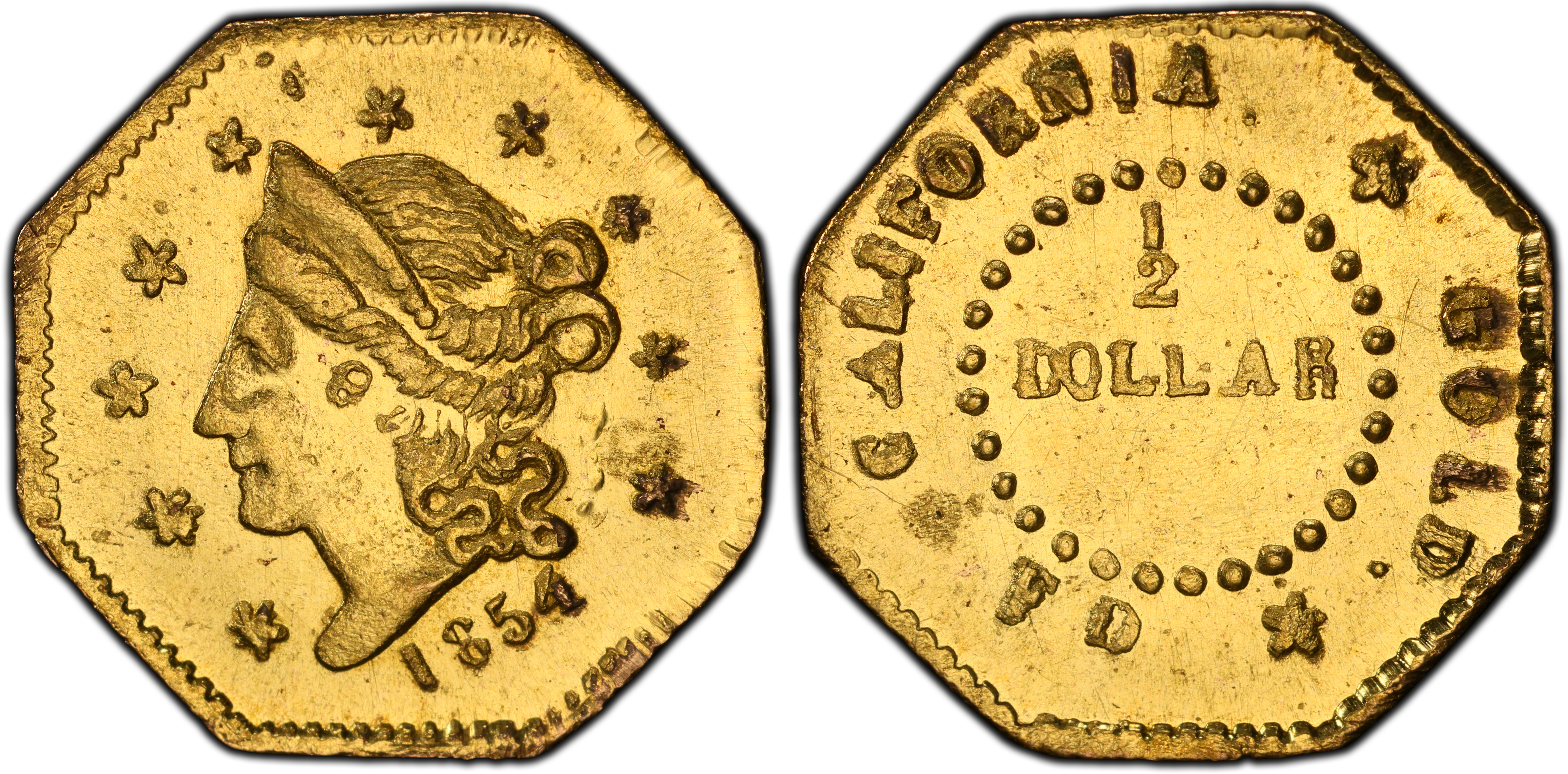
Obverse & Reverse
The 1854 BG-306 Octagonal 50 Cents piece is a tangible relic from the chaotic and economically vibrant era of the California Gold Rush. Following the discovery of gold at Sutter's Mill in 1848, a massive influx of prospectors and merchants descended upon California, creating a burgeoning economy almost overnight. This rapid growth, however, far outpaced the supply of official United States coinage. While private minters quickly began producing large denomination gold coins ($5 to $50) to facilitate major transactions with gold dust, a severe shortage of small-denomination currency paralyzed daily commerce. Simple activities like buying a drink or a meal were complicated by the imprecise and often contentious use of a 'pinch' of gold dust as payment. To fill this critical economic void, several private firms, primarily jewelers and assayers in San Francisco, began striking their own small-denomination gold coins in quarter dollar, half dollar, and dollar values starting in 1852. These are known as 'California Fractional Gold.' The BG-306 is a 'Period One' (1852-1857) issue, a crucial distinction indicating it was produced with the genuine intent of serving as a circulating medium of exchange, unlike later 'Period Two' and 'Period Three' issues which were often made as souvenirs. Struck by the firm of Frontier, Deviercy & Co., San Francisco-based jewelers and watchmakers, the BG-306 and its contemporaries were designed to loosely resemble federal gold coinage to inspire public confidence. Despite being underweight relative to their face value—a common characteristic of Period One fractionals—they were widely accepted in local commerce out of sheer necessity. Their existence was a testament to the ingenuity and quasi-legal entrepreneurship that defined the Gold Rush economy before the San Francisco Mint, which opened in 1854, could produce sufficient federal coinage to stabilize the region's money supply. By 1856-1857, as official U.S. coins became more plentiful, the need for these private issues waned, and most were withdrawn from circulation, lost, or melted, contributing to their modern-day rarity.
Associated EventCalifornia Gold Rush
Reason For MintingTo alleviate a severe shortage of small-denomination coinage for daily commercial transactions in Gold Rush-era California.
Minter HistoryFrontier, Deviercy & Co. was a partnership of San Francisco jewelers and watchmakers active during the early 1850s. Like many jewelers of the period, they possessed the requisite skills in metallurgy and die-cutting to enter the lucrative business of private coinage. The firm was a notable producer of 'Period One' California Fractional Gold, creating dies for various octagonal and round denominations that were intended for actual circulation. Their work is characteristic of the era, mimicking federal designs to gain acceptance but often containing identifying diagnostics and stylistic quirks.
Historical SignificanceThe BG-306 is historically significant as a physical artifact of private enterprise stepping in to fulfill a core government function—the creation of currency—during a period of immense economic expansion and logistical challenges. It represents the resourcefulness of merchants and the unique monetary landscape of the American West before the full integration of federal services. As a 'Period One' issue, it is among the select group of fractional gold pieces believed to have genuinely circulated, making it a direct link to the day-to-day transactions of Gold Rush miners and settlers.
N/A
Denomination50 Cents
Minting Period1854
Assayer/MinterFrontier, Deviercy & Co.
Geographic OriginSan Francisco, California
Obverse DescriptionA small Liberty Head, facing left, her hair tied in a bun. The portrait is surrounded by thirteen six-pointed stars arranged in a circle near the octagonal border.
Obverse Inscription Reverse DescriptionWithin a circle of beads, the denomination '1/2' appears at the top, followed by 'DOLLAR' below it, and the date '1854' at the bottom. The legend 'CALIFORNIA GOLD' encircles the beaded circle along the upper periphery of the octagonal border.
Reverse InscriptionCALIFORNIA GOLD 1/2 DOLLAR 1854
CompositionGold
Stated Fineness Actual FinenessNative California gold, typically around .880 fine due to natural silver alloys.
EdgePlain
Unknown
Survival Estimate76-200 (per Sheldon Rarity Scale for R-4)
Rarity ScaleR-4
This coin is highly sought after for its direct connection to the California Gold Rush and its status as a 'Period One' issue made for circulation. Its octagonal shape is visually distinctive and emblematic of pioneer gold. The specific BG-306 variety is scarce but obtainable, making it a popular goal for serious collectors of the series.
Key VarietiesThe BG-306 is a specific die marriage and does not have major varieties from its original minting period. There are no known official restrikes or patterns associated with this specific variety. Collectors should be aware of other Breen-Gillio varieties of 1854-dated octagonal half dollars, which differ in the style of the Liberty head, star placement, and reverse lettering.
Authentication TipsA key diagnostic for genuine BG-306 examples is a clearly repunched 'R' in 'DOLLAR' on the reverse. The overall strike is often weak in areas due to the crude minting process; a perfectly sharp, modern-looking strike should be viewed with suspicion. Genuine pieces are very thin and made of a slightly debased, often greenish-gold alloy, characteristic of native California gold. Counterfeits are typically too thick, have the wrong 'soapy' luster, and lack the precise die characteristics of the variety. Comparison with high-resolution images of certified examples is essential.
Shopping ConsiderationsA premium quality example for its grade will exhibit minimal contact marks and retain some original mint luster, which often appears as flashy or semi-prooflike fields. Given their use in commerce, many survivors are found in circulated grades. For this issue, look for a bold strike on the date and Liberty's hair details, as these areas can be weak. The planchet quality is also important; seek examples free from distracting planchet flaws, cracks, or edge impairments. A greenish-gold or 'sun-gold' hue, indicative of original surfaces, is highly desirable over coins that have been cleaned or stripped of their natural patina.
A coin's grade is its condition, rated on a 1-70 scale. For rare coins, this is the most critical factor in determining value, as a tiny difference in preservation can mean a huge difference in price.
Relevant Grade TypesOriginal period issues of BG-306 were business strikes intended for circulation and are found in Circulated (1-58) and Mint State (MS, 60-70) grades. No proofs were struck during the original minting period, and there are no known later-date collector restrikes for this specific variety. Any piece described as a 'Proof' would not be a genuine Period One BG-306.
Mint State CharacteristicsUncirculated examples of BG-306 are characterized by flashy, luminous, or semi-prooflike fields. The strike can be inconsistent; a fully struck piece is rare and commands a significant premium, but many Mint State examples will show some weakness in the center of the obverse or on the reverse legends. Due to the softness of the gold and primitive handling, even high-grade MS coins will typically show small, scattered contact marks or hairlines. The luster is key, and it should be vibrant and unbroken across the surfaces.
Circulated Wear PatternsWear first appears on the highest points of the design. On the obverse, look for friction on Liberty's cheek, the hair just above her eye, and the top strands of her bun. On the reverse, the fraction '1/2' and the 'L's' in DOLLAR are high points that will show the first signs of smoothing. In lower grades (VF and below), the stars on the obverse will begin to lose their points and the legends on the reverse will become soft and start to merge with the fields.
Key Factors For ValueFor the BG-306, value is driven primarily by grade and surface quality. An example with original, uncleaned surfaces and attractive 'green-gold' toning will always be worth more than a brighter, cleaned coin of the same grade. Strike quality is a major factor; a sharply struck specimen with full details on Liberty's portrait and the reverse lettering can command a premium of 50% or more over a weakly struck example. Eye appeal is paramount for these tiny coins, so specimens that are well-centered and free of distracting marks or planchet flaws are most desirable. A CAC sticker for this issue is highly valued, confirming both the grade and the quality of the surfaces for the assigned grade.
PCGS Price Guide
| Grade | Price | Population |
|---|---|---|
| 45 | $210.00 | 3 |
| 45+ | $215.00 | N/A |
| 50 | $225.00 | 3 |
| 50+ | $230.00 | N/A |
| 53 | $250.00 | 1 |
| 53+ | $255.00 | N/A |
| 55 | $285.00 | 6 |
| 55+ | $315.00 | N/A |
| 58 | $375.00 | 13 |
| 58+ | $425.00 | N/A |
| 60 | $460.00 | 3 |
| 61 | $500.00 | 10 |
| 62 | $575.00 | 25 |
| 62+ | $650.00 | N/A |
| 63 | $700.00 | 26 |
| 63+ | $775.00 | N/A |
| 64 | $900.00 | 14 |
| 64+ | $1,025.00 | N/A |
| 65 | $1,850.00 | 8 |
| 65+ | $2,500.00 | N/A |
| 66 | $4,750.00 | 1 |