1860 G25C BG-729 (Regular Strike)
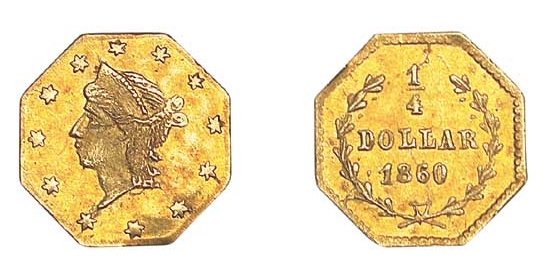
Obverse & Reverse
The 1860 BG-729 25 Cents is a product of the second period of California Fractional Gold production (1859-1882), a fascinating and complex chapter in American numismatics. Following the initial California Gold Rush boom, the state continued to suffer from a chronic shortage of small denomination coinage for daily commerce. While the San Francisco Mint, opened in 1854, addressed the need for larger gold and silver coins, transactions under a dollar remained problematic. Gold dust was impractical and official federal cents were not shipped to the West Coast in quantity. To fill this void, numerous jewelers and assayers in San Francisco began striking their own tiny gold coins in quarter, half-dollar, and dollar denominations. The earliest issues (Period One, 1852-1858) were generally heavier and intended to circulate. The BG-729, however, falls into Period Two, often termed the 'jeweler's issues.' By 1860, the immediate commercial need for these pieces was waning due to an influx of federal silver coins. Production shifted towards creating pieces that appealed to tourists, miners wanting keepsakes, and for use in jewelry. These Period Two coins were typically lighter and of lower intrinsic value than their predecessors, and their designs, while often mimicking federal coinage, showed immense variety. The Coinage Act of 1864 officially prohibited private coinage, but the law was not strictly enforced in California until the early 1880s, allowing these 'Cal Fracs' to be produced for years as tokens or souvenirs. The BG-729, with its classic Liberty Head motif, represents this transitional phase where the line between currency and commemorative blurred. Its existence speaks to a localized economy grappling with unique challenges and the entrepreneurial spirit of the craftsmen who met the perceived demand.
Associated EventCalifornia Gold Rush Aftermath
Reason For MintingTo provide a medium for small-change transactions and serve as a popular souvenir during a period of limited federal coinage on the West Coast.
Minter HistoryThe specific minter for the BG-729 variety is unknown. During this period, numerous San Francisco jewelers, such as Frontier, Deviercy & Co., Robert B. Gray & Co., and Antoine Louis Nouizillet, were active producers. Dies were often sold or traded between firms, and many pieces were left unmarked. Without a specific hallmark, attribution to a particular maker is often impossible, a common characteristic of Period Two fractionals.
Historical SignificanceThis coin is a tangible artifact from a unique period of private minting in U.S. history. It illustrates the economic conditions of post-Gold Rush California and the transition of fractional gold from a necessary circulating medium to a souvenir and jewelry item. As a 'jeweler's issue,' it is representative of the most diverse and popularly collected era of the series.
N/A
Denomination25 Cents
Minting Period1860
Assayer/MinterUnknown Private Minter
Geographic OriginSan Francisco, California
Obverse DescriptionFeatures a small Liberty Head facing left, modeled after the contemporary U.S. gold dollar. The head is surrounded by 13 stars, representing the original colonies. The date, 1860, appears below the bust.
Obverse Inscription1860
Reverse DescriptionA simple wreath of leaves surrounds the denomination. The exact style of the wreath, including the number of leaves and berries, is a key diagnostic for the BG-729 variety, but specific details are not widely published. The denomination is expressed as '25 CENTS' within the wreath, and 'CAL.' appears at the bottom.
Reverse Inscription25 CENTS CAL.
CompositionGold
Stated Fineness Actual FinenessTypically varied from .500 to .900 fine for Period Two issues.
Diameter10.00 mm
EdgePlain
Unknown
Survival EstimateFewer than 75 believed to exist in all grades.
Rarity ScaleR-5 (Very Scarce)
The BG-729 is sought after for its 1860 date, a pivotal year just before the Civil War, and its classic Liberty Head design. As with all Cal Fracs, its tiny size and connection to the Gold Rush mythology make it highly appealing. The octagonal shape adds a layer of collector interest over the more common round issues.
Key VarietiesThe primary variety is the 'Regular Strike' business issue for circulation and sale. No proof strikings from the period of issue are known to exist for this variety. The Breen-Gillio catalog distinguishes hundreds of fractional gold varieties based on minute die differences, such as the position of the date, the number of berries in the wreath, or the presence of die cracks. The BG-729 is one such specific die marriage.
Authentication TipsAuthenticity is a major concern. Genuine pieces often show a softness in strike and planchet quality that modern copies lack. Look for die characteristics consistent with other known examples, though these are not widely published for BG-729. Many counterfeits are brassy, have incorrect weights, or feature mushy, cast-like details. Period Two pieces were struck, not cast. Any evidence of a seam on the edge is a red flag. Certification by a major third-party grading service (PCGS or NGC) is highly recommended.
Shopping ConsiderationsFor this issue, a premium quality example is defined by a sharp strike, particularly on Liberty's coronet, the stars, and the reverse wreath. Many were weakly struck due to the hammer-striking process. Look for clean, original surfaces that have not been harshly cleaned or used in jewelry. Small planchet flaws or adjustment marks are common and not necessarily a major detriment. Avoid examples that have been holed, tooled, or show evidence of being mounted. Eye appeal is paramount; a coin with a pleasing, uniform reddish-gold patina will command a significant premium over a washed-out or spotty specimen.
A coin's grade is its condition, rated on a 1-70 scale. For rare coins, this is the most critical factor in determining value, as a tiny difference in preservation can mean a huge difference in price.
Relevant Grade TypesOriginal issues were business strikes intended for commerce or sale as souvenirs and are found in Circulated (1-58) and Mint State (MS, 60-70) grades. No Proofs (PR/PF) were struck during the original minting period for this variety. Any piece described as a 'Proof' would be a later restrike or fantasy piece and not a genuine 1860 issue.
Mint State CharacteristicsAn uncirculated BG-729 will exhibit frosty, satiny, or sometimes prooflike luster in the fields. The strike is often somewhat soft in the centers, typical for jeweler's issues. The highest points, such as Liberty's hair and the leaves of the wreath, may not be fully detailed even on a choice specimen. Small, scattered contact marks are expected due to the softness of the gold and rudimentary handling at the time of manufacture. A truly premium Mint State piece will combine strong luster with a better-than-average strike and minimal marks.
Circulated Wear PatternsWear first appears on the highest points: the hair above Liberty's eye and ear, her cheek, and the coronet band. On the reverse, the leaves and ribbon bow of the wreath will show flatness first. On moderately worn examples (VF-XF), the individual hair strands will merge and some stars may become indistinct. In lower grades, the legends and date will begin to weaken significantly.
Key Factors For ValueFor the 1860 BG-729, value is driven by three main factors: grade, surface quality, and eye appeal. A high-grade certified example (e.g., MS-62 or higher) is substantially more valuable than a circulated one. Beyond the numerical grade, the quality of the surfaces is critical; original, uncleaned 'skin' with a nice patina is highly prized. Strike sharpness is the next consideration, as well-struck examples are the exception. Finally, a CAC sticker, indicating premium quality for the grade, adds a significant premium for this and other Cal Frac issues.
PCGS Price Guide
| Grade | Price | Population |
|---|---|---|
| 55 | $2,000.00 | 1 |
| 55+ | $2,150.00 | N/A |
| 58 | $2,500.00 | N/A |
| 58+ | $2,750.00 | N/A |
| 60 | $3,000.00 | N/A |
| 61 | $3,250.00 | 1 |
| 62 | $4,250.00 | 3 |