1872 G25C BG-723, Washington (Regular Strike)
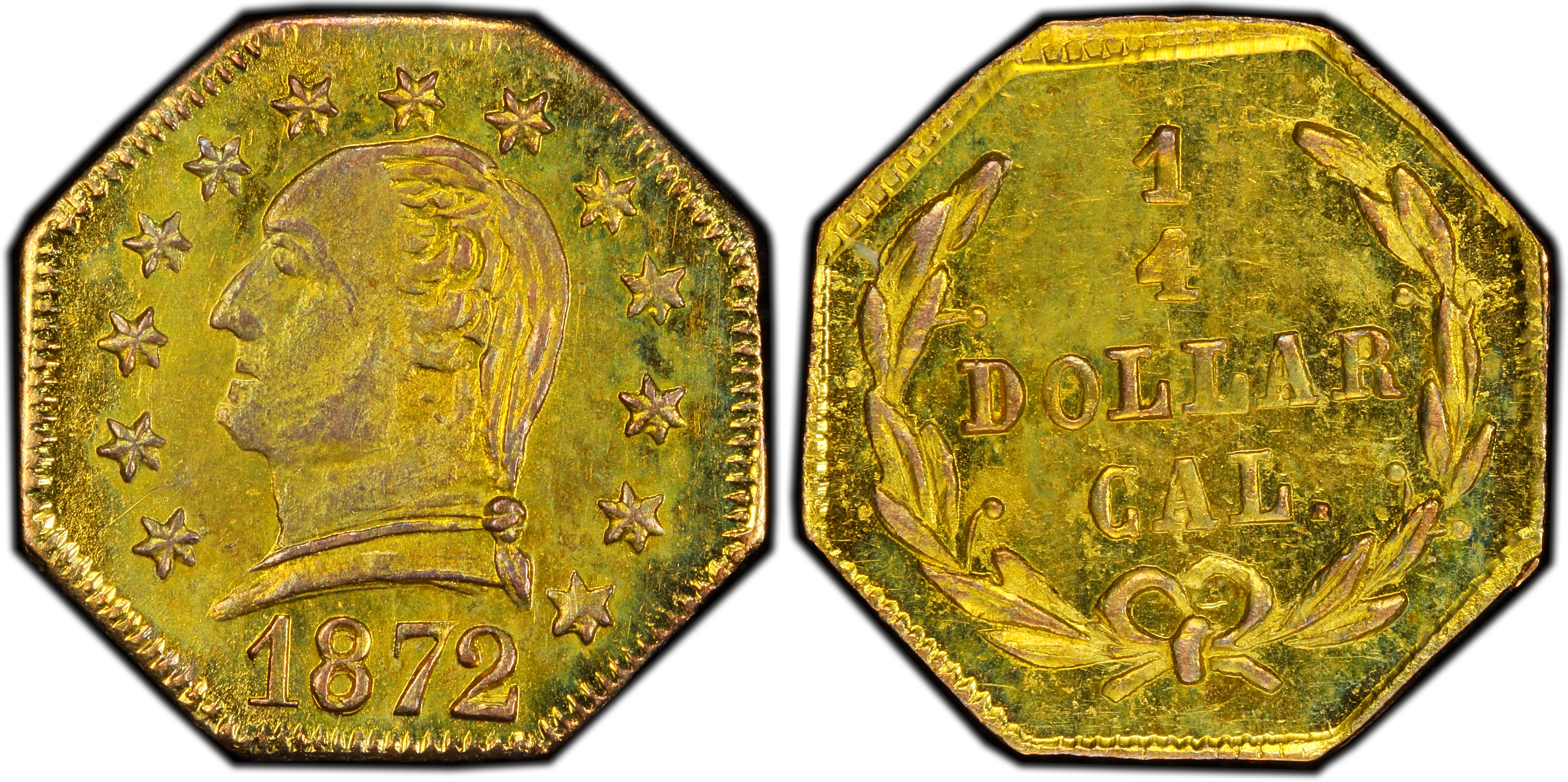
Obverse & Reverse
The 1872 Washington Head 25 Cents, cataloged as BG-723, is a fascinating product of the second period (1859-1882) of California Fractional Gold production. Unlike the earlier 'Period One' issues which were struck out of a genuine commercial need to supplement the lack of small change during the initial Gold Rush boom, the Period Two pieces emerged in a different economic landscape. By the 1870s, the United States Mint in San Francisco was in full operation, and the acute shortage of circulating coinage had largely abated. The continued production of these tiny gold pieces shifted from necessity to novelty. They were primarily created by manufacturing jewelers in San Francisco and sold as souvenirs, keepsakes, and curios for tourists and locals enchanted by the romance of the Gold Rush. These 'jeweler's issues' were often significantly underweight and of a lower fineness than their Period One predecessors, making their face value largely symbolic. The Coinage Act of 1864 had technically outlawed private coinage, but enforcement was lax, allowing this souvenir trade to flourish. The use of George Washington's bust, a revered national symbol, was a popular design choice, lending an air of legitimacy and patriotic appeal to the pieces. The BG-723 variety was struck using the crude 'hammer method,' where dies were struck by hand with a sledgehammer, resulting in inconsistent strike quality. This method, combined with the anonymous nature of their production, means that the specific artisan or firm responsible for BG-723 is lost to history. Production of all such pieces was eventually suppressed by the Secret Service in 1883, bringing an end to this unique chapter in American numismatics. Today, the BG-723 is a prized collectible, not as a coin that fueled a frontier economy, but as a tangible link to the post-Gold Rush culture of California and the entrepreneurial spirit of its craftsmen.
Associated EventPost-California Gold Rush Souvenir Trade
Reason For MintingPrimarily struck for sale as a popular souvenir or keepsake rather than to alleviate a shortage of circulating coinage.
Minter HistoryThe specific minter of BG-723 is unknown, a common trait for Period Two fractional gold. These pieces were typically manufactured by various anonymous San Francisco jewelers who saw a commercial opportunity in creating small gold tokens for the growing tourist and souvenir market. These craftsmen used their metallurgical skills to produce a wide variety of designs, often mimicking federal coinage themes like the Liberty Head or, in this case, the Washington bust, to enhance their appeal.
Historical SignificanceThis coin is significant as an artifact of the evolution of private coinage in California, marking the transition from utilitarian necessity to commercial novelty. It represents a period when the memory of the Gold Rush was commodified and sold to a wider public, and it stands as a testament to a legally gray area of minting that persisted for nearly two decades after the Coinage Act of 1864.
BG-723
Denomination25 Cents
Minting Period1872
Assayer/MinterUnknown Jeweler
Geographic OriginSan Francisco, California
Obverse DescriptionA right-facing bust of George Washington, modeled after the classic design. The portrait is typically centered on the octagonal planchet, surrounded by a simple, unadorned field.
Obverse Inscription Reverse DescriptionThe denomination '1/4' appears in the center, with 'DOLLAR' below it. The date '1872' is positioned beneath the denomination. A decorative wreath or olive branch encircles the central inscriptions along the border.
Reverse Inscription1/4 DOLLAR 1872
CompositionGold
Stated Fineness Actual FinenessVariable, typically between 14 and 22 karats for Period Two issues.
Weight0.38 grams
Diameter9.50 mm
EdgePlain
Unknown
Survival Estimate30-40
Rarity ScaleR-6 (Very Rare: 31 to 75 known)
The BG-723 is highly sought after due to its rare and popular Washington Head design, a departure from the more common Liberty and Indian motifs. Its status as a scarce Period Two issue attracts specialists in the California Fractional Gold series, while the connection to George Washington also gives it crossover appeal for collectors of Washingtonia.
Key VarietiesThe BG-723 itself is a specific die marriage. Within the broader 1872 Washington Head 25C series, other BG numbers exist with slight variations in design, such as BG-818, which features a different portrait style. No original proof strikes or official restrikes of BG-723 are known to exist; all are considered business strikes for the souvenir trade.
Authentication TipsAuthentic examples of BG-723 are characteristically thin and often weakly or unevenly struck due to the hammer-striking process. Look for slight depressions or unstruck areas, which are common and a good sign of authenticity. Counterfeits are often thicker, have a soapy or cast-like appearance, and may exhibit a uniform, unnaturally strong strike. The luster on genuine pieces is often semi-prooflike or satiny, while fakes may be unnaturally bright or have a granular surface. All uncertified examples should be regarded with extreme suspicion and authenticated by a reputable third-party grading service.
Shopping ConsiderationsWhen acquiring an 1872 BG-723, prioritize examples with a sharp, well-defined strike on Washington's portrait and the date, as these areas are often weak. Original, undisturbed surfaces with a pleasing reddish-gold or greenish-gold patina command a significant premium. Avoid coins that have been harshly cleaned, polished, or used as jewelry, as these issues drastically reduce value. Pay close attention to the planchet quality; problem-free examples without significant marks, scratches, or edge bumps are rare and desirable. Given the rarity and value, purchasing a specimen certified by PCGS or NGC is strongly recommended.
A coin's grade is its condition, rated on a 1-70 scale. For rare coins, this is the most critical factor in determining value, as a tiny difference in preservation can mean a huge difference in price.
Relevant Grade TypesAll original 1872 BG-723 pieces are business strikes, created for commercial sale as souvenirs. They are found in Circulated grades (AU-58 and below) and, more commonly, in Mint State (MS, 60-70) grades, as many were preserved as keepsakes. There are no known Proof (PR/PF) examples struck during the original period of issue, nor are there any known later-date restrikes or special collector issues.
Mint State CharacteristicsAn uncirculated BG-723 is defined by its luster and lack of wear. Luster is typically bright and can be satiny or semi-prooflike, especially on the reverse. The strike is a key factor; many are weakly struck on the high points of Washington's hair and the wreath on the reverse. A well-struck example with full detail is a rarity and commands a premium. Due to the crude manufacturing process, it is common to find Mint State examples with minor planchet flaws or strike-throughs; these are generally accepted by collectors as part of the coin's character.
Circulated Wear PatternsOn circulated examples, wear first appears on the highest points of the design. For the obverse, this is the hair above Washington's ear and his cheekbone. On the reverse, the highest points of the wreath and the numerals of the fraction '1/4' will show the first signs of friction and flattening. In lower grades (VF and below), the finer details of the hair and wreath will merge, and the legends will begin to soften.
Key Factors For ValueThe primary drivers of value for an 1872 BG-723 are its certified grade and surface quality. A sharp, well-centered strike is paramount and will always fetch a higher price than a weakly struck counterpart of the same grade. Eye appeal is crucial; coins with original, attractive coloration and vibrant luster are prized over dull or cleaned specimens. Finally, certification by a top-tier service (PCGS or NGC) is nearly essential for market acceptance, with a CAC sticker adding a further premium for examples considered superior for their assigned grade.
PCGS Price Guide
| Grade | Price | Population |
|---|---|---|
| 53 | $1,500.00 | 3 |
| 53+ | $1,550.00 | N/A |
| 55 | $1,750.00 | 3 |
| 55+ | $1,825.00 | N/A |
| 58 | $2,000.00 | 9 |
| 58+ | $2,100.00 | N/A |
| 60 | $2,250.00 | N/A |
| 61 | $2,350.00 | 6 |
| 62 | $2,500.00 | 9 |
| 62+ | $2,750.00 | N/A |
| 63 | $3,250.00 | 6 |
| 63+ | $4,000.00 | N/A |
| 64 | $6,000.00 | 3 |