(1853) G25C BG-206 (Regular Strike)
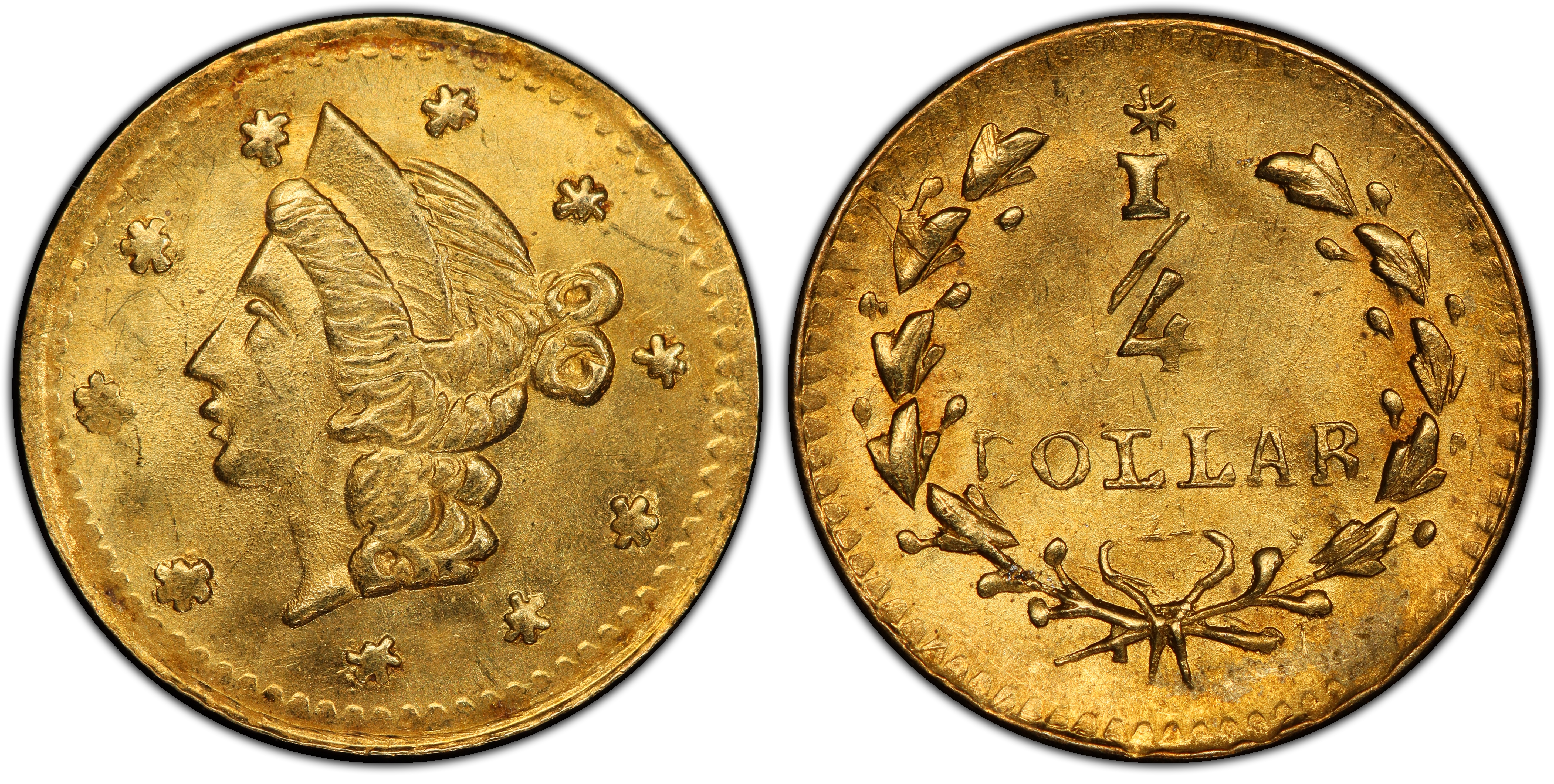
Obverse & Reverse
The BG-206 Quarter Dollar is a quintessential artifact of the California Gold Rush, born from a severe and persistent crisis of small change. Following the discovery of gold at Sutter's Mill in 1848, a massive influx of over 300,000 people descended upon California, creating a vibrant but chaotic economy. While gold dust and nuggets were plentiful, the means to conduct everyday transactions were not. A pinch of gold for a drink or a meal was an inaccurate and untrustworthy system. The United States Mint was slow to respond; its San Francisco branch did not become fully operational until 1856, and initially, it produced no denominations smaller than a ten-dollar eagle. This void in the money supply created a perfect opportunity for private enterprise. A handful of jewelers and metalworkers in San Francisco, many of French origin like Antoine Louis Nouizillet and M. Deriberpe, began striking their own small-denomination gold coins in 1852. These issues, now categorized by numismatists as 'Period One' (1852-1856) California Fractional Gold, were created not as souvenirs, but as a practical solution to a crippling economic problem. They were intended to, and did, circulate. The BG-206, attributed to the year 1853, is a prime example of this necessity-driven coinage. Produced by hand with simple screw presses or even by hammer, these coins were often crudely made but contained gold that was generally close enough to face value to be accepted in local commerce. The native California gold often had a high silver content, giving many of these issues a lighter color than federal gold. As the San Francisco Mint ramped up production of silver and gold coins in the mid-1850s, the need for these fractional pieces waned, and their production ceased by 1857, marking the end of Period One. Today, the BG-206 is highly prized not just for its rarity, but as a direct, tangible link to the frenetic, entrepreneurial spirit of Gold Rush-era San Francisco.
Associated EventCalifornia Gold Rush
Reason For MintingTo alleviate a severe shortage of small-denomination coinage for daily commercial transactions in Gold Rush-era California.
Minter HistoryThe specific minter of the BG-206 variety is unknown, which is common for many Period One California Fractional Gold issues. However, historical records and metallurgical analysis confirm that these pieces were produced by a small group of enterprising jewelers and artisans operating in San Francisco between 1852 and 1856. These private minters were often of French descent and used their existing skills in working with precious metals to fill the critical currency void. While initials or names appear on some varieties, many, like the BG-206, remain anonymous, their legacy embodied solely in the coins they produced.
Historical SignificanceThe BG-206 is a historically significant example of private coinage meeting a public need in the absence of federal infrastructure. As a 'Period One' issue, it represents the most legitimate phase of fractional gold production, when these pieces were essential for commerce rather than mere souvenirs. Its existence demonstrates the resourcefulness of pioneers and businessmen on the American frontier and serves as a key numismatic artifact of the United States' westward expansion.
BG-206
Denomination25 Cents
Minting Period1853
Assayer/MinterUnknown San Francisco Jeweler
Geographic OriginSan Francisco, California
Obverse DescriptionA crudely rendered bust of Liberty facing left, her hair tied in a bun. The portrait is encircled by thirteen five-pointed stars, representing the original colonies. The style mimics the federal gold dollars of the period (1849-1854), though the execution is more primitive.
Obverse Inscription Reverse DescriptionThe denomination '1/4' is centrally located within a wreath composed of two branches tied with a bow at the bottom. The legend 'CALIFORNIA GOLD' encircles the top periphery of the wreath. The design elements are often simple and may show signs of die rust or damage.
Reverse Inscription1/4 CALIFORNIA GOLD
CompositionGold
Stated Fineness Actual FinenessVariable, typically 80-90% gold, with the balance being primarily silver from the native California alloy.
Weight0.40 grams
Diameter10.00 mm
EdgePlain
Unknown
Survival Estimate76-100
Rarity ScaleR-4+
The BG-206 is highly sought after as a genuine 'Period One' issue, meaning it was likely struck for actual circulation during the height of the Gold Rush. Its appeal lies in its direct connection to this pivotal era of American history, its status as a privately minted coin, and its significant rarity. Collectors value the raw, tangible history these tiny gold pieces represent.
Key VarietiesThe primary variety is the BG-206 business strike. No proof or special presentation strikings from the original period of issue are known to exist. All known examples were intended for circulation. There are no major die varieties widely recognized for BG-206, though minor differences resulting from the hand-made nature of the dies and striking process are to be expected. No later restrikes are known.
Authentication TipsAuthentic BG-206 specimens are tiny and often crudely struck. Look for the correct style of Liberty head and wreath, comparing it to high-resolution images of certified examples. The surfaces should have the texture of struck gold, not the porous or smooth look of a cast counterfeit. Genuine pieces must be denominated; fakes and later souvenir tokens often lack a denomination or feature a bear on the reverse, a design not used on 19th-century originals. Weight can be a key indicator, though it varies. Any piece that is magnetic, gold-plated, or significantly overweight should be viewed with extreme suspicion. Given the prevalence of high-quality fakes, professional authentication by a major third-party grading service (PCGS or NGC) is strongly recommended.
Shopping ConsiderationsWhen acquiring a BG-206, a potential buyer should prioritize surface preservation and strike quality. A premium quality example for its grade will exhibit minimal distracting marks and retain some of its original, often satiny, luster. The strike is often uneven on these hand-produced coins, but pieces with a bold strike on the central Liberty portrait and the 'CALIFORNIA GOLD' legend command a premium. Weakness is common, particularly on the stars or the wreath details. Avoid examples that have been harshly cleaned, polished, or show evidence of being mounted in jewelry, as this significantly impairs their value. Look for attractive, original 'old gold' toning, which can range from bright yellow to a deeper reddish-orange hue. Due to their small size, encapsulation by a grading service is essential for protection and confirmation of authenticity and grade.
A coin's grade is its condition, rated on a 1-70 scale. For rare coins, this is the most critical factor in determining value, as a tiny difference in preservation can mean a huge difference in price.
Relevant Grade TypesAll original BG-206 examples are considered business strikes, as they were intended for commerce. They are found in Circulated grades (AG-3 to AU-58) and, more rarely, in Mint State grades (MS-60 to MS-70). No Proof (PR/PF) examples were struck during the original minting period, and there are no known later-date Proof restrikes or special collector issues for this specific variety.
Mint State CharacteristicsAn uncirculated BG-206 will display full original mint luster, which is typically soft and satiny rather than deeply prooflike. Due to the primitive, manual striking process, even high-grade Mint State examples can show some weakness in the strike, particularly on the highest points of Liberty's hair and the finer details of the wreath. Small planchet flaws, die cracks, or minute striations are common and considered characteristic of the issue, not necessarily impairments. Contact marks, while factored into the grade, are often minimal due to the coins' small size and limited time in circulation before being saved.
Circulated Wear PatternsWear first appears on the highest points of the design. On the obverse, this includes Liberty's cheek, the hair just above her ear, and her eyebrow. On the reverse, the high points of the wreath's leaves and the bow are the first areas to show friction. On more heavily circulated examples, the stars and the letters in 'CALIFORNIA GOLD' will become weak and eventually begin to merge with the fields.
Key Factors For ValueFor the BG-206, value is driven by a combination of grade and eye appeal. A sharply struck coin with minimal weakness will always be prized over a softly struck example of the same grade. Surface quality is paramount; coins with clean, original, un-scrubbed surfaces are worth significant premiums over those that have been cleaned or polished. Eye appeal, which includes attractive toning and a well-centered strike, also plays a major role. A sticker from CAC (Certified Acceptance Corporation) indicating premium quality for the grade will add a substantial premium for this issue.
PCGS Price Guide
| Grade | Price | Population |
|---|---|---|
| 45 | N/A | 1 |
| 50 | $250.00 | 1 |
| 50+ | $260.00 | N/A |
| 53 | $270.00 | N/A |
| 53+ | $285.00 | N/A |
| 55 | $300.00 | 1 |
| 55+ | $350.00 | N/A |
| 58 | $450.00 | 13 |
| 58+ | $475.00 | N/A |
| 60 | $525.00 | 2 |
| 61 | $550.00 | 6 |
| 62 | $575.00 | 11 |
| 62+ | $625.00 | N/A |
| 63 | $825.00 | 18 |
| 63+ | $1,000.00 | N/A |
| 64 | $1,575.00 | 11 |
| 64+ | $2,000.00 | N/A |
| 65 | $3,000.00 | 1 |