1871 25C BG-718A (Regular Strike)
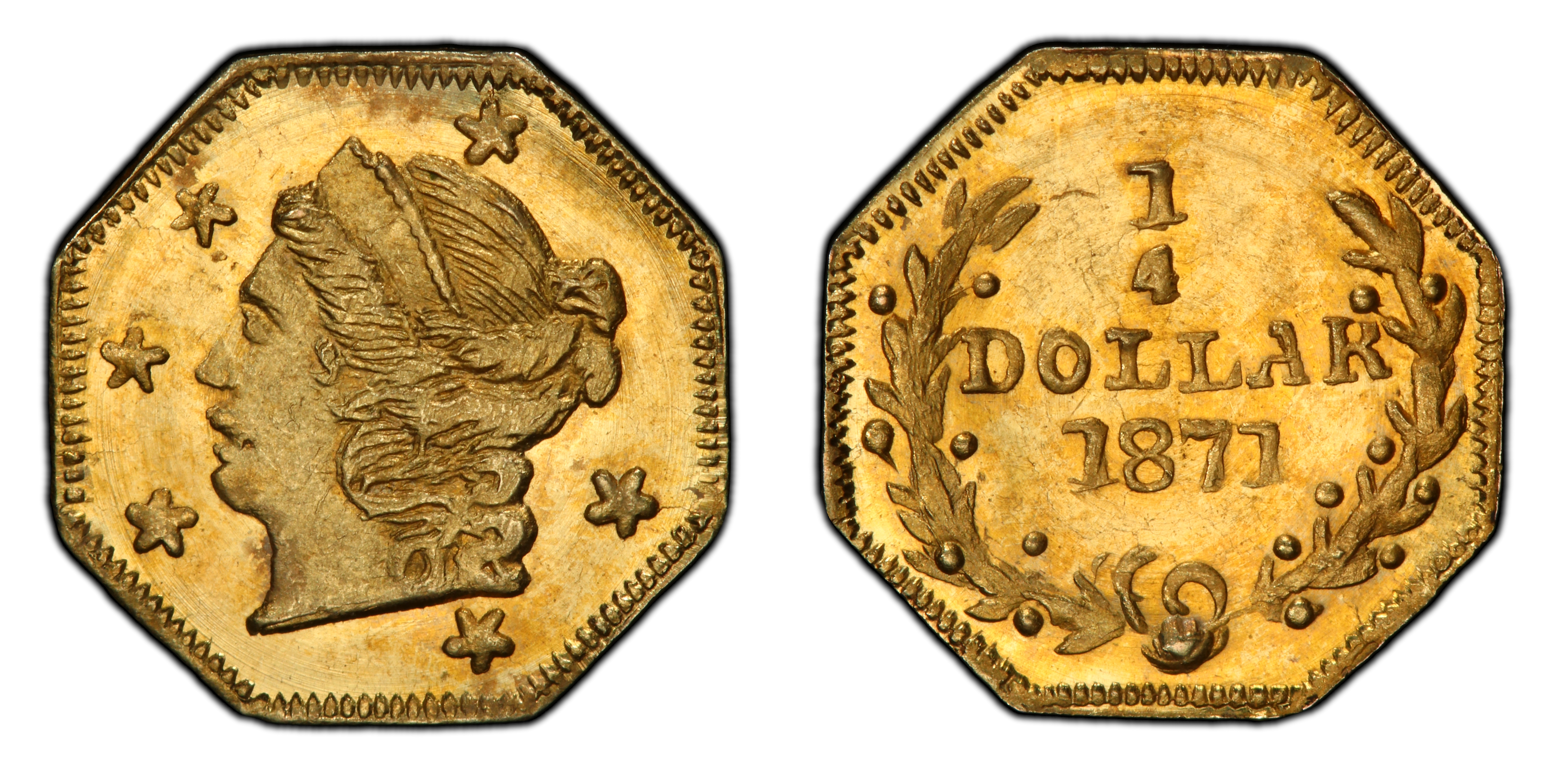
Obverse & Reverse
The 1871 BG-718A 25-cent piece emerges from the second great period of California fractional gold production (1859-1882), a fascinating era when the purpose of these miniature gold issues had shifted dramatically. The initial wave of fractional gold (1852-1857) was a direct response to a severe shortage of small denomination coinage that hampered daily commerce during the Gold Rush. By the 1870s, however, the establishment and output of the San Francisco Mint had largely resolved this issue. The continued production of fractional gold was driven by a different demand: the burgeoning market for souvenirs, jewelry, and curiosities. These later pieces, often termed 'jeweler's issues,' were privately struck, primarily by San Francisco jewelers who recognized the appeal of miniature gold coins to tourists and the general public. The Coinage Act of 1864 had officially outlawed private coinage, but enforcement was lax, allowing this industry to flourish for nearly two more decades. The BG-718A is a quintessential example of this later period. It was not intended to be a workhorse of circulation but rather a memento of California's gold heritage. Its production was not a large-scale minting operation but likely a small, hand-operated affair within a jeweler's shop. The extreme rarity of the variety today, with only a handful of examples known, suggests an exceptionally small original mintage, perhaps struck to test a new die combination or to fulfill a very limited order. These pieces were often underweight and made from native gold of varying purity, as their value was in their novelty rather than their bullion content. The Secret Service eventually cracked down on these private issues in the early 1880s, viewing them as a potential avenue for fraud, which brought the era of California fractional gold to a definitive close. The BG-718A survives as a rare artifact from this final, commercially-driven chapter of private gold minting in the American West.
Associated EventPost-Gold Rush Economic Period
Reason For MintingPrimarily struck for use as souvenirs and jewelry rather than to alleviate a coin shortage, which had been addressed by the San Francisco Mint by this time.
Minter HistoryThe specific minter of BG-718A is unknown, which is characteristic of many 'Period Two' California Fractional Gold pieces. They were generally produced by various San Francisco jewelers who capitalized on the demand for gold souvenirs. Unlike the earlier period issuers who sometimes initialed their work, these later producers often remained anonymous. Their operations were small, using hand-striking methods to produce small batches of these novelties.
Historical SignificanceThis coin is a relic of the 'jeweler's issue' period of California fractional gold, representing the transition of private gold from a circulating medium of necessity to a commercial souvenir. Its immense rarity underscores the small-scale, ephemeral nature of its production and its status as one of the most challenging varieties for the advanced specialist to acquire.
BG-718A
Denomination25C
Minting Period1871
Assayer/MinterUnknown Private Minter
Geographic OriginSan Francisco, California
Obverse DescriptionA Liberty Head facing left, similar in style to contemporary federal gold coinage but cruder in execution. The portrait is surrounded by six stars. Diagnostic for this variety, the first star appears below Liberty's chin and the second star is positioned to the left of her nose.
Obverse Inscription Reverse DescriptionThe denomination '1/4 DOLLAR' and date '1871' are enclosed within a wreath. The wreath is described as a 'double-bowed' type, with 7 berries on the left branch and 8 berries on the right. Specific die characteristics include a recut first '1' in the date and a recut '1' in the fraction. The letters 'AR' in DOLLAR are noted as being incomplete, and the top of the 'D' touches a leaf of the wreath.
Reverse Inscription1/4 DOLLAR 1871
CompositionGold
Stated Fineness Actual FinenessVaries, typical for jeweler's issues, often between .500 and .850 fine.
EdgePlain
Extremely low; likely less than 10.
Survival Estimate3-4 known.
Rarity ScaleR-8 (Unique or 2-3 known).
The BG-718A is a trophy coin for the most advanced collectors of California Fractional Gold. Its appeal lies in its extreme rarity, its distinct die characteristics, and its status as a quintessential 'Period Two' jeweler's issue. Acquiring an example is a significant numismatic achievement.
Key VarietiesThe primary variety is the BG-718A itself. At least two die states of the reverse are known among the few survivors: one with a perfect reverse die and another exhibiting a heavy die crack outside the left branch of the wreath at approximately the 9 o'clock position. No later-date restrikes or special collector issues are known.
Authentication TipsAuthentic examples must have the denomination clearly stated on the reverse (e.g., '1/4 DOLLAR'). Replicas from the 20th century often lack a denomination or feature a bear on the reverse, a design never used on genuine 19th-century issues. The strike on genuine pieces can be uneven, with weakly struck areas, a characteristic often absent on modern fakes. The precise die markers, such as the recut numerals and incomplete letters on the reverse, are critical for authentication and should be compared against high-quality images of known genuine specimens.
Shopping ConsiderationsFor a coin of this rarity, any opportunity to purchase is significant. A 'premium quality' example would be one that is well-centered and sharply struck for the issue, particularly on the date and denomination. Look for brilliant, original luster, often described as 'green-gold' with reflective or prooflike fields. Avoid specimens that have been harshly cleaned, polished, or mounted for jewelry, as originality is paramount. Given the tiny population, any example, even one with minor imperfections, is highly desirable. Due to its high value and rarity, purchase should only be considered if the coin is certified by a top-tier grading service like PCGS or NGC.
A coin's grade is its condition, rated on a 1-70 scale. For rare coins, this is the most critical factor in determining value, as a tiny difference in preservation can mean a huge difference in price.
Relevant Grade TypesAll known examples are business strikes, intended for sale as novelties rather than for circulation. They are found exclusively in Mint State (MS, 60-70) grades, as they did not circulate. No proofs were struck during the original period of issue, and no later-date Proof restrikes are known to exist for this variety.
Mint State CharacteristicsThe few known examples are of exceptional quality, with grades ranging from MS62 to MS64+. An ideal Mint State specimen exhibits brilliant, slightly greenish-gold luster. The fields can be reflective or prooflike, creating a light cameo contrast with the frosted devices. The strike can be sharp, but weakness in some areas is not uncommon for hand-struck issues of this type. As with most soft gold coins, small handling marks may be present, but significant or distracting abrasions would be a major detriment.
Circulated Wear PatternsAs these pieces did not circulate, wear is not a factor. Any loss of detail would be due to a weak strike rather than friction. If an example were to show wear, it would first appear on the highest points of Liberty's hair, cheek, and the leaves and bow of the wreath.
Key Factors For ValueWith a population of only 3-4 coins, rarity is the primary value driver. Beyond that, grade is the key differentiator. A coin with superior surface preservation—free of distracting marks, cleaning, or damage—and sharp strike details will command a significant premium. Eye appeal is crucial; an example with vibrant, original luster and reflective fields will be valued far more than a dull or lifeless specimen. A CAC sticker would provide further assurance of quality and would likely add a substantial premium.
PCGS Price Guide
| Grade | Price | Population |
|---|---|---|
| 62 | $8,500.00 | 2 |
| 62+ | $8,750.00 | N/A |
| 63 | $9,000.00 | N/A |
| 63+ | $9,500.00 | N/A |
| 64 | $10,000.00 | 2 |
| 64+ | $10,250.00 | N/A |
| 65 | $10,500.00 | N/A |
| 65+ | $10,750.00 | N/A |
| 66 | $11,000.00 | 1 |