1854 G$1 BG-528 (Regular Strike)
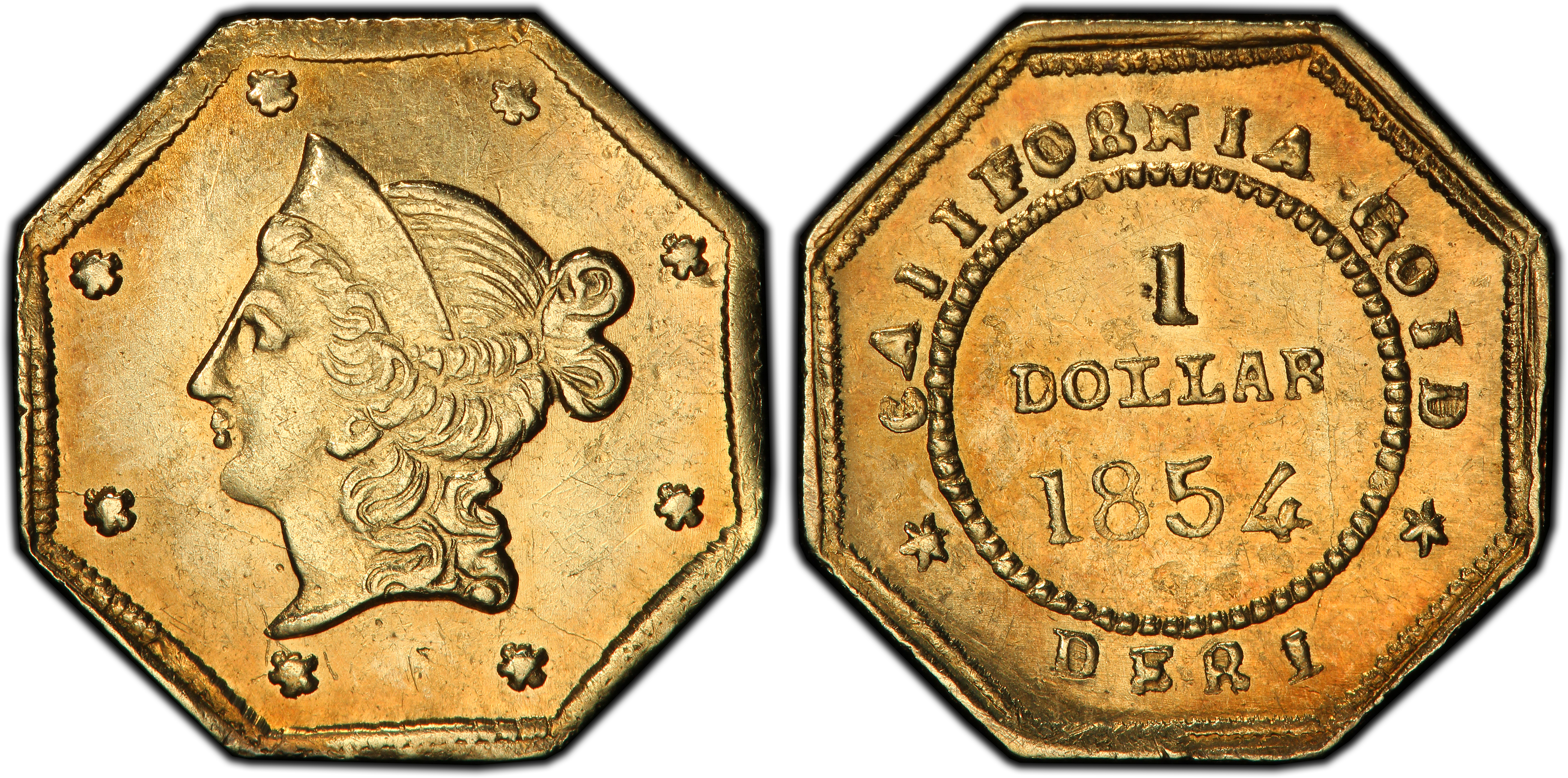
Obverse & Reverse
The 1854 Octagonal Gold Dollar, cataloged as Breen-Gillio 528, is a quintessential artifact from the chaotic and economically vibrant zenith of the California Gold Rush. By 1854, San Francisco was transforming from a frenetic boomtown into a burgeoning metropolis, yet its monetary system remained critically underdeveloped. The sheer volume of raw gold dust and large-denomination ingots pouring from the mines created an ironic and crippling shortage of small-denomination coinage for daily commerce. A shave, a meal, or a drink could not be easily purchased with a pinch of gold dust, a notoriously inaccurate and fraud-prone method of exchange. The newly opened San Francisco Mint, which began operations in April 1854, initially focused on producing larger gold coins and struck a mere 14,632 federal gold dollars that year, a quantity woefully insufficient to quench the region's thirst for circulating small change. Into this monetary vacuum stepped numerous private jewelers and metalworkers, many of French origin, who saw a lucrative opportunity. Among the most prolific was M. Deriberpie, who operated a jewelry business in San Francisco. Capitalizing on the demand, he produced a series of octagonal gold dollars, including the BG-528, which were intended to directly facilitate trade. These 'Period One' fractionals were not government-sanctioned but were tolerated out of sheer necessity. They were crudely but effectively manufactured, likely by the hammer-striking method, where dies were struck by hand onto gold planchets. This process resulted in inconsistent strike quality, with peripheral details often weak. The gold content of these pieces was also notoriously inconsistent and almost always below their stated face value, a fact that eventually led to public distrust and their disappearance from circulation once federal coinage became plentiful. Recent numismatic research based on die states has revealed that Deriberpie's 1854-dated dollars were struck in a sequence different from their catalog numbers, with variety BG-529 being struck before BG-527 and BG-528. This suggests a rapid production pace, with dies failing and being replaced as needed. The BG-528 represents one of the final octagonal dollar varieties from this maker, a testament to a brief but vital chapter of private enterprise solving a public need before the federal government could fully assert its monetary authority on the West Coast.
Associated EventCalifornia Gold Rush
Reason For MintingTo alleviate a severe shortage of small-denomination coinage for daily commercial transactions in Gold Rush-era San Francisco.
Minter HistoryM. Deriberpie was a San Francisco-based jeweler active during the 1850s. Like many of his contemporaries, such as Antoine Nouizillet and the firm of Frontier, Deviercy & Co., he was likely of French origin. These jewelers possessed the requisite skills in metallurgy and die-cutting to manufacture small coins. They produced a significant variety of fractional gold pieces in quarter, half, and dollar denominations. The underweight nature of their products was a common and profitable practice. Deriberpie's operations, along with those of other 'Period One' minters, effectively ceased by 1856-1857 as the San Francisco Mint ramped up production of federal coins, rendering the private issues obsolete and increasingly distrusted by the public.
Historical SignificanceThe BG-528 is historically significant as a tangible example of private coinage meeting a crucial economic need on the American frontier. It represents a period of monetary improvisation before the federal government's infrastructure could catch up to the explosive westward expansion. Its existence and circulation, however brief, underscore the immense economic pressures and unique challenges of the California Gold Rush, making it a prized artifact of American economic and numismatic history.
BG-528
DenominationG$1
Minting Period1854
Assayer/MinterM. Deriberpie
Geographic OriginSan Francisco, California
Obverse DescriptionA fairly crude rendering of a Liberty Head, facing left, with hair tied in a bun. The portrait is encircled by thirteen five-pointed stars, often weakly struck or indistinct, particularly around the periphery. The overall design is a simplified imitation of the federal gold dollars of the period.
Obverse InscriptionLIBERTY (on coronet, often illegible)
Reverse DescriptionA simple wreath surrounds the denomination '1' and 'DOLLAR'. The date '1854' is positioned below the wreath. The inscription 'CALIFORNIA GOLD' encircles the wreath at the periphery. A key diagnostic for this variety is a single star positioned after the word GOLD at approximately the 4 o'clock position.
Reverse InscriptionCALIFORNIA GOLD ★ / 1 / DOLLAR / 1854
CompositionGold
Stated Fineness Actual FinenessVariable, typically ranging from .750 to .850, and generally underweight for the denomination.
EdgePlain
Unknown
Survival Estimate13-30 known examples
Rarity ScaleR-6
The BG-528 is highly sought after for its extreme rarity, its connection to the historic California Gold Rush, and its status as a 'Period One' fractional intended for actual circulation. Its octagonal shape and crude, charismatic style appeal to collectors of territorial gold and early American coinage.
Key VarietiesThere are no known major varieties or officially produced restrikes of the BG-528 from the original period. All known examples are considered business strikes. The primary 'variety' distinction is in the die state, with some examples showing minor die cracks. It is crucial to distinguish this authentic, denominated territorial coin from the plethora of later, non-denominated souvenir tokens and modern replicas, many of which are brass or gold-plated and often feature a bear on the reverse—a design element never used on genuine Period One fractionals.
Authentication TipsAuthentication requires careful examination. Genuine BG-528s will always have the denomination spelled out as 'DOLLAR'. Look for a plain edge. The fabric of the coin should be consistent with a hammer-struck piece, often showing a slightly uneven surface and soft details, especially at the borders. The single star after 'GOLD' on the reverse is a key diagnostic. Be wary of pieces with sharp, uniform details, a modern 'perfect' look, or a suspicious surface color. The presence of a bear on the reverse is a definitive sign of a replica. Due to its high rarity and value, third-party certification from PCGS or NGC is highly recommended.
Shopping ConsiderationsWhen acquiring a BG-528, prioritize originality of the surfaces. A premium quality example for its grade will possess attractive, undisturbed original skin, which may range from yellow-gold to a deeper reddish-gold or greenish-gold toning. Given the typical weak strikes, any example showing unusual sharpness on the central Liberty head and the reverse wreath is highly desirable. Carefully inspect for signs of tooling, harsh cleaning (which will appear as fine, parallel hairlines), or repairs, as these issues dramatically reduce value. Most known examples are in circulated grades (VF to AU), so a problem-free, original coin in this range is a significant prize. Mint state examples are exceedingly rare and command huge premiums.
A coin's grade is its condition, rated on a 1-70 scale. For rare coins, this is the most critical factor in determining value, as a tiny difference in preservation can mean a huge difference in price.
Relevant Grade TypesAll original BG-528 examples are business strikes, created for circulation. They are found in Circulated grades (AG-3 to AU-58) and, very rarely, in Mint State (MS-60 and above). No proofs were struck during the original minting period, and there are no known officially sanctioned later-date proof restrikes for this specific variety.
Mint State CharacteristicsA true Mint State BG-528 is a major rarity. Its quality is defined by the extent of original mint luster, which is typically soft and satiny rather than deeply prooflike. Even uncirculated examples will likely exhibit strike weakness, particularly on the stars, the word 'LIBERTY' on the coronet, and the peripheral lettering. Contact marks, even small ones, are common due to the softness of the gold and primitive handling methods. The key is to find an example with minimal marks and vibrant, unbroken luster.
Circulated Wear PatternsWear first appears on the highest points of the design. On the obverse, check for flatness on Liberty's cheek, hair above the eye, and the coronet. On the reverse, the high points of the wreath's leaves and the numeral '1' will show wear first. In lower grades (VG and below), the peripheral lettering and stars will become faint and merge with the fields, and the date can become difficult to read.
Key Factors For ValueFor the BG-528, rarity is paramount, but within a given grade, value is driven by three key factors. First, surface quality: an example with original, uncleaned surfaces is worth multiples of a cleaned or damaged coin. Second, strike: a coin with a sharper-than-average strike on the central devices commands a significant premium. Third, eye appeal: attractive, even toning and a lack of distracting marks make a coin more desirable. A CAC sticker on a certified coin provides third-party verification of quality for the grade and will add a substantial premium for this issue.
PCGS Price Guide
| Grade | Price | Population |
|---|---|---|
| 40 | $1,000.00 | 1 |
| 45 | $1,200.00 | N/A |
| 45+ | $1,250.00 | N/A |
| 50 | $1,500.00 | N/A |
| 50+ | $1,625.00 | N/A |
| 53 | $1,750.00 | 4 |
| 53+ | $1,900.00 | N/A |
| 55 | $2,350.00 | 5 |
| 55+ | $2,650.00 | N/A |
| 58 | $3,250.00 | 6 |
| 58+ | $3,500.00 | N/A |
| 60 | $4,000.00 | 1 |
| 61 | $4,500.00 | N/A |
| 62 | $5,750.00 | 2 |
| 62+ | $6,500.00 | N/A |
| 63 | $7,500.00 | 1 |