1856 G50C BG-307 (Regular Strike)
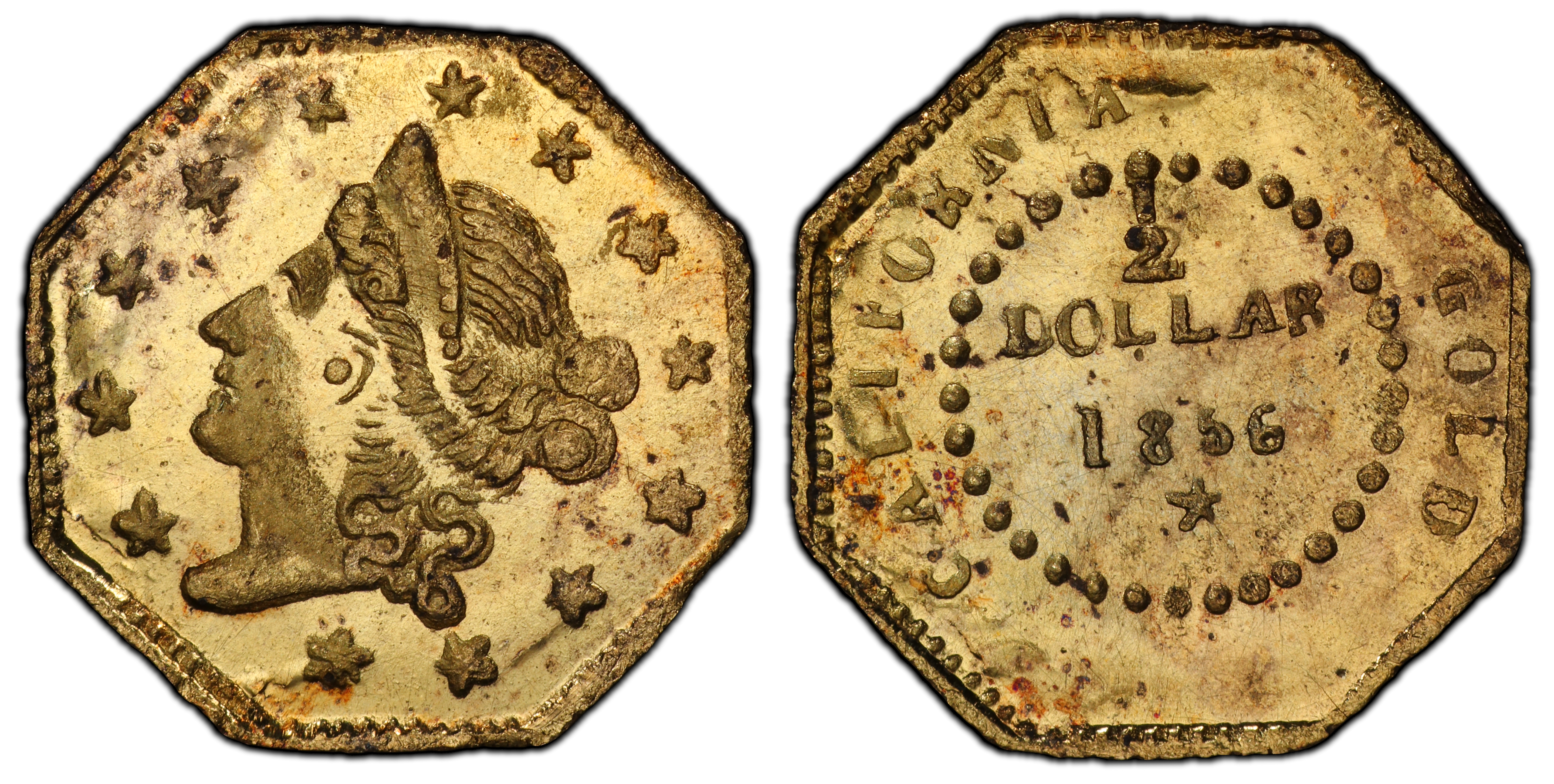
Obverse & Reverse
The 1856 BG-307 50 Cents piece is a tangible artifact from the zenith of the California Gold Rush, a period of chaotic, explosive growth and profound economic necessity. Following the discovery of gold at Sutter's Mill in 1848, a massive influx of prospectors and merchants flooded California, creating a vibrant but fundamentally flawed economy. While gold dust and large private assayer ingots served for major transactions, the region suffered from a crippling shortage of small denomination coinage for daily commerce. The U.S. Mint in Philadelphia was a treacherous continent away, and the newly established San Francisco Mint, which opened in 1854, initially failed to produce sufficient small change to meet the voracious demand. Into this monetary vacuum stepped numerous jewelers and metalworkers, many of French origin, who began privately striking fractional gold coins in quarter, half, and one-dollar denominations starting in 1852. These 'Period One' issues, including the BG-307, were not souvenirs but were intended to and did function as a circulating medium of exchange. The firm of Frontier, Deviercy & Co. was one such enterprise, operating in the heart of San Francisco's commercial district. They employed the common techniques of the day, likely using hand-cut dies and a screw press or even a hammer-striking method to produce their diminutive coins. These pieces were often inconsistent in weight and fineness but were accepted in trade out of sheer necessity. By 1856, the year of this coin's issue, the San Francisco Mint's output of federal silver and gold coinage was beginning to improve, which spelled the end for the legitimate circulation of private fractionals. This coin represents the final chapter of this fascinating and necessary series of private coinage before later issues became primarily souvenirs. Its existence, and its confirmed circulation as evidenced by worn examples and recovery from shipwrecks like the S.S. Central America, is a testament to the ingenuity and frontier capitalism that defined Gold Rush California.
Associated EventCalifornia Gold Rush
Reason For MintingTo alleviate a severe shortage of small-denomination coinage for everyday commercial transactions in Gold Rush-era California.
Minter HistoryFrontier, Deviercy & Co. was a partnership of San Francisco jewelers, Pierre Frontier and Eugene Deviercy, active during the 1850s. Like many of their contemporaries, they were skilled craftsmen who identified and filled a critical economic niche by producing private fractional gold coinage. Their firm was associated with other notable French jewelers of the period, including Alexandre Dubois. After the era of circulating fractional gold ended around 1856, the principals continued in the jewelry trade, and evidence from common die punches suggests they may have been involved in striking souvenir pieces (Period Two issues) as late as the 1870s under various business names.
Historical SignificanceThe BG-307 is historically significant as it represents a 'Period One' California Fractional Gold piece, struck with the intent to circulate as money. It is a direct product of the economic chaos and innovation of the Gold Rush, demonstrating how the private sector stepped in to provide a crucial medium of exchange where the federal government could not. Its distinctive design and rarity make it a key variety for understanding the final year of legitimate private fractional gold coinage in the West.
N/A
Denomination50 Cents
Minting Period1856
Assayer/MinterFrontier, Deviercy & Co.
Geographic OriginSan Francisco, California
Obverse DescriptionThe obverse features a small, classic Liberty Head facing left, her hair tied in a bun with a coronet inscribed LIBERTY (often weakly struck and illegible). The portrait is surrounded by thirteen six-pointed stars, typically unevenly spaced. The date, 1856, appears below the bust.
Obverse Inscription1856
Reverse DescriptionThe reverse is unique among 1856-dated octagonal half dollars. Instead of the typical wreath, the denomination '1/2' is enclosed within a circle of 21 beads. The legend 'CALIFORNIA GOLD' encircles the beaded circle along the periphery of the octagonal planchet. A small dot or star is sometimes noted below the fraction bar.
Reverse InscriptionCALIFORNIA GOLD 1/2
CompositionGold
Stated Fineness Actual FinenessPeriod One issues are generally of higher fineness than later periods, typically struck from native California gold which had a high silver content, but a specific assay for this variety is not widely published.
EdgePlain
Unknown, but presumed to be very small.
Survival EstimateFewer than 30 known
Rarity ScaleR-5+ (31-75 known, though some sources cite High R-5, suggesting 13-30 known)
The BG-307 is highly sought after by specialists in pioneer gold for its rarity, its one-year type design featuring the unique beaded circle reverse, and its direct connection to the final year of circulating fractional gold. It represents a fascinating intersection of numismatics, economics, and American frontier history.
Key VarietiesThe primary variety is the regular business strike of 1856. No major die varieties from the original minting period are widely recognized or collected, though minor differences in die state may exist. There are no known official restrikes, patterns, or trial pieces. Collectors should be aware of the vast number of contemporary counterfeits and modern replicas that imitate California fractional gold, but these are not considered varieties of the original BG-307.
Authentication TipsAuthentic BG-307 pieces will be denominated '1/2' and 'CALIFORNIA GOLD'. Modern replicas often misspell words, use a bear motif (which is not found on genuine Period One fractionals), or lack a denomination. The strike is a key diagnostic; genuine examples are frequently weakly or unevenly struck, particularly on the word LIBERTY and the peripheral legends, due to being made by hand with a hammer or a crude press. Many modern fakes, by contrast, have an unusually sharp, uniform, and 'too perfect' strike. The fabric of the gold should appear correct for the period, not brassy or plated. Referencing high-quality images from major grading services is essential to match die characteristics.
Shopping ConsiderationsWhen acquiring a BG-307, the sharpness of the strike is paramount, as many examples are notoriously weak. A premium-quality coin for its grade will show as much detail as possible on Liberty's hair and coronet, and the beaded circle on the reverse. Original, uncleaned surfaces with some remaining luster command significant premiums. These tiny coins are susceptible to damage, so inspect carefully for evidence of cleaning, scratches, planchet flaws, or signs of having been mounted in jewelry. Because of their handmade nature, perfect centering is rare; well-centered examples are more desirable. Third-party certification from PCGS or NGC is highly recommended for this series due to the prevalence of counterfeits.
A coin's grade is its condition, rated on a 1-70 scale. For rare coins, this is the most critical factor in determining value, as a tiny difference in preservation can mean a huge difference in price.
Relevant Grade TypesOriginal period issues were business strikes intended for circulation. They are found in Circulated grades (AG-3 to AU-58) and, very rarely, in Mint State (MS, 60-70). No proofs were struck during the original period of issue. While some examples are found with prooflike (PL) surfaces due to the polishing of the dies, these are still considered business strikes and are not true Proof coins. No later-date Proof restrikes are known to exist.
Mint State CharacteristicsAn uncirculated BG-307 is exceptionally rare. Quality is defined by the strength of the strike, the quality of the luster, and the absence of marks. The strike is often weak, especially on the high points of Liberty's portrait and the peripheral legends. Luster is typically satiny and slightly reflective. Due to the softness of the gold and rudimentary handling, even Mint State examples will often exhibit scattered microscopic marks. A superior example would be well-centered with an unusually bold strike for the issue.
Circulated Wear PatternsWear first appears on the highest points of the design: Liberty's cheek, the hair above the eye and ear, and the coronet. On the reverse, the beads in the circle and the fraction '1/2' will show the first signs of flattening. On lower grade examples (VG and below), the date and the letters in 'CALIFORNIA GOLD' will become faint and merge with the fields.
Key Factors For ValueFor the BG-307, value is primarily driven by rarity and grade. However, within a given grade, eye appeal is a critical modifier. A coin with original, unmolested surfaces and a strong strike for the variety will always sell for a significant premium over a weakly struck, cleaned, or scratched example in the same grade holder. Coins with attractive, reddish-gold toning that is indicative of original surfaces are highly prized. A CAC sticker for this issue is highly significant, indicating a premium quality coin for the grade, and will add a substantial premium to its value.
PCGS Price Guide
| Grade | Price | Population |
|---|---|---|
| 30 | $190.00 | N/A |
| 35 | $210.00 | 1 |
| 40 | $225.00 | N/A |
| 45 | $235.00 | N/A |
| 45+ | $240.00 | N/A |
| 50 | $275.00 | N/A |
| 50+ | $280.00 | N/A |
| 53 | $300.00 | 3 |
| 53+ | $310.00 | N/A |
| 55 | $330.00 | 4 |
| 55+ | $340.00 | N/A |
| 58 | $375.00 | 4 |
| 58+ | $425.00 | N/A |
| 60 | $575.00 | 2 |
| 61 | $725.00 | 4 |
| 62 | $1,150.00 | 6 |
| 62+ | $1,350.00 | N/A |
| 63 | $1,850.00 | 8 |
| 63+ | $2,250.00 | N/A |
| 64 | $3,750.00 | 7 |
| 64+ | $4,500.00 | N/A |
| 65 | $8,750.00 | 2 |
| 65+ | $10,000.00 | N/A |
| 66 | $14,500.00 | 1 |