1853 G50C BG-419 (Regular Strike)
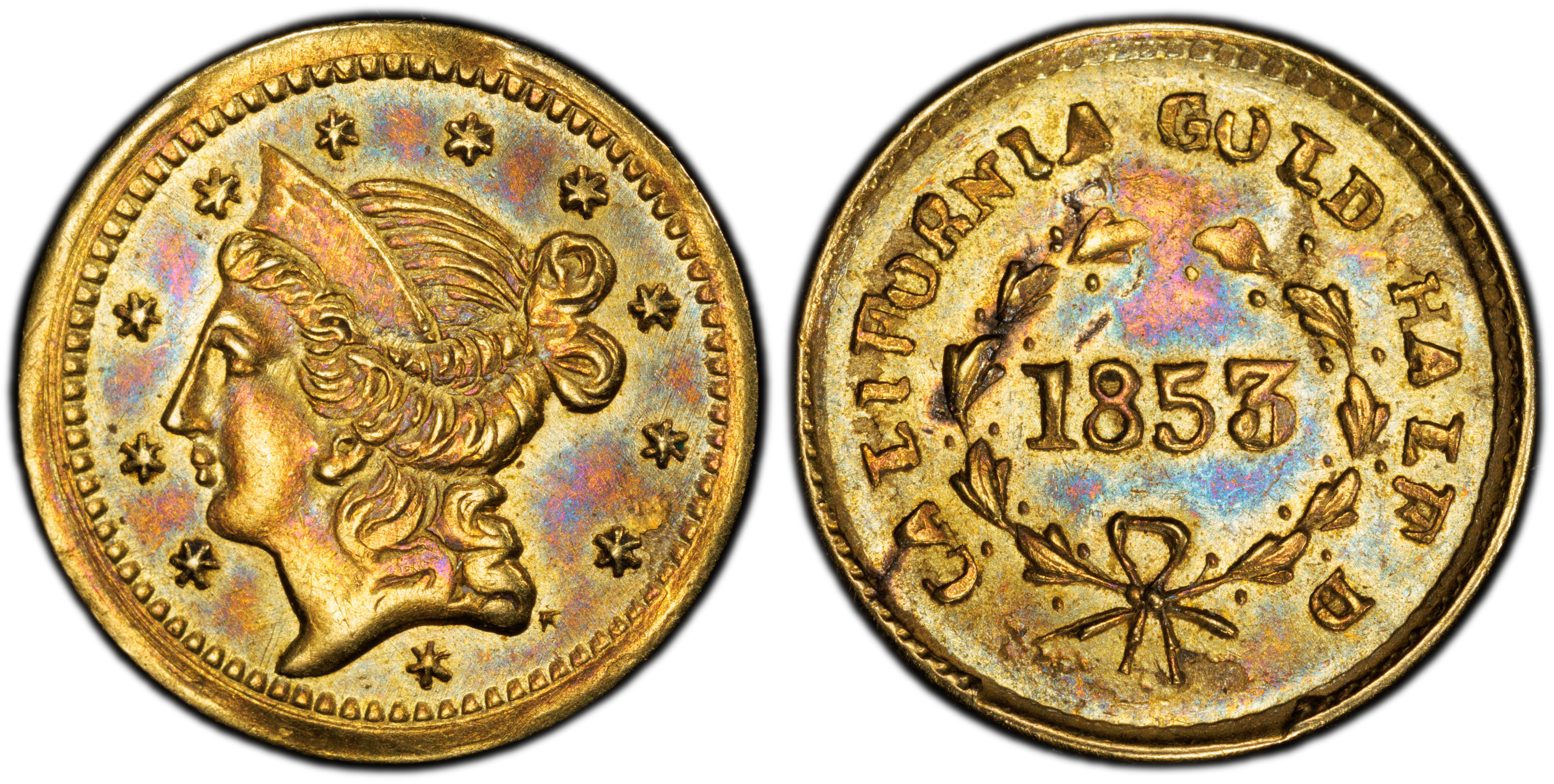
Obverse & Reverse
The 1853 BG-419 half dollar is a numismatic ghost from the zenith of the California Gold Rush, a period of chaotic economic expansion and profound monetary necessity. Following the 1848 discovery of gold at Sutter's Mill, a tidal wave of humanity descended upon California, swelling its population and commerce. This explosive growth created an acute shortage of circulating coinage, particularly for small, everyday transactions. Gold dust, the primary medium of exchange, was imprecise and inconvenient. While several private mints like Moffat & Co. and Wass, Molitor & Co. produced larger denomination coins, the need for fractional currency—quarters, halves, and dollars—was largely unmet by federal authorities, whose San Francisco Mint would not open until 1854. Into this void stepped a number of entrepreneurial jewelers and artisans in San Francisco. Capitalizing on the abundance of raw gold and the desperate need for a convenient medium of exchange, they began striking their own small-denomination coins in 1852. These pieces, now known as California Fractional Gold, were the lifeblood of small commerce, used to pay for meals, drinks, and minor goods. The BG-419 is a product of this 'Period One' (1852-1857) of fractional minting, an era when the coins were struck with the genuine intent of circulation, often with a gold content that approached their face value. The attribution to M. Deriberpie, a San Francisco jeweler, places it among the work of skilled French artisans who were prominent in this trade. However, the coin's immense rarity suggests an infinitesimally small mintage, perhaps the result of an immediate die failure or a trial run that never entered full production. Its existence remained largely unknown to the numismatic community for a century, until the first example was discovered by the pioneering collector Kenneth Lee between 1950 and 1955. This extreme rarity elevates the BG-419 from a mere historical artifact to a legendary prize, representing the ephemeral and often anonymous solutions devised to solve the monetary crises of the American West.
Associated EventCalifornia Gold Rush
Reason For MintingTo alleviate a severe shortage of small-denomination coinage for daily commercial transactions in Gold Rush-era California.
Minter HistoryM. Deriberpie was one of several French jewelers active in San Francisco during the 1850s who turned his skills toward the lucrative production of private coinage. Like many of his contemporaries, such as Antoine Louis Nouizillet, Deriberpie's primary business was likely watchmaking and jewelry, but the local economic conditions provided a unique opportunity. The technical skill evident in the better-preserved examples of his work suggests a professional engraver. His operations, like those of other fractional minters, were small-scale and ceased as the official U.S. Branch Mint in San Francisco ramped up production of federal coinage, rendering the private issues obsolete.
Historical SignificanceThe BG-419 is a prime example of a 'necessary' private issue, created to facilitate commerce in the absence of federal coinage. Its existence underscores the ad-hoc nature of the Gold Rush economy and the ingenuity of local craftsmen. As one of the greatest rarities in the entire series, its significance lies not in its economic impact—which was negligible due to its tiny mintage—but in what it represents: a fleeting moment in the vibrant history of American private and territorial gold.
BG-419
Denomination50 Cents
Minting Period1853
Assayer/MinterM. Deriberpie (Attributed)
Geographic OriginSan Francisco, California
Obverse DescriptionA Liberty Head, facing left, with 'LIBERTY' inscribed on her coronet. The portrait is surrounded by thirteen six-pointed stars, representing the original colonies.
Obverse InscriptionLIBERTY
Reverse DescriptionThe denomination '1/2' is centered within a wreath composed of two branches tied with a bow at the bottom. The legend 'CALIFORNIA GOLD' encircles the top periphery of the wreath, and the date '1853' is below the wreath.
Reverse InscriptionCALIFORNIA GOLD 1/2 1853
CompositionGold
Stated Fineness Actual FinenessPeriod One issues were generally struck from native California gold, which naturally contained silver, resulting in varying fineness often in the .800 to .900 range.
EdgePlain
Extremely low, likely fewer than 10 pieces.
Survival Estimate3 confirmed examples known.
Rarity ScaleR-8 (High)
The BG-419 is a legendary rarity, appealing to the most advanced specialists in California Fractional Gold and Territorial issues. Its allure is a combination of its near-mythical status, its connection to the height of the Gold Rush, and the challenge of acquiring one of only three known specimens. For the specialist, owning a BG-419 is a pinnacle achievement.
Key VarietiesThere are no known varieties of the BG-419 die marriage itself. No known patterns, trial pieces, or later-date restrikes of this specific variety exist. The issue is defined solely by the original 1853 business strikes from this die pair.
Authentication TipsAuthentication requires expert examination, ideally by specialists familiar with the die characteristics of M. Deriberpie's work. Key diagnostics would involve precise comparison to the known genuine examples. Look for the sharp, confident engraving style typical of Deriberpie. The surfaces should exhibit the correct granular texture of manually produced planchets, not the smooth, uniform fields of modern copies. Many modern replicas are gold-plated base metal and will be incorrect in weight, specific gravity, and surface characteristics. Given the coin's value, purchase should only be considered if certified by a top-tier grading service (PCGS or NGC).
Shopping ConsiderationsAcquiring a BG-419 is an event that occurs perhaps once in a decade. A 'premium quality' example would be one of the two known Mint State specimens. A potential buyer should focus on the sharpness of the strike, particularly on Liberty's coronet and the details of the wreath. Surface quality is paramount; look for original, un-cleaned, and un-tooled fields. Given the hand-hammered striking process, some weakness in the strike is to be expected, but a clear date and legends are highly desirable. The provenance of the specific example being offered is a major value factor; the discovery coin from the Kenneth Lee collection holds special significance.
A coin's grade is its condition, rated on a 1-70 scale. For rare coins, this is the most critical factor in determining value, as a tiny difference in preservation can mean a huge difference in price.
Relevant Grade TypesAll known examples of BG-419 are original business strikes intended for circulation, found in both Circulated (the AU-55 example) and Mint State (the MS-61 and MS-63 examples) grades. No Proofs of this variety were struck during the original period of issue, and no later-date Proof restrikes or special collector strikings are known to exist.
Mint State CharacteristicsAn uncirculated BG-419 would be defined by the presence of original mint luster, which on these issues is typically a soft, satiny texture rather than a deep, frosty glow. The strike is often not perfectly centered or uniform due to the hand-hammered production method. High-grade examples will show sharp details on the highest points, such as the hair above Liberty's eye and the bow of the wreath. Small, scattered planchet marks or adjustment marks are common for the series and may not preclude a high grade if they are not distracting.
Circulated Wear PatternsFor a circulated example of this type, wear first appears on the highest points of the design. On the obverse, this includes Liberty's cheek, the hair above the ear, and the coronet. On the reverse, the highest points of the wreath's leaves and the knot of the bow would show the first signs of friction. In lower grades (below AU), the fine details of the hair would merge and the word 'LIBERTY' would become indistinct.
Key Factors For ValueFor the BG-419, with only three examples known, the primary value factor is simply its existence and availability. Beyond that, the grade is the key differentiator. The NGC MS-63 specimen is considered the finest known and would command a significant premium over the PCGS MS-61 or the PCGS AU-55. Eye appeal, characterized by smooth, original surfaces and attractive toning (such as the honey-orange and rose patina described on the finest known example), adds a substantial premium. A CAC sticker on any of the known examples would further enhance its value by confirming its quality for the assigned grade.
PCGS Price Guide
| Grade | Price | Population |
|---|---|---|
| 50 | $16,000.00 | N/A |
| 50+ | $17,000.00 | N/A |
| 53 | $18,000.00 | N/A |
| 53+ | $19,000.00 | N/A |
| 55 | $20,000.00 | 2 |
| 55+ | $21,750.00 | N/A |
| 58 | $24,000.00 | N/A |
| 58+ | $25,000.00 | N/A |
| 60 | $30,000.00 | N/A |
| 61 | $45,000.00 | 1 |
| 62 | $60,000.00 | 1 |
| 62+ | $61,500.00 | N/A |
| 63 | $65,000.00 | N/A |