1853 G25C BG-102 (Regular Strike)
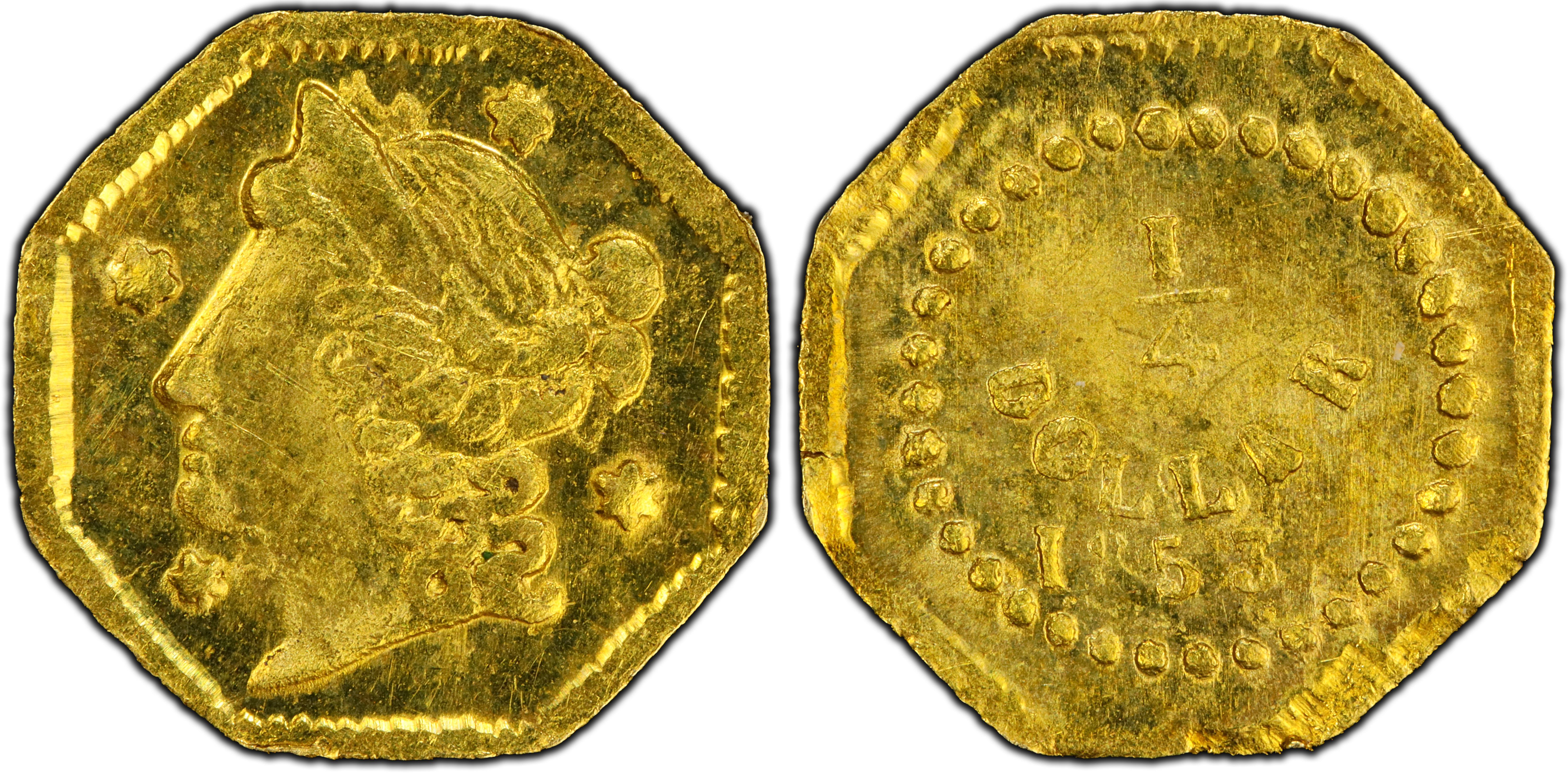
Obverse & Reverse
The 1853 BG-102 25 Cents represents a critical and fascinating chapter in American economic history, born from the chaotic yet vibrant crucible of the California Gold Rush. Following the discovery of gold at Sutter's Mill in 1848, a massive influx of prospectors and merchants descended upon California, ballooning the population and creating a dynamic, yet unstable, economy. While vast quantities of gold were being extracted, a severe shortage of circulating small-denomination coinage plagued daily commerce. Gold dust, weighed in 'pinches,' was an imprecise and cumbersome medium of exchange for minor transactions. Federal coinage was scarce on the West Coast, as the San Francisco Mint would not become fully operational until 1854. Into this void stepped a number of private jewelers and metallurgists in San Francisco, who began striking their own small-denomination gold coins in 1852 to facilitate trade. These 'California Fractional Gold' pieces, including the quarter dollar, half dollar, and dollar denominations, became an essential, if unofficial, part of the local monetary system. The BG-102 is a prime example of a 'Period One' (1852-1857) issue, a classification denoting the earliest pieces that were generally of honest weight and intended for genuine circulation. These were not tokens or souvenirs, but functional coins that traded hands in saloons, general stores, and among miners for everyday needs. The octagonal shape, reminiscent of the larger and highly respected $50 slugs produced by private assayers, likely lent an air of familiarity and trust. Although the exact attribution is not definitive, evidence points to the firm of Frontier, Deviercy & Co. as the likely producers of this variety. These French-emigre jewelers were among the most prolific minters of the era. The coins served their purpose until a sufficient supply of federal silver and gold coinage from the San Francisco Mint rendered them obsolete, after which most were melted, lost, or worn out in circulation, accounting for their present-day rarity.
Associated EventCalifornia Gold Rush
Reason For MintingTo alleviate a severe shortage of small-denomination coinage for daily commerce in Gold Rush-era California before the San Francisco Mint was fully operational.
Minter HistoryFrontier, Deviercy & Co. was a firm of French jewelers and watchmakers located in San Francisco during the Gold Rush. While records are sparse, numismatic scholarship, primarily through die analysis and contemporary accounts, attributes a significant number of Period One fractional gold varieties to them. Like other private minters of the time, such as Antoine Louis Nouizillet, they leveraged their metallurgical skills to meet a pressing economic need, producing coins that were vital for the region's commerce. Their operations ceased as the federal San Francisco Mint ramped up production, making private issues unnecessary.
Historical SignificanceThe BG-102 and its contemporaries are tangible artifacts of the unique economic conditions of the California Gold Rush. They represent a period of private enterprise stepping in to fulfill a crucial governmental function—the creation of a circulating medium of exchange. As a Period One issue, it stands as a testament to an era before federal authority fully consolidated monetary control in the West and before the production of fractional gold devolved into primarily souvenir and jewelry pieces in later periods.
BG-102
Denomination25 Cents
Minting Period1853
Assayer/MinterProbably Frontier, Deviercy & Co.
Geographic OriginSan Francisco, California
Obverse DescriptionA fairly crude depiction of a Liberty Head, facing left, with hair tied in a bun. She is encircled by thirteen stars of varying quality, representing the original colonies. The portrait style is often referred to as the 'Broad Head' type for this variety.
Obverse Inscription Reverse DescriptionThe denomination '1/4' is in the center, surrounded by the legend 'CALIFORNIA GOLD' which forms a circle around it. A simple wreath-like or decorative border encircles the entire design.
Reverse InscriptionCALIFORNIA GOLD 1/4
CompositionGold
Stated Fineness Actual FinenessTypically around .800 to .900, with natural silver alloys common in unrefined California gold.
Weight0.25 grams
Diameter10.00 mm
EdgePlain
Unknown
Survival Estimate201-300
Rarity ScaleR-5
The 1853 BG-102 is highly sought after as a quintessential example of a Period One California Fractional Gold piece. Its octagonal shape, clear date, and historical connection to the peak of the Gold Rush make it a favorite among collectors of pioneer gold and Western Americana. Its status as a circulating coin, not a later souvenir, gives it significant historical gravitas.
Key VarietiesThe primary variety is the regular business strike. There are no known proof restrikes or special collector issues from the period. Die states exist, with some showing a weak '8' in the date. The Breen-Gillio (BG) catalog is the definitive reference, and BG-102 specifically identifies this die marriage. Collectors should be aware of the distinction between Period One issues like this, which circulated, and later Period Two (souvenir) and Period Three (clandestine) issues, which were often backdated.
Authentication TipsAuthentication is critical. Genuine pieces have a characteristic fabric from often crudely prepared dies on primitive presses. Look for softness in some details combined with sharp die lines elsewhere. The weight should be very close to 0.25 grams. Many counterfeits and replicas exist, often made of brass or thinly plated base metal. These fakes frequently have a soapy or cast-like appearance, incorrect weight, and diagnostic 'mushiness' to the lettering and stars. Comparing a suspect piece to high-resolution images of certified examples is essential. The standard reference is the Breen-Gillio guide, "California Pioneer Fractional Gold." If a piece is not in this guide, it is almost certainly a replica or token.
Shopping ConsiderationsFor a premium quality example, look for a bold, well-centered strike. Many examples are weakly struck, particularly on the stars and the date, so a sharp strike commands a significant premium. Original, uncleaned surfaces with some remaining luster are highly desirable. The color should be a natural, rich gold, sometimes with hints of copper toning. Avoid specimens that are harshly cleaned, polished, or show evidence of being mounted in jewelry, such as solder marks or rim damage. Given the small size, even minor surface impairments are magnified. A loupe should be used to carefully inspect for tooling on the fields or repairs. Coins certified by top-tier services like PCGS or NGC are strongly recommended for this series due to the prevalence of counterfeits.
A coin's grade is its condition, rated on a 1-70 scale. For rare coins, this is the most critical factor in determining value, as a tiny difference in preservation can mean a huge difference in price.
Relevant Grade TypesOriginal issues were exclusively business strikes intended for circulation. They are found in Circulated grades (AG-3 to AU-58) and, more rarely, in Mint State (MS-60 to MS-70). No proofs were struck during the original minting period, and there are no known later-date proof restrikes of this specific variety. Any piece described as a 'Proof' should be regarded with extreme skepticism and is likely a modern replica.
Mint State CharacteristicsAn uncirculated BG-102 will exhibit frosty or satiny mint luster in the protected areas around the devices and lettering. The strike is a key factor; many are softly struck, so a sharp, fully detailed Liberty head and reverse legend is rare and desirable. Due to the primitive minting process and soft gold, even high-grade Mint State examples will typically show some light contact marks or planchet imperfections. The overall eye appeal, defined by the quality of luster and strike, is paramount.
Circulated Wear PatternsWear first appears on the highest points of the design: Liberty's cheek, hair bun, and the high points of her brow. On the reverse, the fraction '1/4' and the letters in 'GOLD' will show the first signs of flattening. In lower grades (VG and below), the stars on the obverse will begin to merge with the field, and the date may become partially or fully illegible.
Key Factors For ValueThe primary value drivers for an 1853 BG-102 are grade and surface quality. An example with original, uncleaned surfaces will always be worth significantly more than a cleaned coin of the same grade. Strike quality is the next most important factor; a well-struck specimen can command a premium over a weakly struck example of a higher numerical grade. Eye appeal, encompassing attractive original color and minimal distracting marks, is also crucial. For this series, a CAC sticker signifies superior quality for the grade and typically results in a substantial price premium.
PCGS Price Guide
| Grade | Price | Population |
|---|---|---|
| 50 | $185.00 | N/A |
| 50+ | $195.00 | N/A |
| 53 | $210.00 | 6 |
| 53+ | $225.00 | N/A |
| 55 | $240.00 | 6 |
| 55+ | $255.00 | N/A |
| 58 | $275.00 | 12 |
| 58+ | $300.00 | N/A |
| 60 | $335.00 | 2 |
| 61 | $375.00 | 6 |
| 62 | $475.00 | 24 |
| 62+ | $525.00 | N/A |
| 63 | $575.00 | 39 |
| 63+ | $625.00 | N/A |
| 64 | $700.00 | 20 |
| 64+ | $900.00 | N/A |
| 65 | $1,750.00 | 3 |
| 65+ | $2,000.00 | N/A |
| 66 | $2,500.00 | N/A |