1854 G$1 BG-527 (Regular Strike)
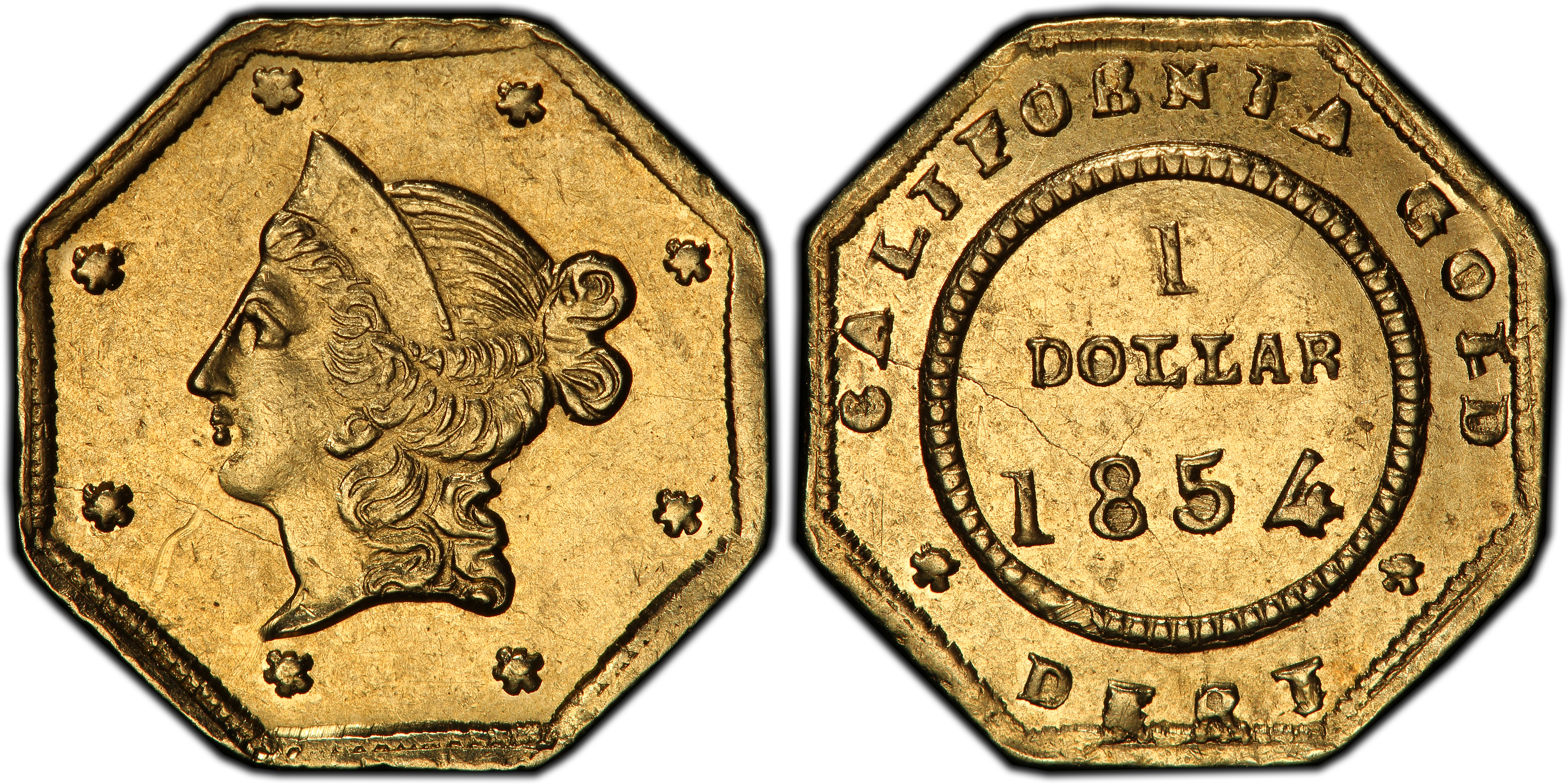
Obverse & Reverse
The 1854 Octagonal Gold Dollar, cataloged as Breen-Gillio 527, is a quintessential artifact from the chaotic and economically vibrant zenith of the California Gold Rush. These privately issued gold pieces, known as 'California Fractional Gold,' arose from a critical necessity for small-denomination currency. Following the discovery of gold in 1848, a massive influx of prospectors and merchants flooded into California, bringing with them vast quantities of raw gold dust but facing an acute shortage of official coinage for daily transactions. While large private ingots and federal Assay Office 'slugs' served for major settlements, the need for coins to buy a meal, a tool, or a drink was dire. Into this monetary vacuum stepped a number of entrepreneurial San Francisco jewelers and metallurgists. M. Deriberpie, a French jeweler, was among the most significant of these private minters. His workshop, along with others, began producing fractional denominations ($0.25, $0.50, and $1.00) starting in 1852. These pieces, retrospectively classified by numismatists as 'Period One' issues (1852-1856), were not novelty items but were struck with the genuine intent of circulating as currency. They were crudely manufactured, often by the 'hammer method,' where dies were struck by hand, resulting in inconsistent strike quality and planchet shapes. The year 1854 was a pivotal one; it marked the official opening of the United States Branch Mint in San Francisco. However, the new mint's initial output was plagued by technical problems and was insufficient to meet the rampant commercial demand, particularly for smaller coins. This delay allowed private minters like Deriberpie to continue their operations, filling a vital role in the regional economy for a brief but crucial period. The BG-527 was struck during this window of opportunity. As the San Francisco Mint ramped up production of official U.S. gold and silver coins by 1856, the necessity for these private issues waned, and they gradually disappeared from circulation, bringing the era of 'Period One' fractionals to a close. Today, they are prized by collectors not only for their immense rarity but also as tangible links to the Gold Rush's formative years.
Associated EventCalifornia Gold Rush
Reason For MintingTo alleviate a severe shortage of small-denomination circulating coinage in California before the new San Francisco Mint could produce sufficient quantities.
Minter HistoryM. Deriberpie was a San Francisco jeweler of French origin active during the Gold Rush. He was one of the most prolific private minters of 'Period One' California Fractional Gold. His issues, often identifiable by the abbreviation 'DERI' or through die attribution, were instrumental in facilitating commerce in the region from 1852 to 1854. Like his contemporaries Antoine Louis Nouizillet and the firm of Frontier, Deviercy & Co., Deriberpie utilized his metallurgical skills to convert raw gold into desperately needed small-denomination coins. Recent numismatic research, particularly the discovery of die-linked varieties, has shown he used a significant number of dies, suggesting a more extensive minting operation than previously understood.
Historical SignificanceThe BG-527 is a historically significant representation of private enterprise stepping in to solve a governmental failure in currency supply. As a 'Period One' issue, it is considered a legitimate circulating coin of the era, unlike later 'Period Two' and 'Three' issues which were often produced as souvenirs. Its existence highlights the unique economic conditions of Gold Rush San Francisco and the transitional period during which the U.S. government was establishing its monetary authority in the West.
N/A
DenominationG$1
Minting Period1854
Assayer/MinterM. Deriberpie
Geographic OriginSan Francisco, California
Obverse DescriptionFeatures a crudely rendered bust of Liberty facing left, her hair tied in a bun at the back. Thirteen stars, often unevenly spaced and shaped, encircle the portrait within the octagonal border. This design is a stylistic, if rustic, imitation of the contemporary federal gold dollars designed by James B. Longacre.
Obverse Inscription Reverse DescriptionThe reverse is dominated by a wreath composed of two branches tied with a bow at the bottom. Inside the wreath is the numeral '1' above the word 'DOLLAR'. The date '1854' is positioned below the bow. Around the periphery, inside the octagonal border, is the inscription 'CALIFORNIA GOLD'. The abbreviation 'DERI' appears above the wreath, identifying the minter.
Reverse InscriptionDERI / 1 / DOLLAR / 1854 / CALIFORNIA GOLD
CompositionGold
Stated Fineness Actual FinenessVariable, typically between 14 and 22 karats. Period One issues were generally of higher, though not standardized, purity than later souvenir pieces.
Weight0.90 grams
Diameter11.50 mm
EdgePlain
Extremely Low
Survival Estimate5-8 examples known
Rarity ScaleR-7
This coin is a landmark rarity in the coveted California Fractional Gold series. Its appeal lies in its status as a true 'Period One' circulating issue, its direct connection to the Gold Rush, the octagonal shape, and its extreme rarity. Being an attributed piece by the known minter M. Deriberpie adds significant numismatic and historical value.
Key VarietiesThe 'Regular Strike' BG-527 itself is the primary variety. However, recent research surrounding the discovery of the unique BG-526a (a mule of a BG-526 obverse and a BG-529 reverse) has been critical. It has allowed numismatists to determine the striking sequence of Deriberpie's 1854 octagonal dollars, proving that the BG-529 variety was struck *before* BG-527 and BG-528. This context is crucial for the specialist collector. No known patterns or restrikes of BG-527 exist.
Authentication TipsAuthentication is paramount for this series. Genuine Period One pieces like BG-527 were struck, not cast, so surfaces should exhibit flow lines and striking characteristics, not casting bubbles or a soapy texture. The lettering and devices are typically crude but sharply defined, unlike modern replicas which can be mushy or tool-enhanced. The presence of the 'DERI' mark is a key identifier. Reference the die characteristics published in Breen-Gillio's work. Many fakes and 20th-century souvenir tokens exist; genuine pieces from this period must have a denomination (e.g., 'DOLLAR'). Any piece featuring a bear is a fantasy item.
Shopping ConsiderationsFor an R-7 issue, any example offered is a major event. A 'premium quality' specimen is one that is free of significant impairment like holes, heavy scratches, or harsh cleaning. Given the crude hammer-striking method, a relatively well-centered and bold strike is highly desirable, as many are weakly struck in areas. Look for honest, even wear that is consistent with circulation. Original, uncleaned surfaces with some remaining luster command a significant premium. Given the high value and prevalence of counterfeits, purchase is recommended only from major, reputable dealers or auction houses, and third-party certification by PCGS or NGC is virtually mandatory.
A coin's grade is its condition, rated on a 1-70 scale. For rare coins, this is the most critical factor in determining value, as a tiny difference in preservation can mean a huge difference in price.
Relevant Grade TypesOriginal period issues like BG-527 were business strikes intended for circulation. They are found in Circulated grades (AG-3 to AU-58) and, very rarely, in Mint State (MS, 60-70). No Proofs were struck during the original minting period, and no later-date Proof restrikes are known to exist for this specific variety.
Mint State CharacteristicsA true Mint State example of BG-527 is a pinnacle rarity. Luster would be subdued and satiny, not bright and flashy, due to the gold alloy and primitive die preparation. The strike is almost always somewhat weak in the centers, particularly on the highest points of Liberty's hair and the details of the wreath. Small planchet flaws, adjustment marks, and a general crudeness are characteristic of the issue and should not be confused with post-strike damage. Contact marks are to be expected due to the softness of the gold.
Circulated Wear PatternsWear first appears on the high points of Liberty's hair, especially the strands above her ear and on the bun. The cheek and the thirteen stars will also show early friction. On the reverse, the highest points of the wreath's leaves and the numeral '1' will exhibit the first signs of wear. On lower-grade examples, the 'DERI' mark and the date can become faint or partially obliterated.
Key Factors For ValueFor an ultra-rarity like BG-527, simply existing without major problems (holes, repairs) is the primary value driver. Beyond that, value is determined by the sharpness of the strike, the quality of the surfaces (originality is prized above all), and overall eye appeal. Even a lightly circulated example with attractive, original reddish-gold surfaces will be valued far more highly than a harshly cleaned or damaged piece of a technically higher grade. A CAC sticker on an existing certified coin would provide a strong endorsement of its quality for the grade.
PCGS Price Guide
| Grade | Price | Population |
|---|---|---|
| 53 | $4,500.00 | 1 |
| 53+ | $5,000.00 | N/A |
| 55 | $6,000.00 | 1 |
| 55+ | $7,500.00 | N/A |
| 58 | $9,000.00 | 3 |
| 58+ | $9,750.00 | N/A |
| 60 | $10,500.00 | N/A |
| 61 | $12,000.00 | 2 |