1871 25C BG-715 (Regular Strike)
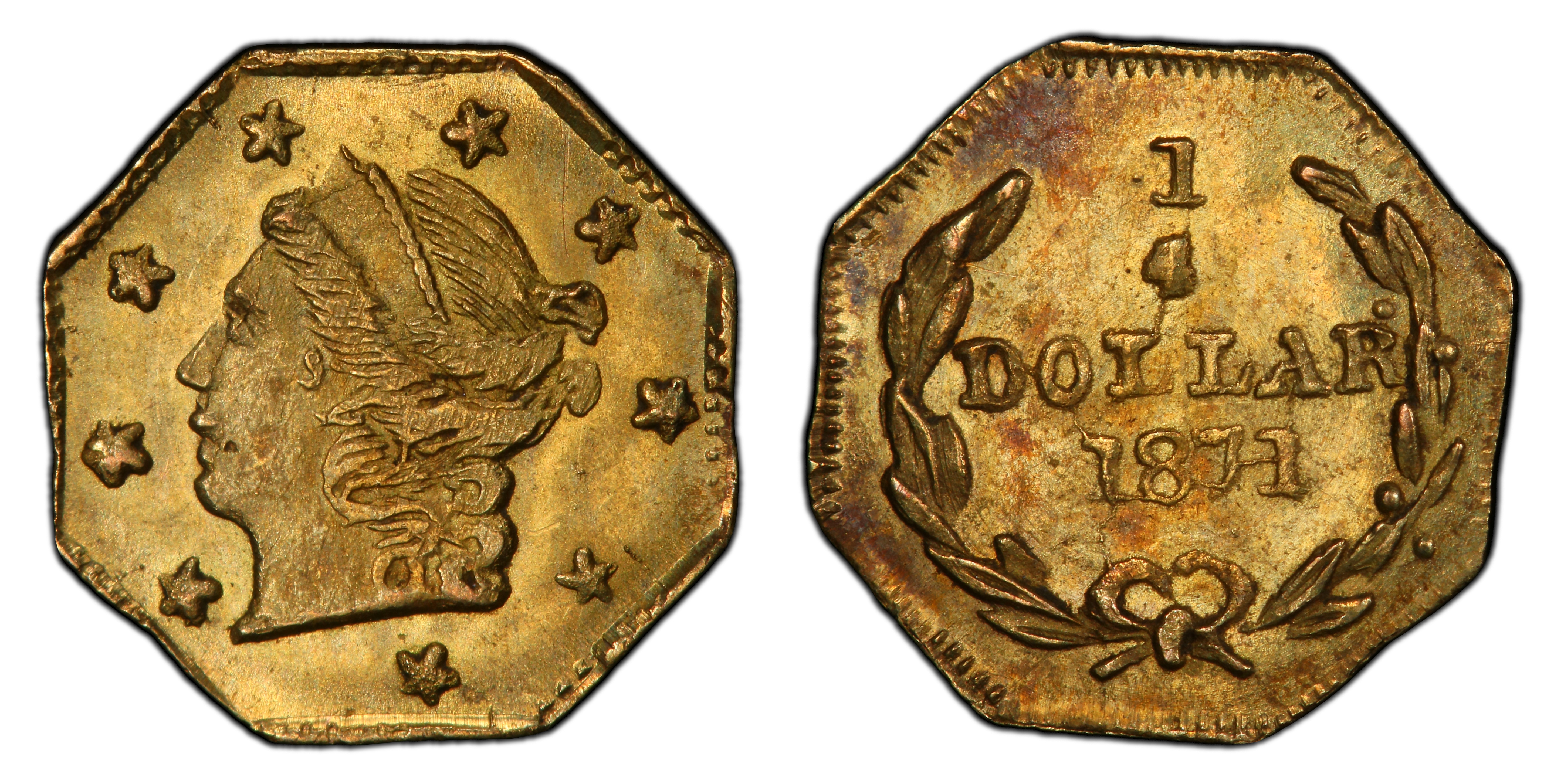
Obverse & Reverse
The 1871 BG-715 25-cent piece emerges from the second major phase of California Fractional Gold production, often termed 'Period Two' (1859-1882) or the 'Jeweler's Era.' Unlike the earlier 'Period One' issues, which were struck out of genuine necessity to alleviate a crippling shortage of small change during the initial Gold Rush, these later pieces served a different purpose. By the 1870s, the United States Mint in San Francisco was in full operation, and the acute need for circulating private coinage had subsided. Instead, a robust market for souvenirs and curiosities had developed, fueled by tourists, merchants, and collectors fascinated by the romance of the Gold Rush. San Francisco jewelers, many of French origin like Antoine Louis Nouizillet and his contemporaries, stepped in to meet this demand. They produced a wide variety of these miniature gold coins, often with lower gold content and less functional design than their predecessors. These were not intended to be workhorse coins for daily commerce but rather keepsakes and novelties. The BG-715, dated 1871, is a prime example of this commercial pivot. While the Coinage Act of 1864 had officially prohibited private coinage, the law was not strictly enforced against these small-denomination pieces until the early 1880s, allowing their production to flourish. These 'jeweler's issues' were typically struck by hand, using a hammer to strike an upper die against a planchet resting on a stationary lower die, a method that resulted in considerable variation in strike quality. The BG-715 is an extreme rarity, a testament to a very small production run, even for a souvenir issue. Its existence speaks to a vibrant collector market in the late 19th century and its survival provides a direct link to the post-Gold Rush commercial landscape of San Francisco.
Associated EventPost-California Gold Rush Souvenir Market
Reason For MintingPrimarily struck to be sold as souvenirs, jewelry, and collector's items rather than to alleviate a currency shortage.
Minter HistoryWhile the specific maker of BG-715 is not recorded, it is attributed to the class of San Francisco jewelers who dominated 'Period Two' production. A key figure in this era was Antoine Louis Nouizillet, a French jeweler who was a prolific producer of earlier fractional gold. Around 1859-60, Nouizillet sold his business to Robert B. Gray & Co., which continued producing pieces using existing dies. By 1871, Gray's interests were sold to the California Jewelry Co. It is highly probable that the dies for BG-715 were created and used by one of these successor firms or a contemporary competitor, leveraging the established market for these popular gold novelties.
Historical SignificanceThe BG-715 is significant not as a circulating coin, but as a numismatic artifact representing the commercialization of the Gold Rush legacy. It marks the transition of fractional gold from essential currency to a collectible souvenir, embodying the evolving economy and tourist trade of 1870s San Francisco. Its great rarity also makes it a key piece for advanced specialists of the series.
BG-715
Denomination25C
Minting Period1871
Assayer/MinterUnknown (Likely by a San Francisco Jeweler, possibly Antoine Louis Nouizillet or his successors)
Geographic OriginSan Francisco, California
Obverse DescriptionA Liberty Head, facing left, with 13 stars surrounding the periphery. The portrait is in the style of the contemporary federal gold coinage but often rendered with less refinement. The date, 1871, is below the truncation of the neck.
Obverse Inscription1871
Reverse DescriptionThe denomination '1/4' is enclosed within a wreath of leaves and berries, tied at the bottom with a bow. The legend 'CALIFORNIA GOLD' appears above the wreath, sometimes abbreviated.
Reverse InscriptionCALIFORNIA GOLD 1/4
CompositionGold
Stated Fineness Actual FinenessVariable, typically 14 to 22 karats for Period Two issues.
Diameter9.50 mm
EdgePlain
Extremely Low
Survival Estimate3-5 pieces
Rarity ScaleR-7 (High R.7 in some references, indicating 3-4 known)
As a major rarity from the popular California Fractional Gold series, the BG-715 holds immense appeal for advanced specialists. Its allure lies in its extreme scarcity, its connection to the romantic 'Jeweler's Era' of production, and the challenge of acquiring one of the very few known examples.
Key VarietiesThe BG-715 is itself a single, distinct die marriage. No major varieties, patterns, or restrikes from the period are known. Collector issues are the raison d'être for this coin; all known examples are essentially what would be considered special strikings for the souvenir market of the day. Some may exhibit semi-prooflike surfaces from polished dies, but these are not formal Proofs.
Authentication TipsAuthentic examples are die-struck, not cast. Look for sharp, albeit sometimes uneven, details consistent with a hammer strike. The surfaces should have a natural, satiny gold luster, not the dull or pitted appearance of a cast counterfeit. Planchet characteristics are key; genuine pieces were often struck on thin, sometimes crude planchets, and may exhibit minor, as-made planchet flaws or cracks. Many modern replicas are gold-plated and worthless; they often have a soapy, indistinct look and incorrect weight.
Shopping ConsiderationsFor a coin of this rarity, any example is a major acquisition. A 'premium quality' specimen would be one that is well-centered and sharply struck for the variety, as many were made with less care than circulating coinage. Look for pristine, undisturbed surfaces with original satiny luster. Since these did not circulate, any significant marks are post-striking damage. Check carefully for evidence of having been mounted in jewelry, such as solder marks or rim damage. Given the hand-struck nature, a slight unevenness in strike is expected and acceptable, but a bold impression on both faces is highly desirable.
A coin's grade is its condition, rated on a 1-70 scale. For rare coins, this is the most critical factor in determining value, as a tiny difference in preservation can mean a huge difference in price.
Relevant Grade TypesOriginal period issues were business strikes, although they were not intended for circulation and were sold directly to collectors and tourists. Therefore, they are found almost exclusively in Mint State (MS, 60-70) grades. It is extremely unlikely to encounter a circulated example. No true Proofs (PR/PF) were struck during the original period; however, some specimens were struck from polished dies and exhibit semi-prooflike or prooflike surfaces, which is a desirable attribute but does not change the MS grade designation.
Mint State CharacteristicsThe quality of an uncirculated BG-715 is judged primarily by the sharpness of the strike and the quality of the surfaces. The strike can be weak in areas, particularly on the highest points of Liberty's hair and the details of the wreath. Luster is typically soft and satiny, though some examples can be semi-prooflike with reflective fields. Due to the softness of the gold and minimal handling, contact marks should be few and far between on high-grade examples. An as-made, nearly imperceptible flan crack has been noted on at least one high-grade specimen, which is considered a planchet characteristic, not a flaw.
Circulated Wear PatternsAs these pieces were souvenirs and did not circulate, wear is not a factor in grading. Any piece showing circulation would be highly unusual. If wear were to occur, it would first appear on the highest points: Liberty's hair above the ear and the leaves and bow of the wreath on the reverse.
Key Factors For ValueFor the BG-715, value is driven by three main factors: rarity, grade, and eye appeal. As an R-7 variety, its mere existence commands a huge premium. The numerical grade (e.g., MS63 vs. MS65) is the next critical component. Finally, eye appeal, which encompasses the quality of the strike, the luster (with a premium for semi-prooflike surfaces), and the absence of distracting marks or coloration, significantly influences value. A CAC sticker would provide a strong premium, confirming that the coin is of superior quality for its assigned grade.
PCGS Price Guide
| Grade | Price | Population |
|---|---|---|
| 58 | $350.00 | 1 |
| 58+ | $375.00 | N/A |
| 60 | $400.00 | N/A |
| 61 | $425.00 | N/A |
| 62 | $450.00 | 2 |
| 62+ | $500.00 | N/A |
| 63 | $675.00 | 6 |
| 63+ | $850.00 | N/A |
| 64 | $1,250.00 | 4 |
| 64+ | $1,450.00 | N/A |
| 65 | $2,250.00 | 8 |
| 65+ | $2,400.00 | N/A |
| 66 | $2,750.00 | 5 |
| 66+ | $3,500.00 | N/A |
| 67 | $5,750.00 | N/A |