1854 G$1 BG-602 (Regular Strike)
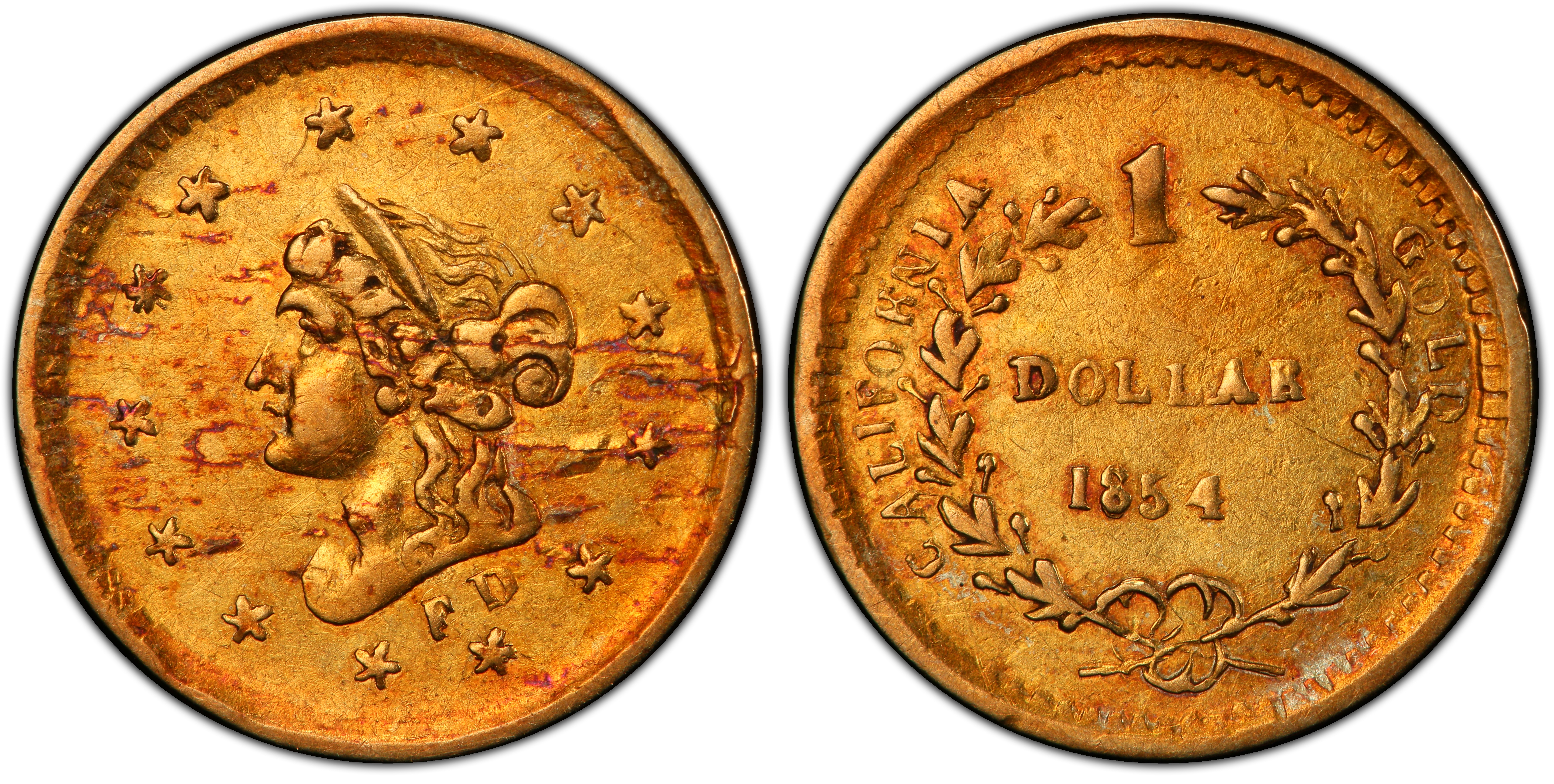
Obverse & Reverse
The 1854 G$1 BG-602 is a tangible relic of the California Gold Rush, a period of frantic economic expansion and numismatic necessity. Following the discovery of gold at Sutter's Mill in 1848, a massive influx of prospectors and merchants descended upon California, creating booming settlements virtually overnight. This explosive growth, however, far outpaced the supply of official United States coinage. Gold dust, a cumbersome and often inequitable medium of exchange, was initially used for transactions, but the need for a more standardized and convenient currency was acute. Private minters, many of whom were jewelers and metallurgists by trade, stepped in to fill this critical void. The BG-602 is a product of this era, classified as a 'Period One' (1852-1856) issue. These early fractional pieces were minted with a genuine commercial purpose: to facilitate everyday transactions in an economy starved for small change. Unlike the later 'Period Two' issues, which were often underweight and produced as souvenirs, Period One coins like the BG-602 were generally made with an honest gold content relative to their face value and were intended to circulate. Produced by the firm of Frontier, Deviercy & Co., San Francisco-based jewelers, these small gold dollars provided a crucial service before the newly established San Francisco Mint could produce sufficient federal coinage to meet demand. The very existence of this coin speaks to the entrepreneurial spirit and ad-hoc solutions that defined the Gold Rush economy. These coins circulated actively until the San Francisco Mint's output of federal gold and silver coins became widespread, at which point the private issues were gradually withdrawn from circulation, becoming the historical rarities they are today.
Associated EventCalifornia Gold Rush
Reason For MintingTo alleviate a severe shortage of small-denomination coinage for daily commerce in California during the Gold Rush, prior to the widespread availability of federal coins from the new San Francisco Mint.
Minter HistoryFrontier, Deviercy & Co. was a prominent firm of French jewelers operating in San Francisco during the early 1850s. Like many of their contemporaries, they leveraged their metallurgical skills to meet the region's desperate need for coinage. They were among the most prolific and respected private minters of the 'Period One' era of California Fractional Gold, known for producing coins of relatively consistent weight and fineness that were trusted in local commerce. The initials 'FD' found below the bust on the BG-602 are the identifying mark of this enterprising firm.
Historical SignificanceThe BG-602 and other Period One fractional gold pieces are historically significant as they represent a crucial, albeit temporary, solution to a major economic problem on the American frontier. They are primary artifacts of the Gold Rush economy, demonstrating how private enterprise filled a gap left by the federal government. Their eventual displacement by official U.S. Mint coinage marks the economic maturation and integration of California into the United States.
BG-602
DenominationG$1
Minting Period1854
Assayer/MinterFrontier, Deviercy & Co.
Geographic OriginSan Francisco, California
Obverse DescriptionThe obverse features a Liberty Head facing left, similar in style to the contemporary federal gold dollars designed by James B. Longacre. She wears a coronet inscribed with 'LIBERTY'. The portrait is encircled by 13 six-pointed stars representing the original colonies. The initials 'FD' for Frontier & Deviercy are located below the truncation of the neck.
Obverse InscriptionLIBERTY
Reverse DescriptionThe reverse design consists of the denomination '1 DOLLAR' and the date '1854' enclosed within a wreath. The wreath is composed of two branches tied together by a bow at the bottom.
Reverse Inscription1 DOLLAR 1854
CompositionGold
Stated Fineness Actual FinenessTypically around .880 to .900 fine, with native silver as the primary alloying metal.
Diameter11.20 mm
EdgePlain
Unknown
Survival Estimate31-75
Rarity ScaleR-6
The BG-602 is highly sought after for its direct connection to the historic California Gold Rush, its status as a 'Period One' issue made for circulation, and its tangible link to San Francisco's early economic development. Its rarity and the romanticism of the 'Old West' make it a centerpiece for collectors of Territorial gold and U.S. numismatic history.
Key VarietiesThe primary variety is the regular business strike as cataloged. No known proof restrikes or special collector issues were produced for this specific variety during or after its period of minting. Collectors should focus on die states, as the crude minting process could result in minor variations in strike and placement.
Authentication TipsGenuine examples typically exhibit a slightly crude, hand-struck appearance. The details, while perhaps soft, should be consistent with known examples. Look for the correct placement and style of the 'FD' initials below the bust. Counterfeits are common and may be cast, showing porosity and soapy details, or struck with incorrect letter and number punches. Weight and specific gravity tests are crucial, as many fakes are gold-plated brass. Comparison to high-resolution images of certified examples is essential.
Shopping ConsiderationsA premium quality example for this issue is defined by a bold strike, particularly on the highest points of Liberty's hair and the details of the wreath. Many specimens are weakly struck due to the manual hammer-striking process. Look for original, uncleaned surfaces with some remaining luster; a uniform, reddish-gold or orange-gold toning is highly desirable. Avoid examples that are holed, bent, or show evidence of being mounted in jewelry, as was common. Heavy circulation marks are expected, but specimens with minimal distracting scratches or rim bumps command significant premiums. Third-party certification by PCGS or NGC is highly recommended for authenticity and accurate grading.
A coin's grade is its condition, rated on a 1-70 scale. For rare coins, this is the most critical factor in determining value, as a tiny difference in preservation can mean a huge difference in price.
Relevant Grade TypesOriginal issues of BG-602 were business strikes intended for circulation and are found in Circulated grades (AG-3 to AU-58) and, very rarely, in Mint State (MS-60 to 70). No Proof (PR/PF) examples were struck during the original minting period, and there are no known later-date Proof restrikes. Any coin described as a 'Proof' would be highly suspect.
Mint State CharacteristicsAn uncirculated BG-602 is exceptionally rare. Quality would be judged on the sharpness of the strike, especially on the stars, the word 'LIBERTY' on the coronet, and the bow on the reverse wreath. Luster is typically satiny rather than frosty. Due to the crude manufacturing process and soft gold, even Mint State examples will likely display some minor planchet flaws or handling marks that occurred at the time of minting.
Circulated Wear PatternsWear first appears on the highest points of the design: Liberty's cheek, the hair above the ear and eye, and the coronet. On the reverse, the highest points of the wreath leaves and the bow will show the first signs of friction. In lower grades (VG and below), 'LIBERTY' on the coronet becomes illegible, and the date and stars may begin to merge with the fields.
Key Factors For ValueFor the BG-602, the primary value drivers are grade and surface quality. An example with original, uncleaned 'skin' is far more valuable than a cleaned or polished specimen in the same grade. Strike quality is paramount; a sharply struck coin in AU-55 might be more desirable to a specialist than a weakly struck MS-61. Eye appeal, which encompasses toning and the absence of distracting marks, plays a major role. A CAC sticker indicates premium quality for the grade and will add a significant price premium for this rare and historically important issue.
PCGS Price Guide
| Grade | Price | Population |
|---|---|---|
| 50 | $23,000.00 | 2 |
| 50+ | $23,500.00 | N/A |
| 53 | $24,500.00 | N/A |
| 53+ | $25,000.00 | N/A |
| 55 | $25,500.00 | 3 |
| 55+ | $26,500.00 | N/A |
| 58 | $27,500.00 | N/A |
| 58+ | $30,000.00 | N/A |
| 60 | $32,500.00 | N/A |
| 61 | $37,500.00 | 1 |