No Date G25C BG-202 (Regular Strike)
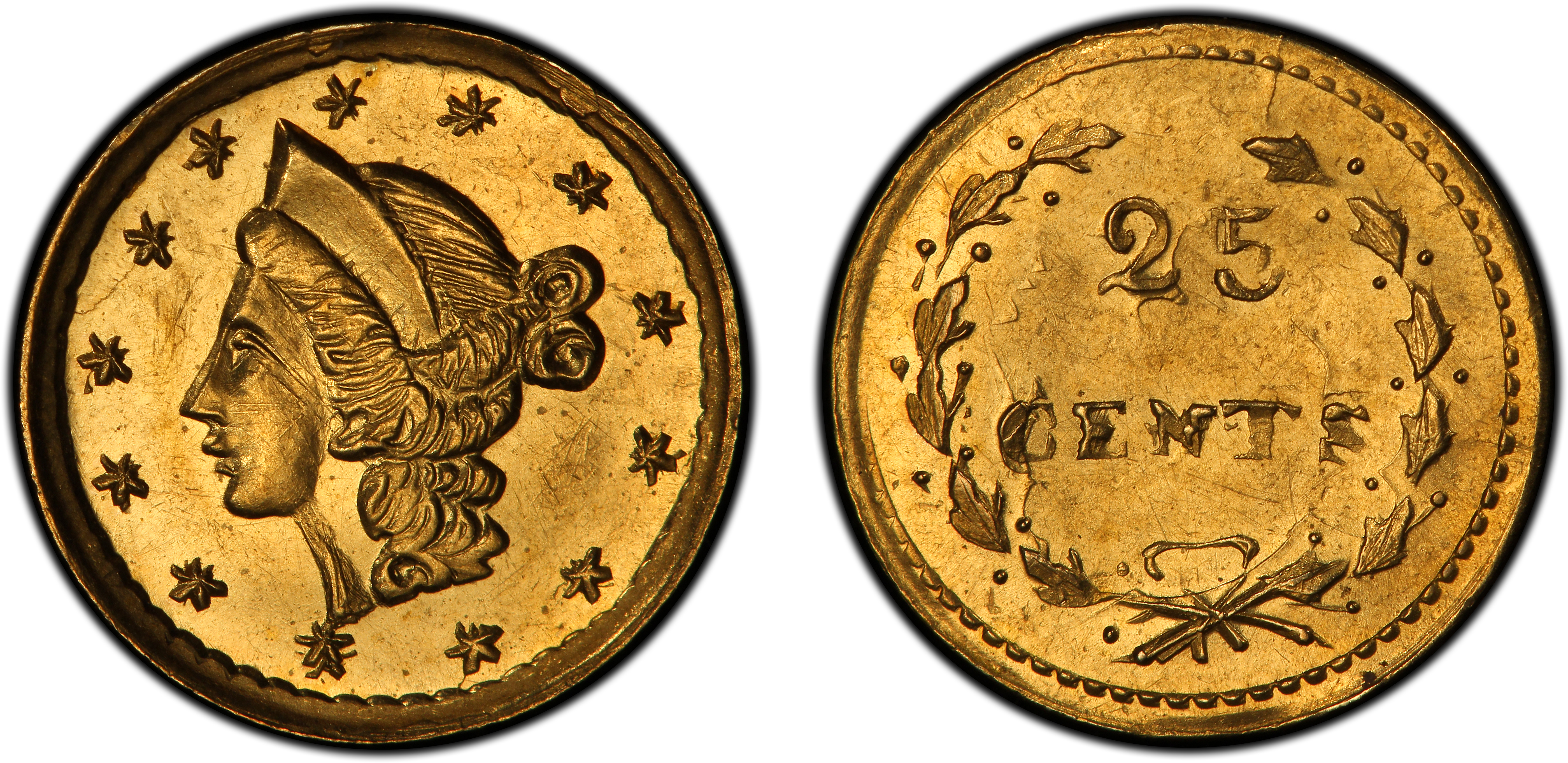
Obverse & Reverse
The BG-202 25 Cents is a quintessential relic of the California Gold Rush, born from acute economic necessity. The massive influx of prospectors and settlers after 1848, the famed 'Forty-Niners,' created a booming economy almost overnight. While immense quantities of gold dust and large-denomination federal and private coins circulated, there was a crippling shortage of small change for daily transactions. A pinch of gold dust for a drink or a loaf of bread was an imprecise and often contentious system. Into this void stepped numerous private minters, often jewelers and metallurgists, primarily in San Francisco. Between 1852 and 1856, a period numismatists classify as 'Period One,' these artisans produced fractional gold coins in 25 cent, 50 cent, and one-dollar denominations. These early issues, including BG-202, were not mere tokens; they were struck with the serious intent of serving as a circulating medium. Their designs often mimicked those of the official U.S. gold dollars, featuring Liberty heads, to foster public acceptance. The BG-202 is an undated example from this crucial first period, struck circa 1853. The coins were typically made by hand, with dies engraved and hardened, and then used to strike planchets with a powerful hammer blow. This process resulted in coins of varying strike quality, often with areas of weakness. Despite being technically underweight compared to their face value in federal coinage, they were widely accepted in local commerce, filling a vital role until the San Francisco Mint began full-scale production of small denomination coins in 1856. The discovery of Period One fractional gold pieces in contemporary shipwrecks, such as the S.S. Central America which sank in 1857, provides definitive proof of their circulation. The Coinage Act of 1864 officially prohibited private coinage, bringing an end to the era of these fascinating and historically significant monetary instruments.
Associated EventCalifornia Gold Rush
Reason For MintingTo alleviate a severe shortage of small-denomination coinage for everyday commercial transactions in Gold Rush-era California.
Minter HistoryThe specific minter or jeweler who created the dies for BG-202 is unknown, a common fate for many Period One California Fractional Gold issues. Most were produced by French immigrant jewelers in San Francisco who possessed the necessary skills for die-sinking and metallurgy. Prominent known makers of Period One fractionals include M. Deriberpe and Antoine Louis Nouizillet, though a direct link between their workshops and this specific variety has not been established. These minters operated in a competitive and unregulated environment, driven by the commercial need for their product.
Historical SignificanceThe BG-202, as a Period One issue, represents the most historically important class of California Fractional Gold. Unlike later issues which were often made as souvenirs, these pieces were a direct and functional response to a crisis in the monetary supply of the booming California territory. They are tangible artifacts of American frontier economics and private enterprise stepping in where the federal government could not yet adequately provide. Its extreme rarity today underscores the heavy use and subsequent melting that these small, practical coins endured.
N/A
Denomination25 Cents
Minting Periodc. 1853
Assayer/MinterUnknown Private Minter
Geographic OriginSan Francisco, California
Obverse DescriptionA crudely rendered bust of Liberty facing left, modeled after the contemporary U.S. gold dollar. She is surrounded by thirteen five-pointed stars, often weakly struck or indistinct. The portrait details are typically soft due to the nature of the strike.
Obverse Inscription Reverse DescriptionA simple wreath, open at the top, encircles the denomination. The design is utilitarian, focusing on conveying the coin's value.
Reverse Inscription1/4
CompositionGold
Stated Fineness Actual FinenessVariable, typically composed of native California gold which contained a natural alloy of silver, resulting in a fineness of approximately .800 to .880 and a characteristically lighter yellow hue than federal coinage.
EdgePlain
Unknown; certainly very small.
Survival Estimate4 to 12 pieces known.
Rarity ScaleR-6+
This variety is highly sought after for its extreme rarity (R-6+), its status as a Period One issue that likely circulated during the Gold Rush, and the charm of its primitive, handmade quality. It represents a tangible link to the romantic and chaotic economy of the California frontier.
Key VarietiesBG-202 is itself a key die variety. There are no known major sub-varieties from the original minting period. No special collector issues, patterns, or restrikes of the BG-202 die marriage are known to exist. Collectors should be aware of the broader category of 'souvenir' or 'token' California gold, often backdated, which were made after 1882 and are distinct from these original Period One circulating issues.
Authentication TipsAuthentication is critical. Genuine BG-202 coins will have a plain edge and often exhibit a weak or uneven strike, particularly on the stars or the periphery. The fabric should be consistent with hand-struck gold of the era, not modern, perfectly round planchets. Fakes often appear too well-made or have incorrect design details. The definitive reference for authentication is 'California Pioneer Fractional Gold' by Walter Breen and Ronald J. Gillio; if a piece is not listed, it should be regarded with extreme suspicion. Any piece with a bear on the reverse is a 20th-century token, not an original fractional coin. Third-party grading by PCGS or NGC is highly recommended.
Shopping ConsiderationsFor a 'premium quality' BG-202, a prospective buyer should prioritize surface preservation and originality over strike sharpness, as nearly all known examples are weakly struck. Look for a specimen with minimal marks, no evidence of cleaning or tooling, and attractive, original reddish-gold toning. Central details on Liberty's portrait, however soft, should be discernible. Given the crude manufacturing, perfectly centered strikes are rare; a well-centered example commands a premium. Due to the high rarity, any available example is significant, but buyers should be patient and aim for one that is certified by a top-tier grading service to ensure authenticity and protect their investment.
A coin's grade is its condition, rated on a 1-70 scale. For rare coins, this is the most critical factor in determining value, as a tiny difference in preservation can mean a huge difference in price.
Relevant Grade TypesAll original BG-202 specimens are business strikes, intended for circulation. They are found in Circulated grades (AG-3 to AU-58) and, very rarely, in Mint State (MS-60 to 70). No Proofs of this variety were struck during the original period of issue. Any later-date Prooflike strikings of other fractional gold designs are considered tokens or souvenirs and are distinct numismatic items.
Mint State CharacteristicsAn uncirculated BG-202 will exhibit some degree of mint luster, though it is often subdued and satiny rather than bright and flashy. Strike is a major issue; even high-grade examples are almost always weakly struck in areas, particularly on the peripheral stars and the highest points of Liberty's hair. Small planchet flaws or adjustment marks are common and not considered major defects unless they are severe. Contact marks from handling are expected, but large, distracting marks will limit the grade.
Circulated Wear PatternsWear first appears on the highest points of the design. On the obverse, look for flattening on Liberty's cheek, hair details above her eye, and the ear. On the reverse, the high points of the wreath will show wear first. In lower grades (Fine and below), the stars and lettering will begin to merge with the fields.
Key Factors For ValueRarity is the primary value driver; being an R-6+ variety, any example is valuable. After that, grade is paramount. A Mint State example is exponentially more valuable than a circulated one. Surface quality is crucial; specimens with clean, original surfaces and pleasing eye appeal will always command a premium over those that have been cleaned, scratched, or otherwise impaired. While strike weakness is typical, an example with an unusually bold strike for the variety would be highly prized. A CAC sticker indicating premium quality for the grade would add a significant premium.
PCGS Price Guide
| Grade | Price | Population |
|---|---|---|
| 55 | $4,250.00 | 1 |
| 55+ | $4,500.00 | N/A |
| 58 | $4,750.00 | N/A |
| 58+ | $5,000.00 | N/A |
| 60 | $5,250.00 | 1 |
| 61 | $5,500.00 | 2 |
| 62 | $5,750.00 | 2 |
| 62+ | $6,750.00 | N/A |
| 63 | $9,750.00 | 5 |
| 63+ | $10,500.00 | N/A |
| 64 | $11,250.00 | N/A |
| 64+ | $12,000.00 | N/A |
| 65 | $13,500.00 | 1 |