1852 G50C BG-426 (Regular Strike)
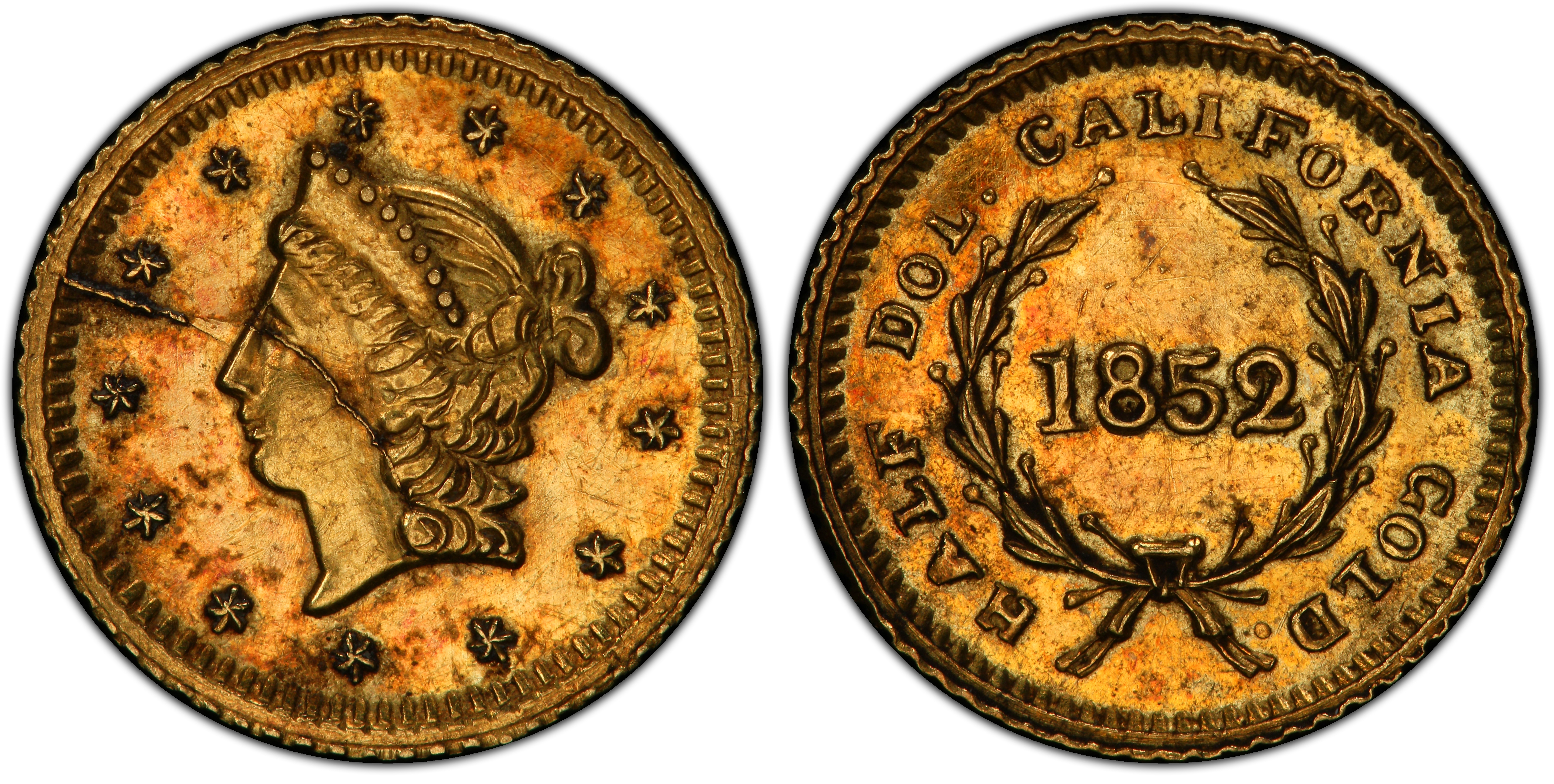
Obverse & Reverse
The 1852 Fifty Cent piece, cataloged as Breen-Gillio 426, is a tangible artifact from the chaotic genesis of California's economy. Following the discovery of gold at Sutter's Mill in 1848, the massive influx of prospectors and entrepreneurs created a vibrant, cash-rich society that paradoxically suffered from a crippling lack of circulating small change. Gold dust, pinches, and nuggets served for larger transactions, but the absence of official U.S. coinage made everyday commerce for goods like food, drink, and supplies incredibly inefficient. The smallest official U.S. gold coin was the dollar, and silver coins were virtually nonexistent on the West Coast, having been hoarded or exported. Into this void stepped a number of private manufacturers, primarily jewelers in San Francisco with the skills and equipment to strike rudimentary coins. These 'Period One' issues, struck from 1852 to 1857, were created out of genuine commercial necessity and were intended to, and did, circulate as a medium of exchange. The BG-426 is a prime example of these indispensable, privately-issued coins. Unlike later 'Period Two' and 'Three' issues, which were often underweight and made as souvenirs, the earliest pieces like BG-426 were generally made with an honest attempt at providing value. Breen and Gillio note that this variety is one of a select few half dollars struck close to its full intended intrinsic worth, using the native gold alloyed with silver that gave these issues their characteristic lighter color. The coins were produced by hand, with steel dies and a sledgehammer, resulting in variable strike quality. Their existence was a direct challenge to the federal government's sole authority to coin money, a practice that would be outlawed by the Coinage Act of 1864, though enforcement in the West was lax until the 1880s. Today, the BG-426 is of the highest rarity, a silent witness to the ingenuity and frontier capitalism that defined the California Gold Rush.
Associated EventCalifornia Gold Rush
Reason For MintingTo alleviate a severe shortage of small denomination coinage for daily commerce in Gold Rush-era California.
Minter HistoryThe minters of most Period One fractional gold pieces, including BG-426, remain anonymous. Historical consensus attributes their manufacture to various jewelers operating in San Francisco. These craftsmen, many of whom were French immigrants, possessed the engraving and striking capabilities necessary to produce small gold coins. They operated outside of federal authority, providing a vital service to the local economy before the San Francisco Mint was fully operational in the mid-1850s. Their work was crude by official mint standards but essential for the region's commerce.
Historical SignificanceAs a 'Period One' issue, the BG-426 represents the most historically important class of California Fractional Gold. These pieces were not souvenirs but were actually used in daily transactions, making them a crucial component of the Gold Rush economy. Its status as an issue struck to a relatively honest weight further distinguishes it. Its extreme rarity today underscores the heavy use and eventual attrition these tiny, essential coins faced.
BG-426
Denomination50 Cents
Minting Period1852
Assayer/MinterAnonymous (Attributed to San Francisco-based jewelers)
Geographic OriginSan Francisco, California
Obverse DescriptionA fairly crude representation of a Liberty Head, facing left, with a coronet. The portrait is encircled by 13 six-pointed stars.
Obverse Inscription Reverse DescriptionThe central device is the denomination '1/2' which is contained within a wreath. The wreath is open at the top and tied with a ribbon bow at the bottom. The legend 'CALIFORNIA GOLD' is inscribed above the wreath, and the date '1852' is below the bow.
Reverse InscriptionCALIFORNIA GOLD 1/2 1852
CompositionGold (from native California bullion, with a naturally high silver content)
Stated Fineness Actual FinenessUnknown, but likely around .880 fine, typical for unrefined California gold.
Weight0.85 grams
Diameter11.00 mm
EdgePlain
Extremely low; precise figures are unknown.
Survival Estimate2-3 known examples
Rarity ScaleR-8 (Extremely Rare)
This coin's appeal lies in its extreme rarity and historical importance as a 'Period One' issue used in actual Gold Rush commerce. Being one of the few varieties struck near its intended weight adds to its desirability. It is a pinnacle acquisition for the advanced specialist in territorial or fractional gold.
Key VarietiesThere are no known major varieties, patterns, or restrikes specifically for the BG-426 die pair. The coin itself is a unique and major variety within the broader series.
Authentication TipsAuthentic Period One fractionals like BG-426 must be denominated; fakes and later souvenirs often omit 'DOLLAR' or 'CENTS' or use generic phrases like 'CAL GOLD CHARM'. Genuine pieces are very thin, often the thickness of a business card. Many originals exhibit weak or uneven strikes due to manual minting, a characteristic often absent in modern, pressure-stamped counterfeits. Replicas frequently feature designs never used on originals, such as bears. Always compare to high-resolution images of certified examples, as subtle die characteristics are the ultimate confirmation.
Shopping ConsiderationsFor a coin of this rarity, any surviving example is a major prize. A 'premium quality' example would be one that is well-centered and shows as much of the design detail as possible, particularly on the high points of Liberty's hair and the wreath leaves. Look for original, uncleaned surfaces, which may have a slightly lighter 'native gold' coloration due to the silver content. Avoid examples that are bent, holed, or have been used as jewelry, although for an R-8 coin, even a damaged specimen is of significant numismatic interest. Third-party certification by PCGS or NGC is absolutely essential for a transaction involving this coin.
A coin's grade is its condition, rated on a 1-70 scale. For rare coins, this is the most critical factor in determining value, as a tiny difference in preservation can mean a huge difference in price.
Relevant Grade TypesAll original BG-426 coins were struck as business strikes for circulation and are found in Circulated (1-58) and, theoretically, Mint State (MS, 60-70) grades. Given the extreme rarity and utilitarian nature of the coin, circulated examples are the norm. No proofs were struck during the original minting period, and there are no known later-date proof restrikes of this specific variety.
Mint State CharacteristicsA true Mint State BG-426, if one exists, would be a numismatic marvel. Quality would be judged by the strength of the strike; these were hand-hammered, so a full, sharp strike would be exceptional and command a massive premium. Luster would be a soft, satiny texture characteristic of unrefined gold alloy, rather than a deep, frosty proof-like sheen. Contact marks from handling and storage would be expected, but large, distracting marks on Liberty's portrait would detract from the grade.
Circulated Wear PatternsWear on this coin would first appear on the highest points: the hair above Liberty's eye and ear, and the high points of the wreath leaves on the reverse. The cheek and the numerals of the date are also susceptible. In lower grades (VG and below), the stars on the obverse and the individual letters in the legend will begin to merge with the fields. The fine details of the bow on the reverse would be one of the first elements to become indistinct.
Key Factors For ValueFor the BG-426, rarity is the dominant value factor. Beyond that, the primary driver is surface preservation. An example with original, uncleaned 'skin' is vastly superior to one that has been harshly cleaned or polished. Sharpness of strike is critical; a well-struck piece showing clear details is highly desirable. Finally, overall eye appeal, meaning a problem-free planchet with attractive original color, contributes significantly. Given the rarity, any certified, genuine example is a major numismatic trophy.
PCGS Price Guide
| Grade | Price | Population |
|---|---|---|
| 58 | $40,000.00 | 1 |
| 58+ | $45,000.00 | N/A |
| 60 | $50,000.00 | N/A |
| 61 | $57,500.00 | N/A |
| 62 | $65,000.00 | 2 |