1853 G50C BG-402 Eagle (Regular Strike)
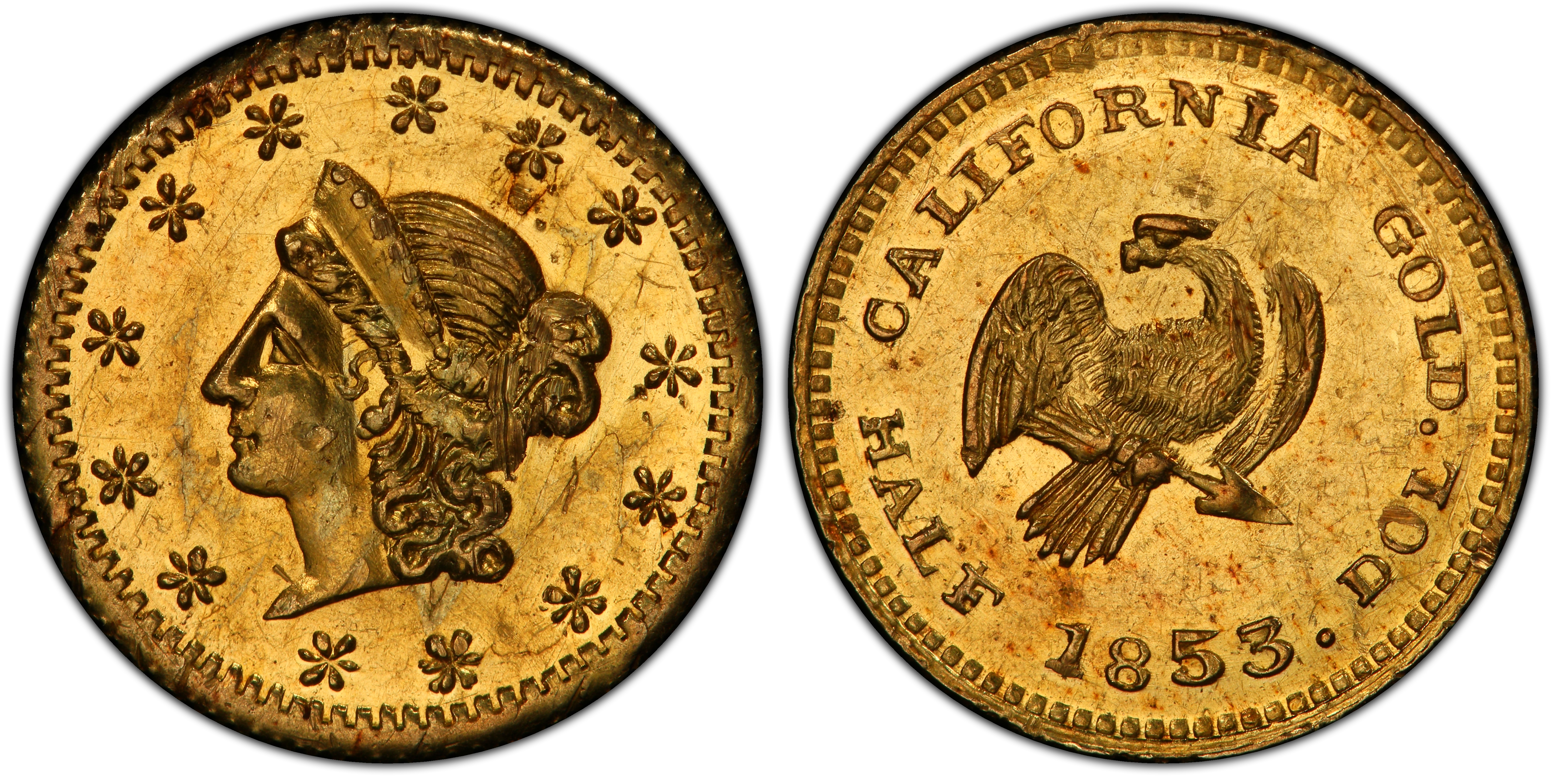
Obverse & Reverse
The 1853 BG-402 Half Dollar is a tangible artifact from the chaotic, formative years of the California Gold Rush. Following the discovery of gold in 1848, a massive influx of prospectors and merchants descended upon California, creating a vibrant but monetarily starved economy. Gold dust and nuggets were plentiful, but the lack of federally issued small-denomination coinage created a severe impediment to daily commerce. A pinch of gold for a drink or small purchase was an imprecise and often contentious system. Into this void stepped a number of private minters, primarily jewelers and metallurgists in San Francisco, who began striking their own coins in 25-cent, 50-cent, and one-dollar denominations starting in 1852. These are collectively known as 'California Fractional Gold.' The BG-402 is classified as a 'Period One' issue (1852-1857), a critical distinction signifying it was produced not as a souvenir, but with the genuine intent to circulate and alleviate the region's chronic shortage of small change. This is strongly supported by numismatic analysis; unlike many later, lighter issues, the BG-402 is one of only a handful of half-dollar varieties struck at or near its full intended intrinsic value. This suggests it was an early, good-faith effort to provide a reliable medium of exchange before the San Francisco Mint began full-scale production of silver and gold coins in 1854 and beyond. These tiny gold pieces, though easily lost, were vital lubricants for the booming Gold Rush economy, enabling transactions for everyday goods and services. However, their small size and the increasing availability of federal coinage led to their gradual disappearance from circulation. By the late 1850s, most fractional gold pieces were made as curiosities or jewelry items, but the BG-402 stands as a testament to the era when private enterprise directly addressed the monetary needs of a frontier society.
Associated EventCalifornia Gold Rush
Reason For MintingTo remedy a severe shortage of small-denomination coinage for everyday commercial transactions in Gold Rush-era California.
Minter HistoryThe specific minter of BG-402 is unconfirmed, as are many Period One issuers. However, the work is attributed to the community of skilled French jewelers and engravers who had settled in San Francisco. These craftsmen, including known figures like Antoine Louis Nouzillet and M. Deriberpie, possessed the requisite skills to create dies and strike coins. They operated small, private workshops and their products, though not officially sanctioned, were essential to the local economy. Their identifying marks were often absent or cryptic, making precise attribution for many varieties like BG-402 a challenge for modern researchers.
Historical SignificanceAs a 'Period One' issue of honest weight, the BG-402 represents the most historically important class of California Fractional Gold. It is a direct monetary solution born of necessity, illustrating the resourcefulness of private citizens on the American frontier before the full establishment of federal infrastructure. It is a relic of a time when the lines between private and public money were blurred by circumstance.
K-Unlisted (Breen-Gillio 402)
Denomination50 Cents
Minting Period1853
Assayer/MinterUnknown San Francisco Jeweler
Geographic OriginSan Francisco, California
Obverse DescriptionA head of Liberty, facing left, with hair tied in a bun. She is encircled by thirteen six-pointed stars. The date, 1853, is below the bust.
Obverse Inscription1853
Reverse DescriptionA heraldic eagle with a shield on its breast, clutching an olive branch and arrows in its talons. The legend is arranged around the periphery.
Reverse InscriptionCALIFORNIA GOLD HALF
CompositionGold
Stated Fineness Actual FinenessVariable, typically from native California gold which contained natural silver alloys.
Weight0.85 grams
Diameter11.50 mm
EdgePlain
Unknown
Survival EstimateFewer than 75 known
Rarity ScaleR-5 (Very Scarce)
The BG-402 is highly sought after as a historically significant 'Period One' issue struck with honest weight, indicating its likely use in actual commerce. Its classic Liberty Head/Eagle design, reminiscent of federal coinage, adds to its appeal. The presence of known die markers allows for precise attribution, making it a favorite of specialists.
Key VarietiesThe BG-402 is itself a key variety. No major variations from the original minting period are known. It is crucial to distinguish this and other Period One business strikes from the later, often lighter 'jeweler's issues' (Period Two) and the backdated tokens (Period Three) that were made primarily as souvenirs and are of lesser historical importance. There are no known restrikes or patterns associated with BG-402.
Authentication TipsThe primary diagnostic for a genuine BG-402 lies in specific die characteristics. According to analysis of the famed Norweb Collection specimen, the obverse exhibits double-punching on the sixth, seventh, and twelfth stars. The reverse die is also diagnostic, showing repunching on the second 'I' in CALIFORNIA and the 'F' in HALF. The strike is often sharp for the series, and the planchet should have a substantive feel consistent with its near-full-weight status. Counterfeits are often underweight, have mushy details, incorrect letter/star placement, or may have a soapy, cast-like surface instead of the sharp, die-struck appearance of originals.
Shopping ConsiderationsA premium quality BG-402 will exhibit a sharp strike, particularly on Liberty's hair details and the eagle's feathers. Original, unconserved surfaces are paramount; many examples have been cleaned or used as jewelry, and these should be avoided or priced accordingly. Look for pleasing, original luster, which can range from satiny to semi-prooflike. Minor, honest circulation wear is expected and accepted, but severe marks or rim damage will significantly detract from the value. Given the coin's tiny size, focusing on examples with excellent eye appeal and problem-free surfaces is key to acquiring a satisfying piece. Certification by a top-tier grading service (PCGS or NGC) is highly recommended for authenticity and liquidity.
A coin's grade is its condition, rated on a 1-70 scale. For rare coins, this is the most critical factor in determining value, as a tiny difference in preservation can mean a huge difference in price.
Relevant Grade TypesAll original BG-402 examples are business strikes intended for circulation. They are found in Circulated grades (AG-3 to AU-58) and, very rarely, in Mint State (MS-60 to MS-70). No proofs were struck during the original minting period, and there are no known later-date collector restrikes. Any piece described as a 'Proof' should be regarded with extreme skepticism and is likely a misattributed prooflike business strike or a modern fake.
Mint State CharacteristicsAn uncirculated BG-402 is exceptionally rare. Quality is defined by a sharp, full strike, particularly on the highest points of Liberty's hair and the eagle's head and wing feathers. Luster is typically bright and satiny, though some examples may be prooflike. Due to the small size and minting process, even Mint State examples may show minor planchet flaws or die polishing lines. Bag marks are less common than on larger coins, but tiny contact marks can be present and will affect the grade.
Circulated Wear PatternsWear first appears on the highest points of the design. On the obverse, check for flatness on Liberty's hair above the eye and on the ear. On the reverse, the eagle's head, the upper portions of the wings, and the shield's horizontal lines are the first areas to show wear. On lower-grade examples, the stars and peripheral lettering will begin to merge with the fields. The date on the obverse and the denomination on the reverse are relatively protected and often remain legible even on well-worn specimens.
Key Factors For ValueFor the BG-402, value is driven by three main factors: 1) Grade and Surface Preservation: An example with minimal wear and original, uncleaned surfaces commands a significant premium. 2) Strike Quality: Sharply struck coins with full details are prized over those with typical central weakness. 3) Eye Appeal: Coins with a smooth, attractive appearance and perhaps a hint of original reddish-gold toning are far more desirable than dull or spotty examples. A CAC sticker for this issue is a strong indicator of superior quality for the grade and will add a substantial premium.
PCGS Price Guide
| Grade | Price | Population |
|---|---|---|
| 60 | $43,500.00 | N/A |
| 61 | $50,000.00 | 1 |
| 62 | $55,000.00 | N/A |
| 62+ | $62,500.00 | N/A |
| 63 | $70,000.00 | 1 |