1854 G50C BG-304B (Regular Strike)
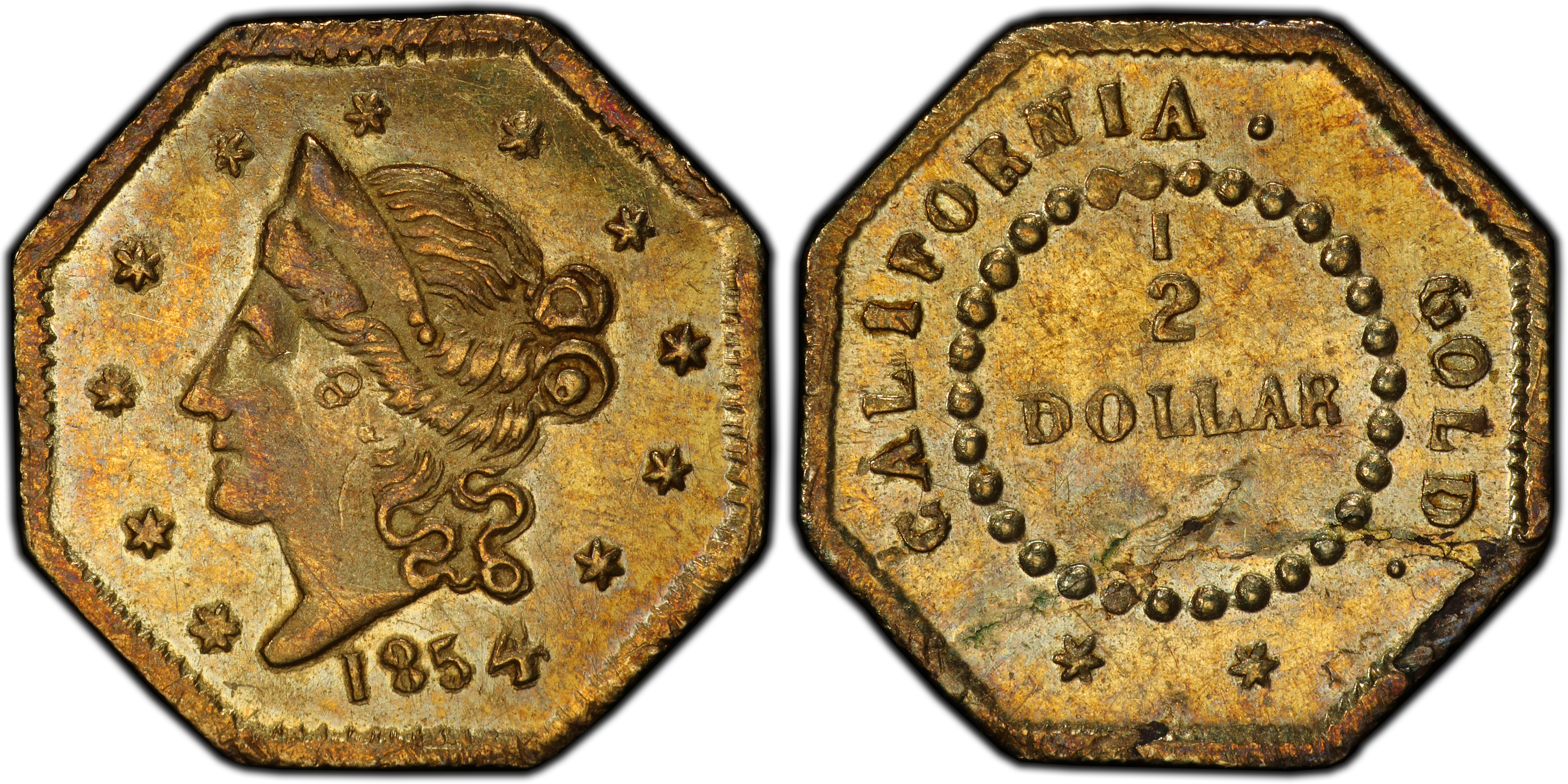
Obverse & Reverse
The 1854 Octagonal Gold 50 Cents, cataloged as Breen-Gillio 304B, stands as one of the most elusive and historically significant issues within the entire corpus of private territorial coinage. Its creation is a direct consequence of the chaotic and economically volatile environment of Gold Rush San Francisco. Following the discovery of gold at Sutter's Mill in 1848, a massive influx of prospectors and merchants flooded into California, creating a vibrant economy almost overnight. However, this boom was severely hampered by a chronic shortage of circulating small-denomination coinage. Gold dust, weighed or estimated by the 'pinch,' served as a clumsy medium of exchange for minor transactions, leading to disputes and inefficiencies. The United States Mint, struggling to establish a significant presence, initially focused on larger denominations, leaving a vacuum for coins valued under a dollar. Into this void stepped a number of enterprising private minters, primarily jewelers and metalsmiths located in San Francisco. Between 1852 and 1857, a period numismatists classify as 'Period One,' these craftsmen produced fractional gold coins in 25-cent, 50-cent, and one-dollar denominations. These Period One issues, unlike the later souvenir pieces of Period Two and Three, were struck with the genuine intent of serving as a circulating medium. They were designed to mimic federal coinage in appearance, featuring Liberty heads and wreaths, and were generally produced with a gold content close enough to their face value to be accepted in local commerce. The BG-304B is a quintessential example of this phenomenon—a tiny, functional piece of gold intended to buy a drink, a meal, or some other daily necessity in a city awash with gold but starved for change. Its octagonal shape was a common feature of the period, possibly to distinguish it from federal issues. The extreme rarity of the BG-304B today suggests an infinitesimally small original mintage, perhaps as a trial or part of a very limited batch that was quickly lost or melted. Its status as a Breen-Gillio Rarity-9 variety places it in the highest echelon of numismatic rarity, with its very existence being a testament to the ad-hoc monetary solutions that defined the American frontier.
Associated EventCalifornia Gold Rush
Reason For MintingTo alleviate a severe shortage of small-denomination coinage for everyday commercial transactions in Gold Rush-era California.
Minter HistoryThe specific minter for BG-304B is unknown, as is common for many fractional gold varieties. Most Period One issues were produced by San Francisco jewelers and artisans, many of French origin, who typically did not sign their work. These individuals possessed the requisite skills in die-sinking and metallurgy to strike these miniature coins, which were often produced by hand using a hammer-and-anvil method. Their operations were small-scale and ceased once the San Francisco Mint began producing sufficient quantities of federal coinage in 1856-1857, making their surviving issues exceedingly rare.
Historical SignificanceThe BG-304B is a tangible artifact of the economic growing pains of the American West. It represents a private, localized solution to a national monetary failure, embodying the spirit of frontier ingenuity. As one of the rarest of all fractional gold pieces, its significance lies not in its widespread use, but in its very existence as evidence of this brief, fascinating, and unofficial chapter in American currency.
N/A
Denomination50 Cents
Minting Period1854
Assayer/MinterUnknown Private Minter
Geographic OriginSan Francisco, California
Obverse DescriptionFeatures a Liberty Head portrait facing left, similar in style to the contemporary U.S. federal gold coinage designed by James B. Longacre. The head is surrounded by thirteen stars representing the original colonies.
Obverse Inscription[None - Pictorial]
Reverse DescriptionA wreath of foliage surrounds the denomination. The date is positioned within the wreath. The design is utilitarian, intended for clear identification of value.
Reverse Inscription1/2 DOLLAR 1854
CompositionGold
Stated Fineness Actual FinenessVariable, but typically .800 to .900 for Period One issues, often with a natural silver alloy from unrefined California gold.
EdgePlain
Extremely low, likely fewer than a dozen.
Survival Estimate1-2 known specimens.
Rarity ScaleR-9 (Breen-Gillio Scale), indicating a unique or nearly unique item.
This coin represents a 'holy grail' for the advanced specialist in California fractional gold. Its appeal is rooted in its legendary rarity (R-9) and its status as a true circulating issue from Period One. Owning a BG-304B is to possess one of the ultimate rarities in the entire field of U.S. private and territorial coinage.
Key VarietiesThe BG-304B is a terminal variety itself, with no known sub-varieties from the original minting period. There are no known restrikes or pattern pieces associated with this specific die pairing. The closely related BG-304A is a distinct variety of similar rarity from the same year. The broader 1854 G50C series contains several other BG numbers (e.g., BG-305, BG-306) from different dies and minters, each a collectible variety in its own right.
Authentication TipsAuthentication is paramount for any fractional gold piece, and especially for a great rarity like BG-304B. Authenticity should only be determined by leading experts or third-party grading services. Key diagnostics would involve precise die characteristic matching against the known genuine example(s). Look for the correct placement of stars, date numerals, and letters. Genuine Period One pieces have a distinct fabric; they are often weakly or unevenly struck due to the hammer-striking process. They should not have the artificial look, uniform thickness, or suspicious surfaces (e.g., casting bubbles, tool marks around lettering) of common modern replicas. Most fakes are either gold-plated brass or lack the denomination 'DOLLAR', instead using 'CALIFORNIA GOLD' or featuring a bear on the reverse.
Shopping ConsiderationsAcquisition of a BG-304B is a once-in-a-generation event, typically occurring only when a legendary collection is liquidated at a major auction. A potential buyer should expect to pay a significant six-figure sum. The primary consideration is pedigree; a documented chain of ownership tracing back through major numismatic collections (e.g., Roe, Totheroh) is essential. For this coin, 'premium quality' is defined by its mere existence and authenticity rather than its numerical grade. Any example, even if circulated or impaired, would be a cornerstone of a collection. Focus on verifying the coin's authenticity and provenance above all else. Certification by PCGS or NGC is non-negotiable.
A coin's grade is its condition, rated on a 1-70 scale. For rare coins, this is the most critical factor in determining value, as a tiny difference in preservation can mean a huge difference in price.
Relevant Grade TypesOriginal BG-304B coins were business strikes intended for circulation and are found in Circulated (1-58) and Mint State (MS, 60-70) grades. Given the coin's function, circulated examples are the norm for the type, though a Mint State specimen may exist. No proofs were struck during the original period of issue, and there are no known later-date collector restrikes for this specific variety.
Mint State CharacteristicsA theoretical Mint State BG-304B would be judged on the sharpness of its strike and the quality of its luster. Due to the primitive minting techniques, even an uncirculated example would likely show some weakness in the centers of the design, particularly on the highest points of Liberty's hair and the wreath. Luster would be soft and satiny, characteristic of unrefined California gold alloy. Contact marks would be expected due to the softness of the metal, but large, distracting marks would detract from the grade.
Circulated Wear PatternsFor octagonal Liberty Head half dollars of this period, wear first appears on the high points of Liberty's coronet, cheek, and hair curls above the ear. On the reverse, the highest points of the wreath leaves and the digits of the date will show initial friction and flattening. In lower grades (VF and below), the stars on the obverse and the lettering on the reverse will become soft and begin to merge with the fields.
Key Factors For ValueFor a legendary rarity like BG-304B, the single most important factor for value is authenticity, confirmed by a top-tier grading service and supported by a strong pedigree. The numerical grade is a secondary, albeit important, consideration. Any example with its original surfaces, free from harsh cleaning, tooling, or significant damage, would command an immense premium. Eye appeal, including attractive original coloration from the native gold-silver alloy, also contributes significantly to its desirability among the handful of collectors who could ever hope to acquire it.
PCGS Price Guide
| Grade | Price | Population |
|---|---|---|
| 58 | $11,500.00 | 1 |