1871 25C BG-717, PL (Regular Strike)
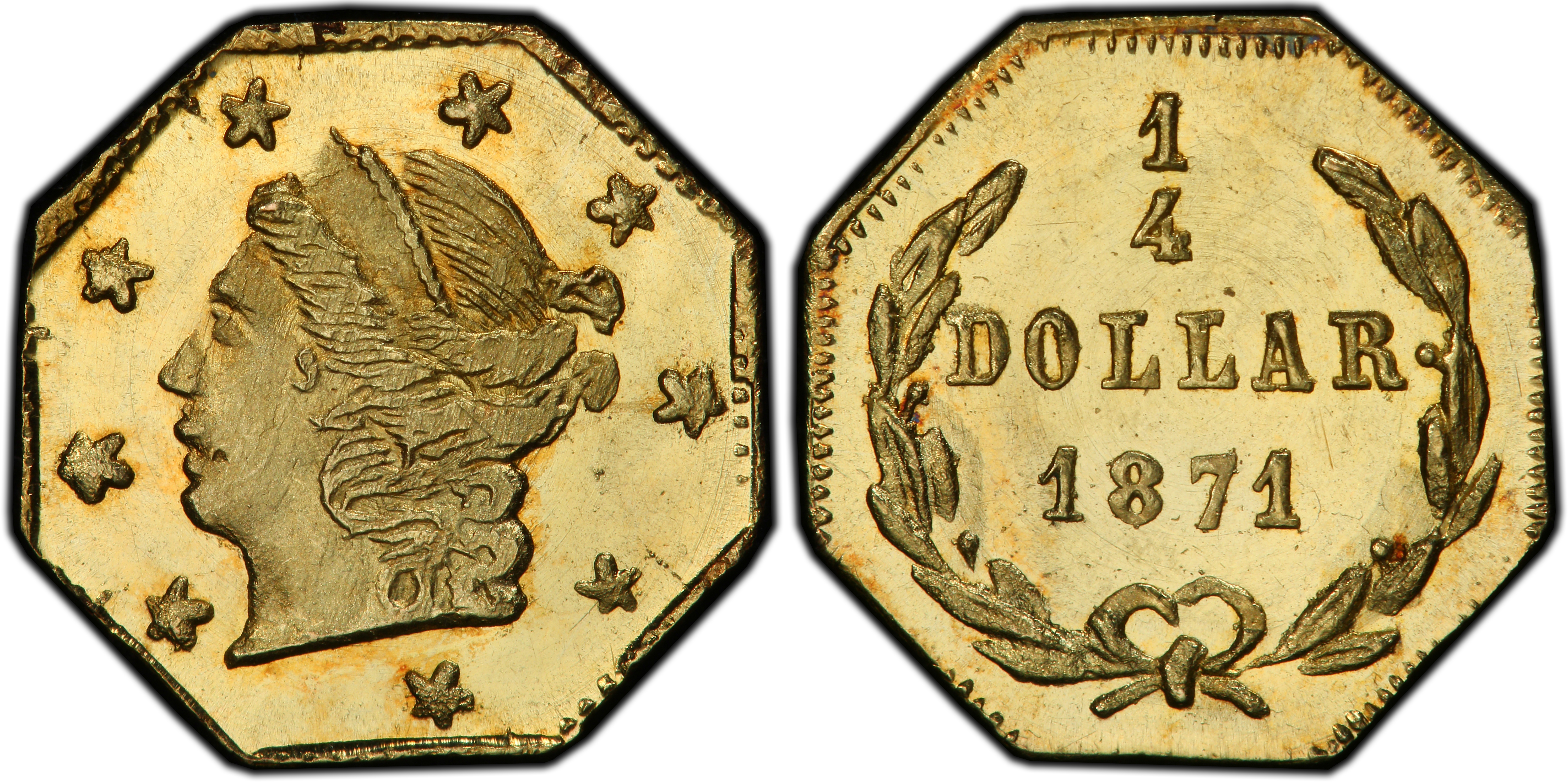
Obverse & Reverse
The 1871 BG-717 25 Cents token emerges from the second major phase of California Fractional Gold production (1859-1882). Unlike the initial 'Period One' issues, which were struck with a higher intrinsic value to genuinely alleviate the severe shortage of small change during the Gold Rush, these 'Period Two' pieces, often termed 'jeweler's issues,' had a more complex role. By the 1870s, the initial chaos of the Gold Rush had subsided, and the San Francisco Mint was in full operation, reducing the functional need for private coinage. However, local commerce, particularly for small transactions, still faced inconveniences. Simultaneously, California had become a destination, and a powerful sense of regional pride and romanticism about the '49er era was growing. Private minters, many of whom were jewelers of French origin, stepped into this dual market. They produced beautifully crafted, yet typically underweight, gold tokens that served both as occasional currency in a pinch and, more importantly, as popular souvenirs and keepsakes for tourists and residents alike. The Coinage Act of 1864 had officially prohibited private coinage, but enforcement on the remote West Coast was lax until the early 1880s, allowing this cottage industry to persist. These tiny gold pieces were tangible symbols of the state's immense gold wealth and the independent spirit of the frontier. The BG-717, with its distinctive Liberty head and octagonal shape, is a quintessential example of this later period, embodying the transition from a purely utilitarian private currency to a cherished numismatic and historical memento. Its existence reflects a unique chapter in American economic history where federally-issued money had not yet fully monopolized circulation, leaving a niche for these fascinating and historic private issues.
Associated EventCalifornia Gold Rush (Later Period)
Reason For MintingTo serve a dual role as circulating currency for small transactions and as souvenirs for a growing tourism trade in post-Gold Rush California.
Minter HistoryThe specific minter or jeweler responsible for the BG-717 variety is not definitively known, a common trait for many Period Two California Fractional Gold issues. During this era, several partnerships of French jewelers, such as Deriberpe & Nouizillet (D.N.) and Frontier & Deviercy (F.D.), were active in San Francisco. These artisans used their skills to create a wide variety of intricate and competing designs, often not marking their work with identifiable initials. Their primary business was jewelry, and the minting of these small gold pieces was a profitable sideline that capitalized on the abundant local gold and the public's fascination with it.
Historical SignificanceThis coin is significant as a representative of the 'jeweler's issue' period of California Fractional Gold, highlighting the transition of private coinage from a necessary medium of exchange to a commercial and souvenir product. It demonstrates the lingering economic independence of the American West and the continued demand for gold in daily life, even after the establishment of a federal mint in San Francisco.
BG-717
Denomination25 Cents
Minting Period1871
Assayer/MinterUnknown Private Minter
Geographic OriginSan Francisco, California
Obverse DescriptionA Liberty Head facing left, often described as a 'Broad head' with a characteristically incomplete nose. The head is surrounded by 13 crudely rendered stars, with the date 1871 below.
Obverse Inscription1871
Reverse DescriptionThe denomination '25 CENTS' is enclosed within a wreath of leaves and berries. A key diagnostic for this variety is a large, prominent berry attached to the inside of the wreath near the center of the 'R' in 'CENTS'.
Reverse Inscription25 CENTS
CompositionGold
Stated Fineness Actual Fineness EdgePlain
Unknown
Survival Estimate100-150
Rarity ScaleR-3 to R-4
The BG-717 is sought after for its classic octagonal shape, distinctive Liberty Head design, and specific die characteristics. Examples with prooflike (PL) or cameo (CAM) surfaces are particularly prized, offering a gem-like aesthetic that appeals to collectors who value exceptional eye appeal in this historic series.
Key VarietiesThe primary variety recognized by grading services is the Prooflike (PL) striking. While produced as regular business strikes, some were made using highly polished dies, resulting in coins with mirrored fields. No original-period proofs or later restrikes are known to exist for this specific variety.
Authentication TipsAuthentic examples must exhibit the specific die markers of the BG-717 variety: an obverse with a broad Liberty head, an incomplete nose, and crude stars. The key reverse diagnostic is the large berry attached to the inside of the wreath by the 'R'. Counterfeits often have incorrect details, a soapy or cast appearance, and may be made of brass or thinly plated gold. Weight and specific gravity tests can also help identify non-gold copies.
Shopping ConsiderationsA premium quality BG-717 is defined by a sharp strike, which is not always a given with these private issues. Look for full definition in Liberty's hair and the details of the wreath. The most desirable pieces will have deeply reflective, prooflike fields, often with frosted devices creating a cameo contrast. Original, undisturbed surfaces with attractive orange-gold toning command significant premiums. Common problems to avoid include cleanings, which dull the luster and leave hairline scratches, and jewelry use, such as solder marks or holing, which drastically reduces numismatic value.
A coin's grade is its condition, rated on a 1-70 scale. For rare coins, this is the most critical factor in determining value, as a tiny difference in preservation can mean a huge difference in price.
Relevant Grade TypesOriginal 1871 BG-717 issues were business strikes intended for commerce or sale as souvenirs, and they are found in Circulated (1-58) and Mint State (MS, 60-70) grades. No Proofs (PR/PF) were struck during the original period of issue, and no later-date restrikes are known. The 'PL' designation for 'Prooflike' is a surface characteristic applied to exceptional business strikes and is highly desirable.
Mint State CharacteristicsIn uncirculated (MS) grades, the quality is determined by luster, strike, and marks. Luster on BG-717 can range from satiny to deeply prooflike. The strike can be inconsistent; well-struck examples will show detail in Liberty's hair curls and the individual leaves of the wreath. Softer strikes often show flatness on the high points and a less-defined nose. Due to the softness of the gold and their small size, even high-grade examples can show minor contact marks from handling or storage with other pieces.
Circulated Wear PatternsWear first appears on the highest points: Liberty's cheek, hair above the eye, and the ear. On the reverse, the bow of the wreath and the highest leaves will show friction first. As wear progresses, the stars on the obverse will become faint and the finer details of the wreath will merge. In lower grades (VG and below), the date and legends will begin to weaken.
Key Factors For ValueFor the BG-717, the single most important factor for value is surface quality. An example with original, lustrous surfaces will be worth multiples of a cleaned or polished coin of the same grade. The presence of a Prooflike (PL) or Cameo (CAM) designation from a major grading service (PCGS or NGC) adds a significant premium. A sharp, well-centered strike and attractive, original toning also contribute heavily to eye appeal and market value. A CAC sticker for this issue is highly valued as it confirms premium quality for the assigned grade.
PCGS Price Guide
| Grade | Price | Population |
|---|---|---|
| 67 | $2,150.00 | 1 |