1856 G25C BG-228 (Regular Strike)
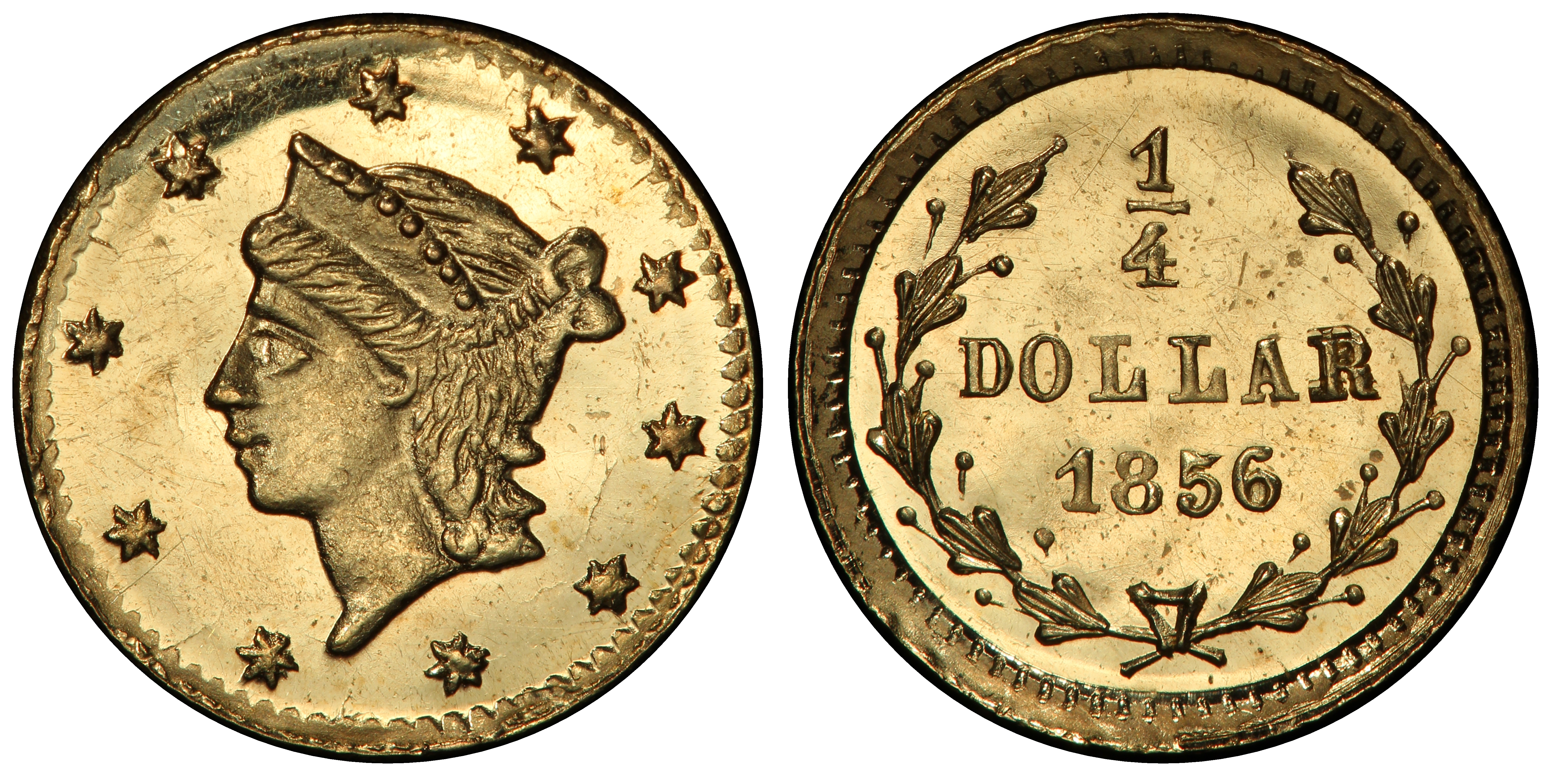
Obverse & Reverse
The 1856 BG-228 25 Cent piece is a quintessential artifact from the final year of the initial, utilitarian phase of California Fractional Gold, known to numismatists as 'Period One' (1852-1856). The California Gold Rush, which began in 1848, flooded the region with people and raw gold, yet the economy was paradoxically starved for circulating small-denomination coinage. Gold dust, weighed in 'pinches,' was an imprecise and cumbersome medium for minor transactions. While private assayers and minters began issuing larger denomination coins ($5 and up) as early as 1849, the critical need for coins valued under a dollar remained unmet. Into this commercial vacuum stepped a number of San Francisco jewelers and artisans, many of French origin, who began striking their own fractional gold pieces in quarter dollar, half dollar, and dollar denominations starting in 1852. These were not government issues, but privately manufactured coins intended to facilitate everyday trade. The BG-228 was struck at the zenith of this practice, just as the newly established San Francisco Mint (opened in 1854) was finally ramping up production of federal silver and gold coinage. By the end of 1856, the widespread availability of official U.S. coins rendered the private fractionals obsolete for their original purpose. This historical context is critical: the BG-228 was not a souvenir, but a functional piece of money created to solve a real economic problem. Its existence speaks to the ingenuity and ad-hoc capitalism of the Gold Rush frontier. After 1856, the production of fractional gold ceased, only to be revived a few years later as 'Period Two' issues, which were primarily made as souvenirs and jewelry items, often with debased gold content. The BG-228, as a Period One issue, represents the authentic, circulating coinage of the era and is therefore highly prized by collectors of Pioneer Gold.
Associated EventCalifornia Gold Rush
Reason For MintingTo alleviate a severe shortage of small-denomination circulating coinage for daily commerce in Gold Rush-era California.
Minter HistoryThe specific minter or jeweler responsible for the BG-228 variety is unknown, a common circumstance for many Period One California Fractional Gold issues. Production was not centralized, and many pieces were either unsigned or bore the initials of partnerships like Frontier, Deviercy & Co. (F.D.) or Antoine Louis Nouizillet. These artisans used their existing skills and tools, such as screw presses or even simple hammer dies, to create the tiny coins. Their primary business was jewelry, and coin minting was an opportunistic and temporary sideline to meet a pressing local demand.
Historical SignificanceThis coin is a tangible link to the raw, unregulated economy of the California Gold Rush. It represents a private, local solution to a failure in the national monetary supply. As a 'Period One' issue, it is considered a legitimate circulating coin of the Territorial period, unlike the later souvenir issues. Its extreme rarity underscores the ephemeral nature of these privately minted coins, most of which were lost or melted once official U.S. coinage became plentiful.
N/A
Denomination25 Cents
Minting Period1856
Assayer/MinterUnknown Private Minter
Geographic OriginSan Francisco, California
Obverse DescriptionA small Liberty Head, facing left, with hair tied in a bun. The portrait is encircled by thirteen six-pointed stars, representing the original colonies. The engraving style is typically somewhat crude compared to federal coinage of the period.
Obverse Inscription Reverse DescriptionThe denomination '1/4' appears at the top, with 'DOLLAR' below it, and the date '1856' at the bottom. This is all enclosed within a continuous, simple wreath composed of two branches tied with a bow at the base.
Reverse Inscription1/4 DOLLAR 1856
CompositionGold
Stated FinenessNot explicitly stated on the coin. Period One issues were generally made from native California gold, which naturally contained silver, resulting in a fineness typically ranging from .800 to .900.
Actual FinenessNot specifically known for this variety, but assumed to be consistent with other Period One issues. Most were slightly underweight for their face value even when struck from high-purity gold.
EdgePlain
Unknown
Survival Estimate4-6 known specimens.
Rarity ScaleR-7 (Extremely Rare)
The BG-228 is highly coveted for its extreme rarity (R-7) and its status as a 'Period One' issue, representing the authentic circulating coinage of the Gold Rush. As one of the final issues of this period, it holds a special place for specialists. The miniature size and historical importance make it a compelling piece of Western Americana.
Key VarietiesThis is a specific die marriage (BG-228). Within California Fractional Gold, there are no known official restrikes or patterns for this variety. Collectors should be aware of the broader categories: 'Period One' (1852-1856) issues intended for circulation, and 'Period Two' (1859-1882) issues, which were primarily souvenirs and often have different designs or lower gold content. Counterfeits and modern replicas are extremely common in the Cal Gold series.
Authentication TipsAuthentic Period One fractionals like BG-228 are denominated ('DOLLAR' or 'CENTS'). Replicas often lack a denomination or feature anachronistic designs, like a bear on the reverse (the 'bear flag' design is a major red flag for counterfeits). Genuine pieces were struck on very thin planchets, often weakly struck in areas, and can have a slightly wavy appearance. Replicas are often thicker, have a soapy or cast-like appearance, and may have incorrect weights. Familiarity with the die characteristics shown in the Breen-Gillio reference is the best defense.
Shopping ConsiderationsFor an R-7 variety, any opportunity to acquire an example is significant. A 'premium quality' example would be one that is well-centered and reasonably well-struck for the issue, showing clear details in Liberty's hair and the wreath. Original, uncleaned surfaces with some remaining luster are exceptionally rare and command huge premiums. Most known examples will be circulated. Be wary of coins that have been harshly cleaned, polished, or mounted in jewelry, as this is common. Look for signs of tooling or repairs in the fields. A coin certified by PCGS or NGC is essential for a transaction of this rarity and value.
A coin's grade is its condition, rated on a 1-70 scale. For rare coins, this is the most critical factor in determining value, as a tiny difference in preservation can mean a huge difference in price.
Relevant Grade TypesAll original 1856 BG-228 coins are business strikes, intended for circulation. They are found in Circulated grades (AG-3 to AU-58) and, very rarely, in Mint State (MS-60 to 70). No proofs were struck during the original minting period. No later-date proof restrikes are known to exist for this specific variety.
Mint State CharacteristicsA true Mint State BG-228 is almost unknown. If one were to surface, its quality would be judged by the sharpness of the strike, particularly on the highest points like Liberty's hair bun and the bow of the wreath. Luster on these pieces is typically subdued and satiny rather than deeply frosty. Due to the crude manufacturing process, even uncirculated examples can exhibit planchet flaws, waviness, and striking weakness. Light adjustment marks (file marks to adjust planchet weight) would not be unusual.
Circulated Wear PatternsWear first appears on the highest points of the design. On the obverse, check for flatness on the hair above Liberty's eye and on her cheek. On the reverse, the high points of the wreath's leaves and the tie on the bow will show the first signs of smoothing. In lower grades (VG and below), the stars on the obverse will begin to merge with the field, and the date and denomination on the reverse will become faint.
Key Factors For ValueRarity is the primary driver of value for BG-228. Given that, the key differentiators are grade and surface quality. An example with original, uncleaned surfaces is paramount and worth a substantial premium over a cleaned or damaged piece in the same grade. Strike quality is also critical; a specimen with a sharp, well-centered strike is more desirable than a weakly struck or off-center one. Finally, any example with a certification from PCGS or NGC, particularly with a CAC sticker indicating premium quality for the grade, will be the most valuable and liquid in the market.
PCGS Price Guide
| Grade | Price | Population |
|---|---|---|
| 53 | $3,750.00 | N/A |
| 53+ | $4,000.00 | N/A |
| 55 | $4,500.00 | 2 |
| 55+ | $4,750.00 | N/A |
| 58 | $5,250.00 | 1 |
| 58+ | $6,000.00 | N/A |
| 60 | $7,500.00 | N/A |
| 61 | $8,750.00 | N/A |
| 62 | $10,000.00 | 4 |
| 62+ | $11,500.00 | N/A |
| 63 | $15,000.00 | 1 |
| 63+ | $16,500.00 | N/A |
| 64 | $20,000.00 | 1 |