1871 25C BG-714 (Regular Strike)
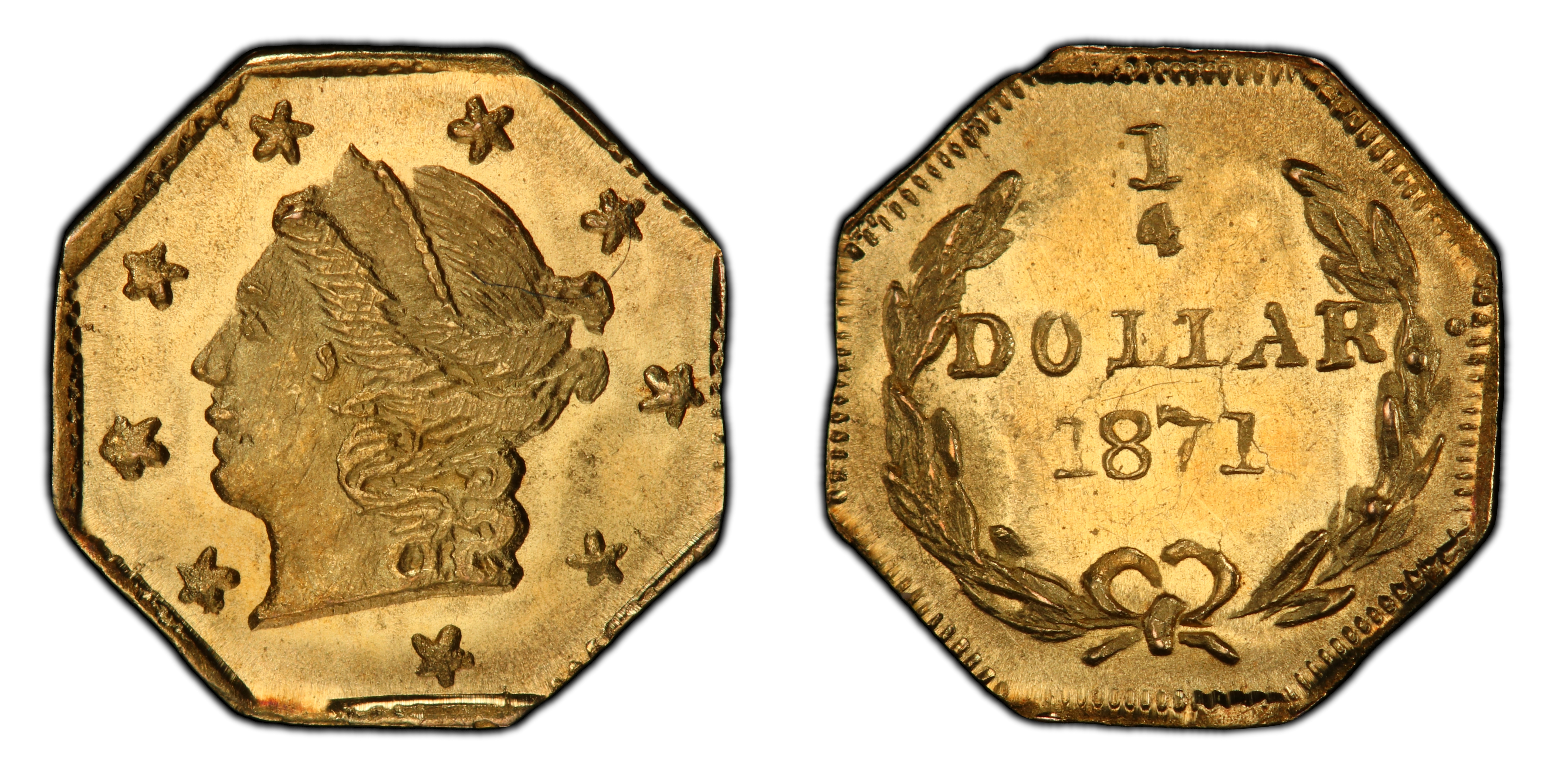
Obverse & Reverse
The 1871 BG-714 25-cent piece emerges from the second major phase of California fractional gold production, often termed 'Period Two' (1859-1882) by numismatists following the classification system established by Walter Breen and Ronald J. Gillio. By this era, the acute shortage of small change that had plagued California in the early 1850s had been largely resolved by the output of the federal San Francisco Mint, which opened in 1854. Consequently, the primary purpose of these tiny gold pieces shifted from utilitarian commerce to the burgeoning souvenir and jewelry trade. San Francisco was becoming a major tourist destination, and visitors from the East Coast and Europe were eager for keepsakes of the famous Gold Rush. Enterprising jewelers, many of French origin like the proprietors of Frontier & Co., astutely filled this demand. Unlike the 'Period One' issues which were struck with at least a pretense of conforming to federal weight and fineness standards, the 'Jeweler's Issues' of Period Two were notoriously underweight and often of debased purity. Their legality was dubious at best, existing in a gray area until the Secret Service began to crack down more forcefully on private coinage in the early 1880s. The production methods were often rudimentary, employing hand-cut dies and manual screw presses or even hammer striking, which resulted in significant variations in strike quality. The BG-714 was produced by Frontier & Co., a successor firm to Frontier, Deviercy & Co., a prominent name in the San Francisco jewelry scene. These pieces were never intended to be a mainstay of circulation, but their novelty meant they were widely disseminated as charms, gifts, and pocket pieces. While some undoubtedly were passed fraudulently as actual quarter dollars in commerce, their primary role was that of a memento, a tangible, glittering piece of the California dream, long after the initial frenzy of the Gold Rush had subsided. Their modern numismatic significance lies in their direct connection to this fascinating transitional period in California's economic and social history, representing the commercialization of the Gold Rush mythos.
Associated EventCalifornia Gold Rush Aftermath & Tourism Boom
Reason For MintingPrimarily created to be sold as souvenirs and jewelry charms to tourists in San Francisco, not for general circulation.
Minter HistoryFrontier & Co. was a San Francisco-based jewelry firm that succeeded the partnership of Frontier & Deviercy. These French jewelers were among the most prolific producers of 'Period Two' California fractional gold. They utilized common die punches across various denominations and designs, creating an extensive and complex series of souvenir coinage throughout the 1860s and into the 1870s.
Historical SignificanceThe BG-714 is a quintessential example of a 'Jeweler's Issue,' representing the shift in fractional gold from a necessary form of currency to a commercial souvenir. It encapsulates the romanticism and tourist trade that grew out of the Gold Rush, making it a tangible artifact of California's evolving identity in the post-frontier era.
N/A
Denomination25 Cents
Minting Period1871
Assayer/MinterFrontier & Co.
Geographic OriginSan Francisco, California
Obverse DescriptionA small, somewhat crude Liberty Head faces left, surrounded by 13 five-pointed stars. The portrait detail is typically soft, a characteristic of many fractional gold issues from this period. The date, 1871, is below the bust truncation.
Obverse Inscription1871
Reverse DescriptionThe denomination '1/4' appears in the center, enclosed within a wreath. The wreath is composed of two branches tied with a bow at the bottom. Above the fraction and within the wreath is the word 'DOLLAR'. The legend 'CALIFORNIA GOLD' is inscribed in an arc around the upper periphery, outside of the wreath.
Reverse InscriptionCALIFORNIA GOLD / 1/4 DOLLAR
CompositionGold
Stated Fineness Actual FinenessVariable, often lower than federal standards for coinage, as was typical for Period Two issues.
EdgePlain
Unknown
Survival Estimate50-75 known. Based on combined NGC and PCGS population reports (totaling over 55 graded examples as of late 2024) and accounting for ungraded specimens.
Rarity ScaleR-5 (Very Rare)
This variety appeals to specialists in the vast and complex series of California fractional gold. Its octagonal shape, clear date, and attribution to a known maker (Frontier & Co.) make it a desirable type coin. High-grade examples are particularly sought after for their sharp details and lustrous, prooflike surfaces.
Key VarietiesThe BG-714 is a specific die marriage and does not have major varieties from its original minting period. No special collector issues, patterns, or restrikes are known to exist for this specific variety.
Authentication TipsGenuine pieces will have a specific die alignment and lettering style consistent with other Frontier & Co. products. Counterfeits often have incorrect lettering fonts, a mushy or cast appearance, and may be gold-plated brass, which will have an incorrect weight and specific gravity. A key diagnostic for many genuine fractionals is a somewhat weak or uneven strike, whereas modern fakes are often unnaturally sharp and uniform. All genuine Period Two issues must be denominated (e.g., 'DOLLAR'); pieces that say 'CAL GOLD' without a denomination are typically modern charms.
Shopping ConsiderationsA premium quality example for its grade will exhibit a sharp, well-centered strike, which is uncommon for the issue. Look for good definition in Liberty's hair and the stars on the obverse, and the bow and leaves of the wreath on the reverse. Original, prooflike or semi-prooflike surfaces are highly desirable and command a significant premium. Check carefully for evidence of having been mounted in jewelry, such as rim damage, solder marks, or tooling. Cleaning is also common; a coin with original, unmolested 'skin' and deep luster is far superior to a harshly cleaned one, even if the latter is technically in the same grade bracket.
A coin's grade is its condition, rated on a 1-70 scale. For rare coins, this is the most critical factor in determining value, as a tiny difference in preservation can mean a huge difference in price.
Relevant Grade TypesOriginal issues of BG-714 were business strikes, although many were produced with prooflike surfaces for souvenir sales. They are found in Circulated (1-58) and Mint State (MS, 60-70) grades. No true Proofs were struck during the original period of issue, and no later-date Proof restrikes are known. The term 'Prooflike' (PL) is a designation added to Mint State coins that have mirror-like surfaces.
Mint State CharacteristicsUncirculated examples are defined by their luster. High-quality pieces display frosty devices against semi-prooflike or prooflike fields. The strike is a key differentiator; many are softly struck in the center, so a sharp strike on the Liberty portrait and the wreath is a mark of quality. Due to the nature of their production and handling as souvenirs, even high-grade Mint State examples can show minor planchet flaws or light contact marks. A superior coin will be well-centered and free of distracting marks in the primary focal areas.
Circulated Wear PatternsWear first appears on the highest points: Liberty's cheek, hair details above the eye, and the ear. On the reverse, the high points of the wreath's leaves and the bow knot will show the first signs of friction and flattening. In lower grades (VF and below), the stars on the obverse will begin to lose their points and the fine details of the wreath will merge.
Key Factors For ValueFor the BG-714, the key value drivers are surface quality and strike. An example with deeply reflective, prooflike fields and sharply struck devices will command a substantial premium over a typical, softly struck piece of the same grade. Eye appeal is paramount; coins with original, vibrant gold luster are preferred over those that are dull or have been cleaned. Finally, certification by a top-tier service (PCGS or NGC) is essential for market acceptance, with a CAC sticker adding a further premium for coins deemed superior for their assigned grade.
PCGS Price Guide
| Grade | Price | Population |
|---|---|---|
| 53 | $180.00 | 1 |
| 53+ | $185.00 | N/A |
| 55 | $190.00 | 1 |
| 55+ | $200.00 | N/A |
| 58 | $220.00 | 4 |
| 58+ | $230.00 | N/A |
| 60 | $240.00 | 1 |
| 61 | $250.00 | 1 |
| 62 | $260.00 | 21 |
| 62+ | $275.00 | N/A |
| 63 | $300.00 | 24 |
| 63+ | $320.00 | N/A |
| 64 | $400.00 | 32 |
| 64+ | $460.00 | N/A |
| 65 | $700.00 | 49 |
| 65+ | $800.00 | N/A |
| 66 | $900.00 | 31 |
| 66+ | $1,100.00 | 3 |
| 67 | $2,000.00 | 7 |
| 67+ | $4,000.00 | 1 |
| 68 | $10,500.00 | 1 |