(1853) G25C BG-201 (Regular Strike)
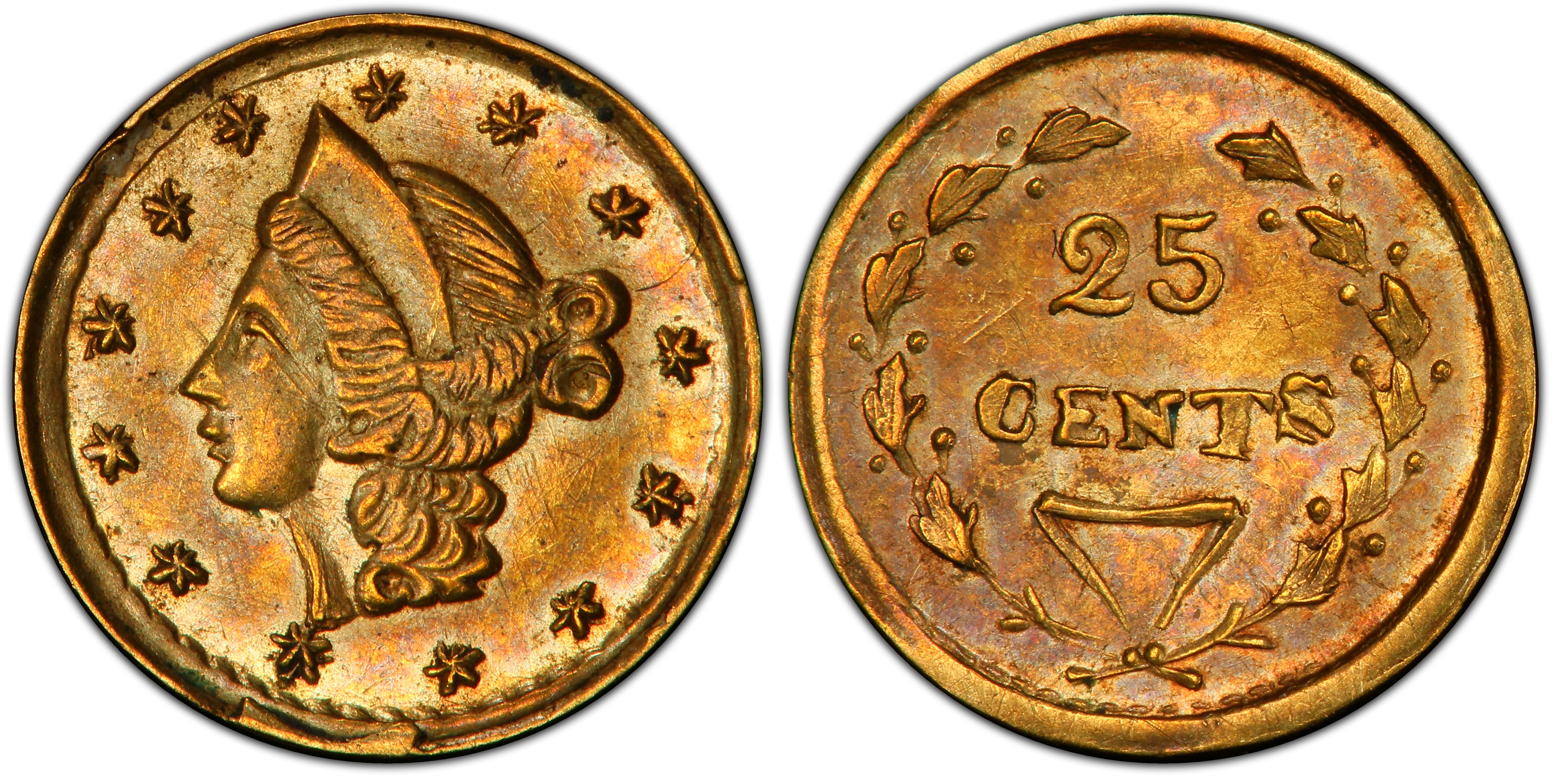
Obverse & Reverse
The BG-201 25 Cents is a quintessential example of a 'Period One' California Fractional Gold piece, a series born of necessity and ingenuity during the height of the California Gold Rush. Following the discovery of gold at Sutter's Mill in 1848, a massive influx of prospectors and merchants flooded into California. While large transactions could be settled with gold dust, nuggets, or the hefty private assayer ingots and coins being produced, daily commerce was severely hampered by a chronic shortage of small denomination coinage. The nearest U.S. Mint was in New Orleans, an arduous and dangerous journey away. Common transactions for food, lodging, or a drink became exercises in estimation, often using a 'pinch' of gold dust, a notoriously inaccurate and contentious method. To fill this critical void, jewelers and metalsmiths in booming cities like San Francisco began striking their own tiny gold coins in 25-cent, 50-cent, and one-dollar denominations. These 'Period One' issues, struck from 1852 to roughly 1857, were generally made with the intent to circulate and alleviate the small change crisis. They were struck from native California gold, which often contained a high percentage of silver, giving them a distinct lighter color. The BG-201, attributed to the French jeweler Antoine Louis Nouizillet, is one of the earliest of these efforts. Its simple, almost crude, Liberty Head design mimics the style of the official U.S. gold coinage of the era, a deliberate choice to inspire public confidence. These pieces were indispensable for a short time, but the opening of the San Francisco Mint in 1854 and its subsequent full-scale production of federal coinage by 1856 rendered them obsolete. Most were eventually melted down, contributing to their immense rarity today. The BG-201 is not merely a coin but a tangible artifact from a chaotic and foundational period in American economic history, representing a private solution to a public monetary failure.
Associated EventCalifornia Gold Rush
Reason For MintingTo provide a circulating medium for small commercial transactions due to a severe shortage of U.S. government-issued small change in Gold Rush California.
Minter HistoryAntoine Louis Nouizillet was one of several French jewelers and artisans who emigrated to San Francisco during the Gold Rush. Capitalizing on the abundance of raw gold and the desperate need for coinage, these craftsmen applied their skills to minting. Nouizillet is one of the few positively identified makers of Period One fractional gold. His rudimentary equipment and hand-cut dies resulted in coins with a distinctive, somewhat primitive character. Like many of his contemporaries, his minting operations were likely small-scale and ceased once the official San Francisco Mint began adequately supplying the region with federal coinage.
Historical SignificanceAs a 'Period One' issue, the BG-201 is a historically significant piece that is believed to have actually circulated to facilitate commerce. It represents a crucial, albeit temporary, phase in the monetary development of the American West before the establishment of formal federal minting operations. Its extreme rarity today underscores the ephemeral nature of these private issues, most of which were withdrawn and melted once their purpose was served.
N/A
Denomination25 Cents
Minting Period1853
Assayer/MinterAntoine Louis Nouizillet
Geographic OriginSan Francisco, California
Obverse DescriptionA crude, somewhat bulbous depiction of a Liberty Head facing left, modeled after the contemporary U.S. gold dollar. The head is surrounded by thirteen small, irregularly spaced six-pointed stars.
Obverse Inscription Reverse DescriptionThe denomination '1/4' is enclosed within a simple wreath composed of two branches tied together at the bottom with a bow. Along the upper periphery, outside the wreath, is the legend 'CALIFORNIA GOLD'.
Reverse InscriptionCALIFORNIA GOLD 1/4
CompositionGold
Stated Fineness Actual FinenessTypically .800 to .880, containing native silver.
Weight0.25 grams
Diameter9.50 mm
EdgePlain
Extremely low, likely fewer than 100.
Survival Estimate6-7 known examples.
Rarity ScaleHigh R-7
The BG-201 is a prize for the advanced specialist in California or Territorial gold. Its appeal lies in its extreme rarity, its status as a true 'Period One' circulating issue, its charmingly primitive artistry, and its direct connection to the chaotic commercial environment of the San Francisco Gold Rush.
Key VarietiesThere are no known major varieties, patterns, or restrikes specifically for the BG-201 die pair. All known examples are considered original business strikes from the 1853 period. Later period souvenir pieces (Period Two and Three) often used different designs and were not intended for circulation.
Authentication TipsAuthenticity is paramount for this issue. Genuine examples exhibit a characteristic soft strike, particularly on the highest points of Liberty's hair and the wreath's leaves. The planchets are often thin and slightly irregular. The surfaces should show the mellow, slightly brassy color of native California gold, not the harsh yellow of modern gold alloys. Be highly suspicious of sharply struck, perfectly round examples with uniform surfaces, as these are hallmarks of modern replicas. Most crude fakes have mushy details and incorrect lettering fonts. Genuine pieces will not have a bear on the reverse; this is a common feature of 20th-century souvenir tokens.
Shopping ConsiderationsFor a coin of this rarity, any example is a major acquisition. A 'premium quality' specimen would be one that is free from damage such as bending, holes, or harsh cleaning. Look for pleasing, original surfaces with some remaining luster in the protected areas. Given the typically weak strike, a coin showing unusual sharpness in the central details (Liberty's portrait, the '1/4') would command a significant premium. Eye appeal is critical; seek out examples with a smooth, attractive appearance and avoid those with distracting planchet flaws or contact marks. Third-party certification by PCGS or NGC is virtually mandatory for a transaction involving a BG-201.
A coin's grade is its condition, rated on a 1-70 scale. For rare coins, this is the most critical factor in determining value, as a tiny difference in preservation can mean a huge difference in price.
Relevant Grade TypesAll original BG-201 coins are business strikes intended for circulation. They are found in Circulated grades (AG-3 to AU-58) and, very rarely, in Mint State (MS-60 to 70). No proofs were struck during the original minting period. No later-date proof restrikes of this specific variety are known to exist; any such item would be a modern creation with no numismatic standing.
Mint State CharacteristicsAn uncirculated BG-201 is an extreme rarity. It will exhibit a soft, satiny luster characteristic of early gold. The strike is almost always weak in the center, so even a high-grade MS example may lack full detail in Liberty's hair and the wreath. Contact marks are to be expected due to the softness of the gold and rudimentary handling at the time of minting, but large, distracting marks will limit the grade. The key is to find an example with minimal friction and attractive, original surfaces.
Circulated Wear PatternsWear first appears on the high points of Liberty's cheek, hair curls above the ear, and the leaves and bow of the wreath on the reverse. On moderately worn examples (VF-XF), the individual stars on the obverse may begin to merge with the fields. In lower grades, the legends become weak, and Liberty's portrait becomes flat and indistinct.
Key Factors For ValueFor the BG-201, rarity is the primary driver of value. After that, surface preservation is the most critical factor; an example with original, uncleaned 'skin' is vastly preferred over a harshly cleaned or polished coin, even if the latter shows less wear. Strike quality is a major consideration, with any specimen showing above-average sharpness in the central devices being highly desirable. Finally, overall eye appeal, encompassing color, luster, and the absence of distracting flaws, plays a huge role in determining the final value. A CAC sticker on a certified example would confirm premium quality for the grade and add a significant price premium.
PCGS Price Guide
| Grade | Price | Population |
|---|---|---|
| 58 | $3,500.00 | 2 |
| 58+ | $3,750.00 | N/A |
| 60 | $4,000.00 | N/A |
| 61 | $4,500.00 | N/A |
| 62 | $5,500.00 | 1 |
| 62+ | $6,000.00 | N/A |
| 63 | $7,000.00 | 2 |
| 63+ | $7,750.00 | N/A |
| 64 | $9,500.00 | 2 |