1853 G$1 BG-515 (Regular Strike)
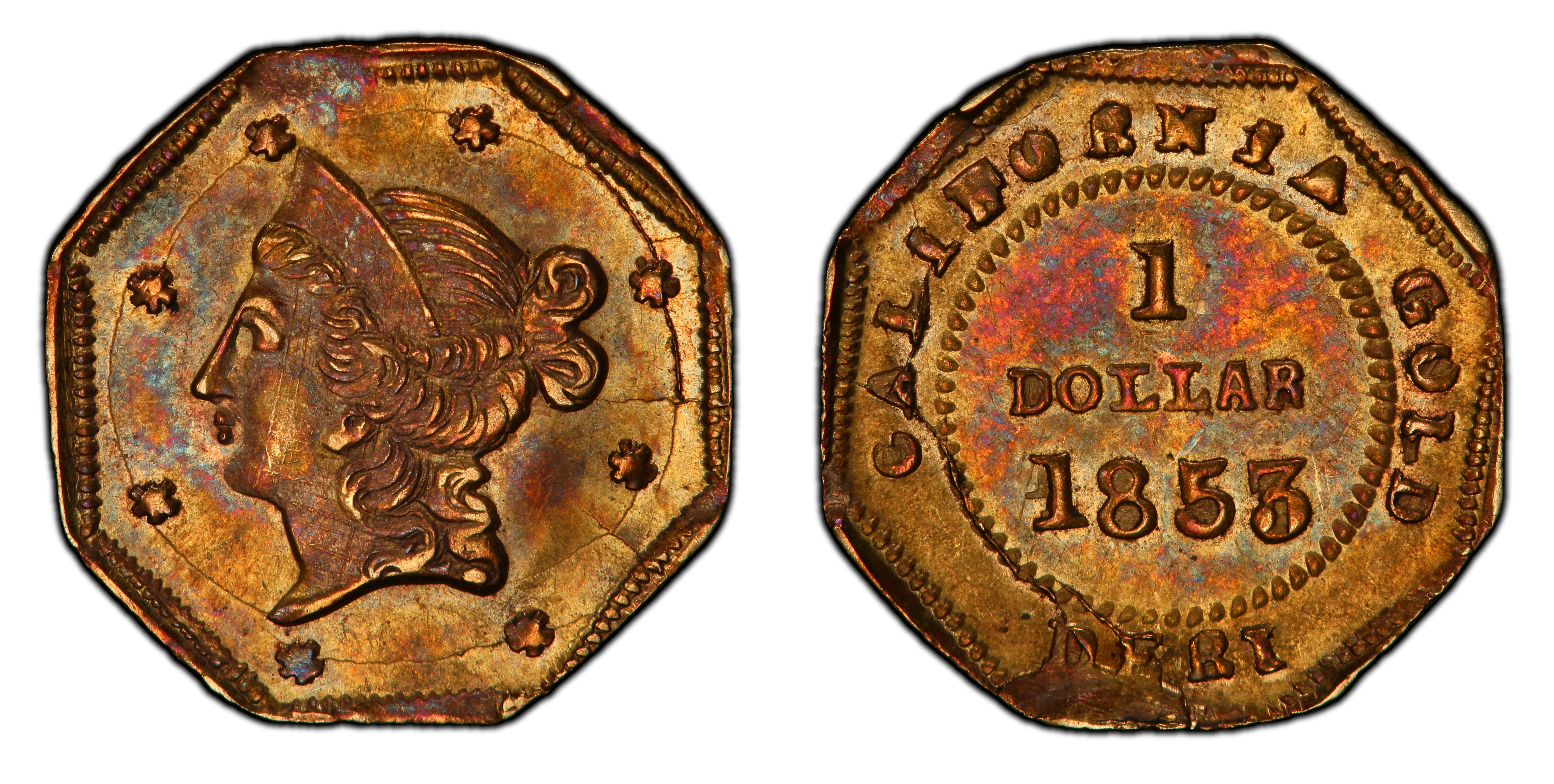
Obverse & Reverse
The 1853 BG-515 octagonal gold dollar is a tangible relic from the most fervent period of the California Gold Rush, a time defined by immense economic upheaval and an acute shortage of circulating currency. Following the discovery of gold in 1848, a massive influx of prospectors and merchants descended upon California, creating a vibrant but chaotic economy based largely on gold dust. This system was imprecise and fraught with inefficiency, especially for small, everyday transactions. While private assayers began issuing larger denomination gold coins ($5 and up) as early as 1849, the need for 'small change' was dire. Into this void stepped a number of San Francisco jewelers and metalsmiths, who in 1852 began striking their own fractional denomination gold pieces in quarter dollar, half dollar, and dollar values. These 'Period One' issues, struck from 1852 to 1857, were created out of necessity and were intended to function as a circulating medium. The BG-515 was produced by M. Deriberpe, a French jeweler located at 158 Kearney Street, who often abbreviated his name as 'DERI' on his coinage. These pieces mimicked the general design of the official U.S. Liberty Head gold dollars to foster public acceptance, though they were octagonal and significantly underweight. The production method was crude, typically involving hand-cut dies and a sledgehammer to strike the planchets, resulting in inconsistent strike quality. Despite being technically illegal as private currency, their utility in a coin-starved economy ensured they were tolerated and used in local commerce. However, by late 1853, these tiny gold pieces also became popular as souvenirs—lightweight and easy to mail back East as a memento of the California adventure. This dual role as both currency and keepsake defines their history. As the new San Francisco Mint ramped up production of federal coinage by 1856-1857, the necessity for these private issues waned, and their production ceased, marking the end of Period One. Today, the BG-515 is prized not only for its extreme rarity but as a direct link to the pioneering days of Gold Rush commerce.
Associated EventCalifornia Gold Rush
Reason For MintingTo alleviate a severe shortage of small-denomination coinage for daily commercial transactions in Gold Rush-era San Francisco.
Minter HistoryM. Deriberpe (sometimes spelled Deriberpie) was a French manufacturing jeweler listed in the 1852 San Francisco directory. His workshop was located at 158 Kearney Street, the same building that housed another notable fractional gold minter, Antoine Louis Nouizillet. This proximity has led numismatists to believe they may have collaborated, and some coins bearing the initials 'D.N.' are attributed to their partnership. Deriberpe is known for signing his individual work with the abbreviated inscriptions 'DERI' or 'DERIB,' as seen on the BG-515. His issues are characteristic of the 'Period One' California fractionals, created for practical commercial use before the San Francisco Mint was fully operational.
Historical SignificanceThe BG-515 is a historically significant example of private coinage issued to solve a critical economic problem on the American frontier. It represents the ingenuity of local merchants in the face of federal government delays in providing adequate currency. As a 'Period One' issue, it is among the small group of fractional gold pieces believed to have genuinely circulated, making it a more important economic artifact than the later issues (Periods Two and Three) which were primarily made as souvenirs. Its great rarity today underscores the ephemeral nature of these early, utilitarian pieces.
K-
DenominationG$1
Minting Period1853
Assayer/MinterM. Deriberpe
Geographic OriginSan Francisco, California
Obverse DescriptionOctagonal coin featuring a Liberty Head portrait, stylistically similar to the contemporary U.S. Mint gold dollars by James B. Longacre. The head is surrounded by thirteen stars along the border.
Obverse Inscription Reverse DescriptionThe central reverse design features the denomination '1' and 'DOLLAR' within a wreath. The date '1853' and the minter's abbreviated name 'DERI' are located along the lower periphery. The design is enclosed within a beaded border.
Reverse Inscription1 DOLLAR 1853 DERI
CompositionGold
Stated Fineness Actual FinenessTypically varied but generally underweight and made from native California gold, which had a natural silver alloy, resulting in fineness between .800 and .900.
EdgePlain
Extremely Low
Survival Estimate6-8 examples known
Rarity ScaleR-7
The BG-515 is a classic rarity in the California Fractional Gold series. Its appeal is multi-faceted: it is a 'Period One' issue made for circulation, it is from a known and desirable maker (Deriberpe), it has a classic Liberty Head design, and it is exceedingly rare (R-7). Acquiring any example, even in a lower or repaired grade, is a significant achievement for the advanced collector of pioneer gold.
Key VarietiesTwo distinct die states are known for BG-515: * **Die State I:** Known as the 'Perfect Die' state, with clean fields and no evidence of die cracks or breaks. This is the earliest and rarest state. * **Die State II:** Shows prominent die cracks through the obverse stars and a noticeable die break forming under the 'DE' of 'DERI' on the reverse. Most known examples are from this later die state.
Authentication TipsAuthentication requires expert examination. Genuine examples are struck, not cast, and should have sharp details, even if weakly struck in areas. The lettering style, particularly the unique 'DERI' abbreviation, should match known examples. The planchet should be thin and made of gold, not a gilt base metal. Modern replicas are common in the fractional gold series; they are often overly shiny, have incorrect weights, soapy details, and may feature designs (like bears) not found on genuine Period One issues. Any unlisted variety or piece with unusual surface characteristics should be considered suspect until verified by a specialist or top-tier grading service.
Shopping ConsiderationsFor a coin of this rarity, any opportunity to acquire one is notable. A 'premium quality' example would be one that is well-centered, has a reasonably sharp strike on the Liberty portrait and the reverse inscriptions, and retains some original luster. Due to their crude manufacture and circulation, most survivors show wear and may have impairments. Even a repaired or damaged example, such as the holed specimen sold by Stack's Bowers, is considered highly desirable simply to fill a spot in a collection. Buyers should prioritize originality of the surfaces; avoid examples that have been harshly cleaned, polished, or exhibit evidence of tooling. Pay close attention to the die state, as a rare Die State I specimen would command a significant premium over the more 'common' Die State II examples.
A coin's grade is its condition, rated on a 1-70 scale. For rare coins, this is the most critical factor in determining value, as a tiny difference in preservation can mean a huge difference in price.
Relevant Grade TypesOriginal 1853 BG-515 dollars were business strikes intended for circulation. They are found in Circulated grades (AG-3 to AU-58) and, very rarely, in Mint State (MS-60 and above). No proofs were struck during the original minting period, and there are no known later-date Proof restrikes for this specific Breen-Gillio variety.
Mint State CharacteristicsA true Mint State BG-515 is a major numismatic prize. Luster would be soft and satiny, typical of early pioneer gold. The strike is a critical factor; due to the hand-hammered process, a full, sharp strike across all elements (Liberty's hair, stars, wreath details) would be exceptional and highly desirable. Most uncirculated examples would still be expected to show some weakness in the centers. Small, planchet-related marks or adjustment marks are common and should not be confused with post-striking damage. The color of the gold is typically a rich yellow, sometimes with reddish or greenish hues from the natural alloy.
Circulated Wear PatternsWear first appears on the highest points of the design. On the obverse, this includes Liberty's cheek, the hair just above her ear, and the coronet. On the reverse, the high points of the wreath leaves and the numeral '1' will show the first signs of friction. On moderately circulated examples, the finer details of the hair and wreath will be smoothed, and the legends will begin to soften. In lower grades (VG and below), Liberty's portrait becomes flat, and the reverse inscriptions, especially the delicate 'DERI', may become faint or partially obliterated.
Key Factors For ValueGiven its R-7 rarity, any example is valuable. The primary value drivers are grade and surface integrity. An unimpaired, problem-free coin with original surfaces will sell for a massive premium over a repaired, cleaned, or damaged piece of the same circulated grade. Sharpness of strike is paramount for eye appeal; a well-struck coin is always preferred. Finally, provenance to a famous collection can add significant value. A CAC sticker would provide strong third-party endorsement of quality for the grade and would be highly sought after by discerning collectors.
PCGS Price Guide
| Grade | Price | Population |
|---|---|---|
| 58 | N/A | N/A |
| 61 | $22,500.00 | 1 |
| 62 | $27,500.00 | 1 |
| 64 | N/A | 1 |