1855 G25C BG-225 (Regular Strike)
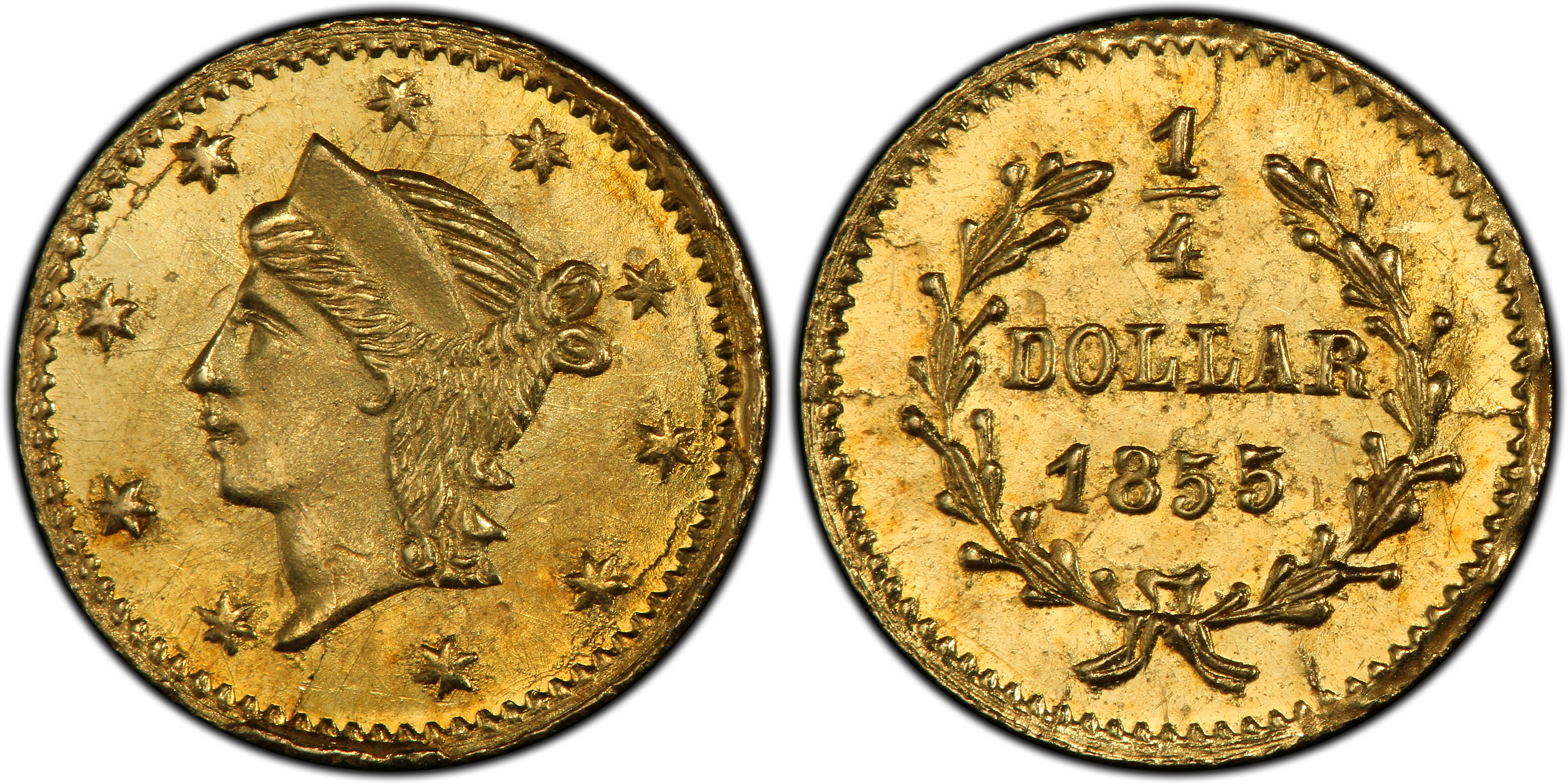
Obverse & Reverse
The 1855 BG-225 25 Cents is a quintessential artifact from what numismatists classify as 'Period One' of the California Fractional Gold series. This initial period, from 1852 to 1857, represents the most authentic and utilitarian phase of this fascinating private coinage. Following the initial chaos of the Gold Rush that began in 1848, an immense quantity of gold dust and nuggets flooded the California economy, but a severe, chronic shortage of small denomination coinage created a significant impediment to daily commerce. A pinch of gold dust for a drink was an inexact and wasteful system. The newly established San Francisco Mint, which opened in 1854, focused its efforts on larger denomination coins, leaving the void in small change unfilled. Private jewelers and metalsmiths in San Francisco stepped in to meet this acute commercial need by striking their own fractional denomination gold coins. These tiny pieces, denominated in 25 Cents, 50 Cents, and One Dollar, were not legal tender but were widely accepted due to necessity. The BG-225 was struck in this environment of commercial improvisation. Most of these early issues were produced by the 'hammer method,' a crude process where dies were struck by hand with a sledgehammer, resulting in inconsistent strike quality. The BG-225 is particularly notable for its die state; the obverse die developed a catastrophic crack running from Liberty's ear to the rim, which severely limited its useful life and is a key reason for the variety's formidable rarity today. By the late 1850s, as the U.S. Mint increased its output of small change, the practical need for these fractional pieces diminished, and they transitioned from circulating currency to popular souvenirs and jewelry items in 'Period Two'. The BG-225, as a Period One issue, stands as a genuine monetary relic of the Gold Rush boomtown economy of San Francisco.
Associated EventCalifornia Gold Rush
Reason For MintingTo alleviate a severe shortage of small-denomination coinage for daily commerce in Gold Rush-era California.
Minter HistoryThe specific minter for the BG-225 variety is unknown, which is common for many Period One California Fractional Gold issues. It was almost certainly produced by one of the many jewelers or assayers operating in San Francisco in the mid-1850s who possessed the skills to create dies and work with gold. Prominent producers of the era included figures like Antoine Louis Nouzillet and the firm of Frontier, Deviercy & Co., though there is no definitive link of this specific variety to a known maker. These minters operated in a semi-legal gray area, producing what were essentially tokens whose acceptance was based on convenience and the public's desperate need for a medium of exchange.
Historical SignificanceThe BG-225 is a tangible link to the raw, frontier economy of Gold Rush San Francisco. Its creation speaks to the ingenuity and necessity-driven solutions that arose in the absence of adequate federal infrastructure. As a 'Period One' issue, it represents the series in its purest form, struck for circulation rather than as a souvenir, making it a key historical document of the economic conditions of the American West.
N/A
Denomination25 Cents
Minting Period1855
Assayer/MinterUnknown, likely a San Francisco jeweler
Geographic OriginSan Francisco, California
Obverse DescriptionA Liberty Head motif, facing left, stylistically similar to the contemporary U.S. federal gold dollar. Liberty is wearing a coronet, and her hair is tied in a bun. The portrait is encircled by thirteen stars representing the original colonies.
Obverse Inscription Reverse DescriptionThe denomination '25 CENTS' is framed by a wreath of leaves and berries, open at the top. The date '1855' appears below the wreath.
Reverse Inscription25 CENTS 1855
CompositionGold
Stated Fineness Actual FinenessVaries, but Period One issues generally ranged from 14 to 22 karats, containing significantly less gold than their face value.
Weight0.25 grams
Diameter9.50 mm
EdgePlain
Unknown
Survival EstimateVery few; likely less than 30-40 pieces across all grades.
Rarity ScaleR-7 (Low)
This variety is highly sought after for its extreme rarity, its status as a genuine 'Period One' circulating issue, and its dramatic, identifiable die crack. It appeals to specialists in California gold, territorial coinage, and pioneer history.
Key VarietiesThe primary variety is the regular strike from the heavily cracked obverse die. No known restrikes, proofs, or patterns exist for the BG-225. It is a singular issue defined by its die state. Other BG-numbered varieties from 1855 exist, but they are from different dies and makers.
Authentication TipsThe key diagnostic is the prominent, heavy die crack on the obverse running from the rim at approximately 7 o'clock, just behind Liberty's neck, up towards her ear. Counterfeits of fractional gold abound; many are brass or gold-plated. Genuine pieces have a distinct color and weight. Suspects often have incorrect design details, a 'soapy' or cast appearance, and may be attracted to a magnet. Authentication by a major grading service (PCGS or NGC) is highly recommended.
Shopping ConsiderationsA premium quality example of BG-225, given its rarity, is one that simply exists and is authentic. However, for a given grade, look for the strongest possible strike, as these were often weakly and unevenly impressed. Seek out examples with minimal distracting marks; a few thin scratches are common and noted even on high-grade specimens. The peach-gold or yellow-gold color should be original and not appear harshly cleaned or polished. The visibility of the die crack is a crucial and desirable feature, not a flaw. Due to the high value and prevalence of fakes, purchasing a specimen certified by PCGS or NGC is the only prudent approach.
A coin's grade is its condition, rated on a 1-70 scale. For rare coins, this is the most critical factor in determining value, as a tiny difference in preservation can mean a huge difference in price.
Relevant Grade TypesAll known original examples of BG-225 are business strikes intended for circulation. They are graded on the standard scale and can be found in Circulated grades (AG-3 to AU-58) and, very rarely, in Mint State (MS-60 to MS-70). No proofs were struck during the original minting period, and there are no known later-date proof restrikes or special collector strikings for this specific variety.
Mint State CharacteristicsAn uncirculated BG-225 will exhibit some measure of original mint luster, often with a soft, satiny texture. The strike is almost never full; weakness in the centers of the stars or the details of the wreath is common and expected. Due to the hand-hammering process, the fields may not be perfectly flat and can show some reflectivity. Small planchet flaws or adjustment marks are not uncommon. The key is to find an example with minimal contact marks and undisturbed, original surfaces.
Circulated Wear PatternsWear first appears on the highest points: Liberty's cheek, the hair above her eye and ear, and the coronet. On the reverse, the highest points of the wreath's leaves and the numerals of the denomination will show the first signs of friction. On lower grade examples, the stars will begin to merge with the fields and the legends will become soft.
Key Factors For ValueFor the BG-225, rarity is the paramount factor. Any authenticated example is valuable. After that, surface preservation is key; a coin that has not been cleaned, polished, or used in jewelry commands a significant premium. The sharpness of the strike, while often imperfect, adds to the value if it is stronger than typical for the issue. Eye appeal, meaning an attractive, original coloration and a minimum of distracting marks, is highly prized. A CAC sticker on a certified coin would indicate premium quality for the grade and add a further premium.
PCGS Price Guide
| Grade | Price | Population |
|---|---|---|
| 50 | N/A | N/A |
| 55 | $1,250.00 | N/A |
| 55+ | $1,400.00 | N/A |
| 58 | $1,850.00 | 2 |
| 58+ | $2,000.00 | N/A |
| 60 | $2,150.00 | N/A |
| 61 | $2,300.00 | 1 |
| 62 | $2,450.00 | 3 |
| 62+ | $2,600.00 | N/A |
| 63 | $2,750.00 | 2 |
| 63+ | $2,900.00 | N/A |
| 64 | $3,150.00 | 3 |
| 64+ | $3,500.00 | N/A |
| 65 | $6,500.00 | 1 |