1853 G50C BG-408 (Regular Strike)
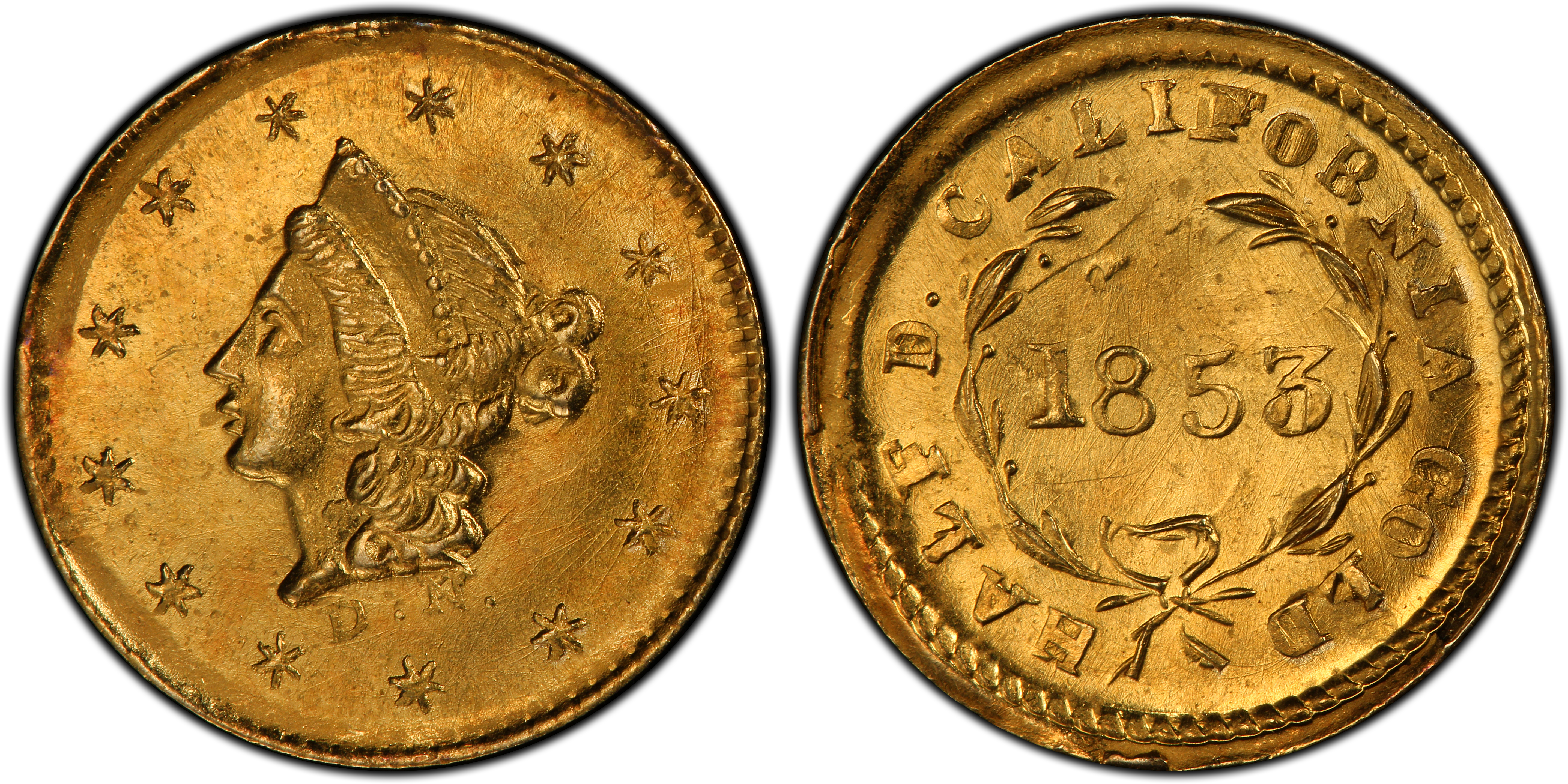
Obverse & Reverse
The 1853 BG-408 50 Cents piece is a quintessential artifact from the 'Period One' (1852-1857) era of California Fractional Gold. Its existence is a direct consequence of the unique economic conditions in California following the 1848 gold discovery. The massive influx of population during the Gold Rush created a vibrant, cash-based economy, yet the region was geographically isolated and suffered from a chronic shortage of official United States small-denomination coinage. While private minters and the U.S. Assay Office produced large denomination gold coins ($5 to $50) from the abundant local bullion, there was a severe lack of circulating coins for everyday transactions. A pinch of gold dust, the default medium of exchange, was imprecise and prone to waste. Into this void stepped enterprising jewelers and metalsmiths, primarily in San Francisco, who began striking their own fractional-denomination gold coins. The BG-408 was produced by the partnership of M. Deriberpe, an engraver, and Antoine Louis Nouizillet, a prominent French jeweler. Their 'D.N.' initials proudly stamped below the bust signify one of the few attributable makers of these early issues. These 'Period One' coins were intended for actual commerce and were generally designed to resemble the official U.S. gold dollar, as seen in the Liberty head motif of the BG-408. However, most were underweight for their stated value, making them technically tokens, but they were nonetheless accepted in trade out of sheer necessity. Production was crude by federal mint standards; coins were often hand-struck using a hammer method, resulting in inconsistent strike quality. By 1854, the new San Francisco Mint began to ramp up production of federal coinage, gradually alleviating the coin shortage. As a result, the commercial necessity for fractional gold waned, and by the late 1850s, their primary role shifted to that of souvenirs for tourists and keepsakes for those back East. The BG-408, as a rare R-6 variety, represents a tangible link to this brief, chaotic, and fascinating period of monetary improvisation on the American frontier.
Associated EventCalifornia Gold Rush
Reason For MintingTo alleviate a severe shortage of small-denomination coinage for daily commerce in Gold Rush-era California.
Minter HistoryM. Deriberpe and Antoine Louis Nouizillet were San Francisco-based French jewelers and engravers active during the Gold Rush. Nouizillet was a key figure in the production of fractional gold, involved in several partnerships (including with F. Routhier, marked 'N.R.'). Their partnership, identified by the 'D.N.' mark on varieties like BG-408, was responsible for a small but numismatically significant portion of 'Period One' issues. Their work is characterized by designs that emulate federal coinage, intended to foster public acceptance and circulation.
Historical SignificanceThe BG-408 is a prime example of a privately issued coin created to solve a critical economic need on the American frontier. It represents a period of monetary self-reliance before federal institutions were fully established in the West and is a key artifact of the commercial life of the California Gold Rush.
N/A
Denomination50 Cents
Minting Period1853
Assayer/MinterM. Deriberpe & Antoine Louis Nouizillet
Geographic OriginSan Francisco, California
Obverse DescriptionA beaded border encircles a Liberty Head, facing left, with hair tied in a bun. The word 'LIBERTY' is inscribed on her coronet. Thirteen stars surround the portrait, representing the original colonies. The initials 'D.N.' for Deriberpe & Nouizillet appear below the truncation of the bust.
Obverse InscriptionLIBERTY, D.N.
Reverse DescriptionThe denomination '1/2' appears within a wreath of two olive branches tied with a bow at the bottom. The legend 'CALIFORNIA GOLD' is inscribed above the wreath, and the date '1853' is below. A beaded border encircles the entire design.
Reverse InscriptionCALIFORNIA GOLD 1/2 1853
CompositionGold
Stated Fineness Actual FinenessNative California gold, typically around .880 fine due to natural silver content.
EdgePlain
Unknown
Survival Estimate13 to 30 known
Rarity ScaleR-6
The BG-408 is highly sought after as a rare, dated, and attributed 'Period One' fractional. Its connection to known minters Deriberpe & Nouizillet, its R-6 rarity, and its classic Liberty Head design make it a prize for specialists in territorial and pioneer gold.
Key VarietiesThe primary variety is the BG-408 business strike. There are no known patterns, proofs, or restrikes associated with this specific die marriage. Other 'D.N.' varieties exist but are distinct BG numbers.
Authentication TipsAuthentic examples of BG-408 are identified by specific die characteristics. A key diagnostic for this variety is the presence of a pair of parallel die cracks on the obverse. Genuine pieces exhibit a hand-struck appearance, often with slight imperfections in striking and centering. Counterfeits are common in the fractional gold series; many are cast or have incorrect details (e.g., wrong font, mushy details, incorrect style of Liberty head). Comparison with high-resolution images of certified examples is essential. All genuine Period One issues are denominated (e.g., '1/2', 'DOLLAR', or 'CENTS'); pieces marked 'CAL GOLD' without a denomination are typically later tokens or charms.
Shopping ConsiderationsFor a premium quality BG-408, a prospective buyer should seek an example with a bold, well-centered strike. Given the manufacturing method, many are weakly struck on the high points, such as Liberty's hair and the details of the wreath; sharp examples command significant premiums. Look for pleasing, original surfaces with some remaining mint luster. The natural color is often a slightly greenish or brassy yellow-gold due to the silver alloy. Avoid examples that have been harshly cleaned, which strips the original surface and imparts a bright, sterile look. Evidence of tooling, polishing in the fields, or removal from jewelry (indicated by rim damage or solder marks) should be heavily discounted. Given the coin's rarity, even problem-free circulated examples in AU grades are highly desirable.
A coin's grade is its condition, rated on a 1-70 scale. For rare coins, this is the most critical factor in determining value, as a tiny difference in preservation can mean a huge difference in price.
Relevant Grade TypesOriginal BG-408 issues were all business strikes intended for commerce. They are found in Circulated grades (AG-3 to AU-58) and, very rarely, in Mint State (MS-60 to 70). No proofs were struck during the original minting period, and there are no known later-date proof restrikes of this variety.
Mint State CharacteristicsAn uncirculated BG-408 will exhibit full, unbroken mint luster, though the texture may be slightly satiny or softly reflective rather than frosty like a modern coin. Due to the hand-striking process, absolute sharpness is rare; expect some softness on the highest points of the design even on a choice piece. Small, planchet-related flaws or adjustment marks may be present and are often accepted for the issue. The tiny size makes contact marks less of a concern than on larger coins, but any significant or distracting marks will still impact the grade.
Circulated Wear PatternsWear first appears on the highest points: Liberty's cheek, the hair above the ear, and the coronet. On the reverse, the high points of the wreath's leaves and the bow will show initial friction. As wear progresses, the stars on the obverse and the letters in the legends will become softer and begin to merge with the fields. In lower grades (VG and below), the date and initials 'D.N.' may become faint or partially obliterated.
Key Factors For ValueFor the BG-408, value is driven by its R-6 rarity, grade, and eye appeal. A sharply struck coin with minimal marks and original, uncleaned surfaces will command a massive premium over a weakly struck or cleaned example of the same grade. The presence of the known obverse die cracks is a diagnostic feature, not a flaw, and does not detract from the value. Attractive, original reddish or greenish-gold toning is highly prized. Third-party certification by PCGS or NGC is virtually required for market acceptance, and a CAC sticker on a certified coin indicates premium quality for the grade and will further enhance its value.
PCGS Price Guide
| Grade | Price | Population |
|---|---|---|
| 50 | $600.00 | 1 |
| 50+ | $615.00 | N/A |
| 53 | $640.00 | 1 |
| 53+ | $650.00 | N/A |
| 55 | $675.00 | 5 |
| 55+ | $725.00 | N/A |
| 58 | $875.00 | 5 |
| 58+ | $950.00 | N/A |
| 60 | $1,100.00 | 1 |
| 61 | $1,250.00 | 1 |
| 62 | $1,575.00 | 7 |
| 62+ | $1,900.00 | N/A |
| 63 | $3,750.00 | 3 |
| 63+ | $4,000.00 | N/A |
| 64 | $5,500.00 | 1 |
| 64+ | $6,000.00 | N/A |
| 65 | $7,500.00 | N/A |