No Date G25C BG-224, PL (Regular Strike)
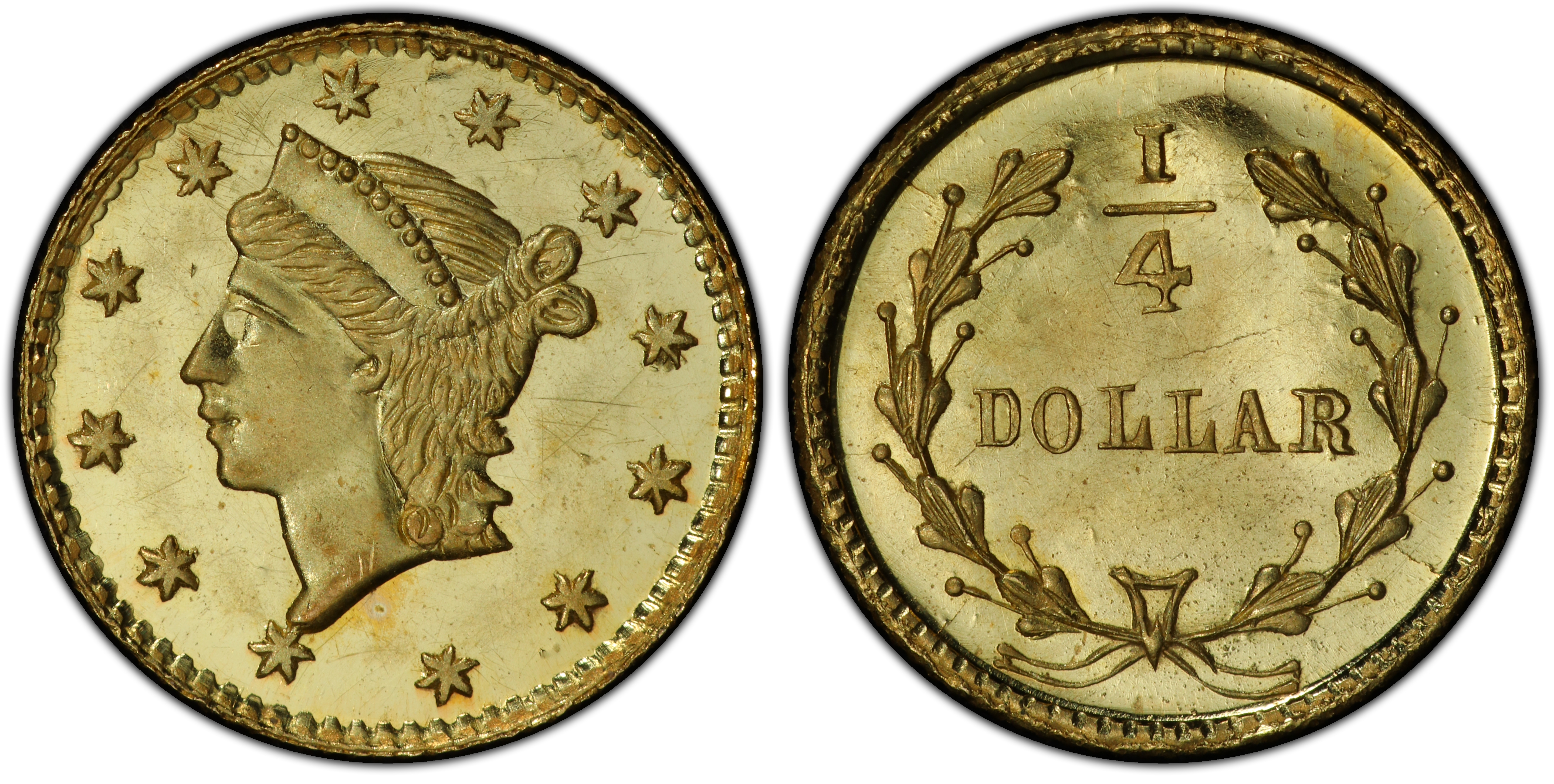
Obverse & Reverse
The BG-224 25 Cents is a quintessential example of 'Period One' California Fractional Gold, born from the chaotic and economically starved conditions of the early Gold Rush. Following the massive influx of '49ers, California was awash in raw gold dust but critically lacked official, small-denomination coinage for everyday transactions. A pinch of gold dust for a drink or a loaf of bread was an inexact and often contentious system. Into this void stepped a number of private minters, primarily jewelers and metalsmiths in San Francisco, who began striking fractional denominations in 1852. These pieces were not officially sanctioned but were tolerated out of sheer necessity. Struck circa 1853-1854, the BG-224 entered circulation at a pivotal moment. The United States Branch Mint in San Francisco was set to open in April 1854, an event that would ultimately doom the private issues by providing a steady supply of federal coinage. The producers of these fractional pieces, likely working with crude hand-cut dies and manual screw or hammer presses, knew their window of opportunity was closing. Consequently, production was often rushed, and quality control was secondary to speed. Like most of its contemporaries, the BG-224 was intentionally underweight. While a federal gold dollar of the era contained 1.672 grams of .900 fine gold, a theoretical full-weight 25-cent piece should have weighed about 0.42 grams. The BG-224, at approximately 0.30 grams, was significantly lighter, providing a tidy profit for its anonymous maker on every piece struck. Despite being underweight, these fractional coins gained a degree of acceptance in local commerce, serving as the pocket change for miners, merchants, and settlers in the boomtowns. However, their utility was short-lived. As federal silver and gold coins became more plentiful from the new mint, the private fractionals were quickly driven from circulation, viewed with suspicion due to their light weight. Many were likely melted down, while others were saved as curiosities or souvenirs of the Gold Rush, a fate that accounts for the relatively high proportion of surviving examples in Mint State condition. Its numismatic significance today lies in its direct connection to the raw, entrepreneurial spirit of Gold Rush San Francisco and its status as a tangible artifact of a pre-federal monetary system in the American West.
Associated EventCalifornia Gold Rush
Reason For MintingTo alleviate a severe shortage of small-denomination coinage for daily commerce in Gold Rush-era California.
Minter HistoryThe specific minter of the BG-224 variety is not definitively known and the dies bear no identifying initials. Numismatic scholarship attributes most 'Period One' (1852-1857) issues to a small group of San Francisco-based French jewelers and metallurgists, including Antoine Louis Nouizillet, M. Deriberpie, and the firm of Frontier, Deviercy & Co. These craftsmen used their existing skills to meet the commercial demand for coinage, operating in a legally gray area prior to the full establishment of federal minting in the region.
Historical SignificanceThe BG-224 is a historically significant artifact representing the peak of private fractional coinage in California, created to solve a circulating currency crisis just before the establishment of the San Francisco Mint rendered such issues obsolete.
N/A
Denomination25 Cents
Minting Period1853-1854
Assayer/MinterUnknown/Unattributed
Geographic OriginSan Francisco, California
Obverse DescriptionA small, somewhat crudely rendered bust of Liberty faces left, her hair tied in a bun. She wears a coronet, though the inscription 'LIBERTY' is typically not visible or legible due to the coin's minuscule size and often weak strike. The bust is surrounded by thirteen six-pointed stars, often unevenly spaced and styled.
Obverse Inscription Reverse DescriptionA simple wreath, composed of two branches tied with a bow at the bottom, encircles the denomination. Within the wreath, the value is expressed on two lines as '1/4' above 'DOLLAR'. A circle of beads or denticles typically encloses the entire design, though it may be weak or incomplete.
Reverse Inscription1/4 DOLLAR
CompositionGold
Stated FinenessNot stated, but presumed to be native California gold.
Actual FinenessVaries, typically 14k to 22k (.585 to .917 fine), as they were made from unrefined native gold which had a high natural silver content.
Weight0.30 grams
Diameter9.50 mm
EdgePlain
Unknown
Survival Estimate300-500
Rarity ScaleR-3
This variety is popular as an affordable and historically rich example of a 'Period One' California fractional. Its appeal lies in its direct connection to the Gold Rush, its status as a private, non-federal coin, and its charmingly crude execution. The 'No Date' attribution adds a layer of intrigue.
Key VarietiesThe primary BG-224 is a single variety. However, collectors should be aware of contemporary counterfeits and later copies, specifically BG-1314 and BG-1315, which are listed in the Breen-Gillio reference as copies of BG-224 and are collectible in their own right as part of the history of this coinage. A small number of genuine BG-224 examples have been recovered from the wreck of the S.S. Central America, and when certified as such, carry a significant premium.
Authentication TipsGenuine BG-224s exhibit a characteristic die style. The stars on the obverse are often softly struck and slightly irregular. The '1' in the fraction on the reverse is typically thin and weakly struck at its top. The planchets are often slightly irregular and may show file marks or adjustment marks, consistent with crude, manual production. Be wary of pieces with a modern, uniform, 'brassy' look; authentic pieces have the rich, slightly varied color of unrefined gold. Any piece that appears to be cast, with porous surfaces and a soft, soapy feel to the details, is a counterfeit.
Shopping ConsiderationsA premium quality example for its grade will show a bold strike for the issue, with as much detail as possible on Liberty's hair and the leaves of the reverse wreath. Many examples were struck on polished planchets, resulting in attractive proof-like (PL) or deep mirror proof-like (DMPL) surfaces; these command significant premiums. Luster should be original and unbroken. Common problems to avoid are harsh cleanings, which impart hairline scratches across the fields, and jewelry use (evidence of mounting or solder). Given the coin's tiny size, even minor surface imperfections are magnified, so prioritize clean surfaces and strong eye appeal.
A coin's grade is its condition, rated on a 1-70 scale. For rare coins, this is the most critical factor in determining value, as a tiny difference in preservation can mean a huge difference in price.
Relevant Grade TypesOriginal BG-224 issues were business strikes intended for circulation, found in Circulated (1-58) and Mint State (MS, 60-70) grades. Due to their quick withdrawal from commerce and use as souvenirs, a large portion of the surviving population is in Mint State. No true Proofs were struck during the original period of issue. The frequent appearance of 'PL' (Proof-like) designations is due to the use of highly polished dies for striking, a common practice among jeweler-minters, and does not indicate a special striking.
Mint State CharacteristicsIn uncirculated grades, the quality is defined by the strength of the strike and the quality of the luster. A typical example may be weakly struck on the highest points of Liberty's hair bun and on the wreath's bow. Luster is typically vibrant and satiny, though on proof-like examples it becomes highly reflective. Due to the softness of the gold and crude handling at the time of manufacture, it is common to see small, scattered contact marks even on high-grade specimens. The key is finding a piece with minimal marks and a sharp strike for the variety.
Circulated Wear PatternsWear first appears on the highest points of the design. On the obverse, this is the hair bun at the back of Liberty's head and her cheek. The surrounding stars, being of lower relief, are often better preserved. On the reverse, friction first dulls the highest leaves in the wreath and the knot of the bow. In grades below VF, the fraction '1/4' will begin to lose definition, and the legends will soften into the fields.
Key Factors For ValueBeyond the numerical grade, value is driven by several factors. Surface quality is paramount; an example with original, undisturbed luster and skin will be worth far more than a cleaned or polished piece of the same grade. Strike sharpness is critical; coins with a full, bold impression are highly prized. Eye appeal, encompassing attractive toning (often a reddish-gold hue) and the presence of proof-like fields, can add a substantial premium. Finally, a CAC sticker for this issue is highly sought after, as it confirms both the grade and the superior quality for that grade.
PCGS Price Guide
| Grade | Price | Population |
|---|---|---|
| 64 | $750.00 | N/A |
| 64+ | $850.00 | 1 |
| 65 | $1,550.00 | 1 |
| 65+ | $1,800.00 | N/A |
| 66 | $2,500.00 | 1 |