1853 G$1 BG-516 (Regular Strike)
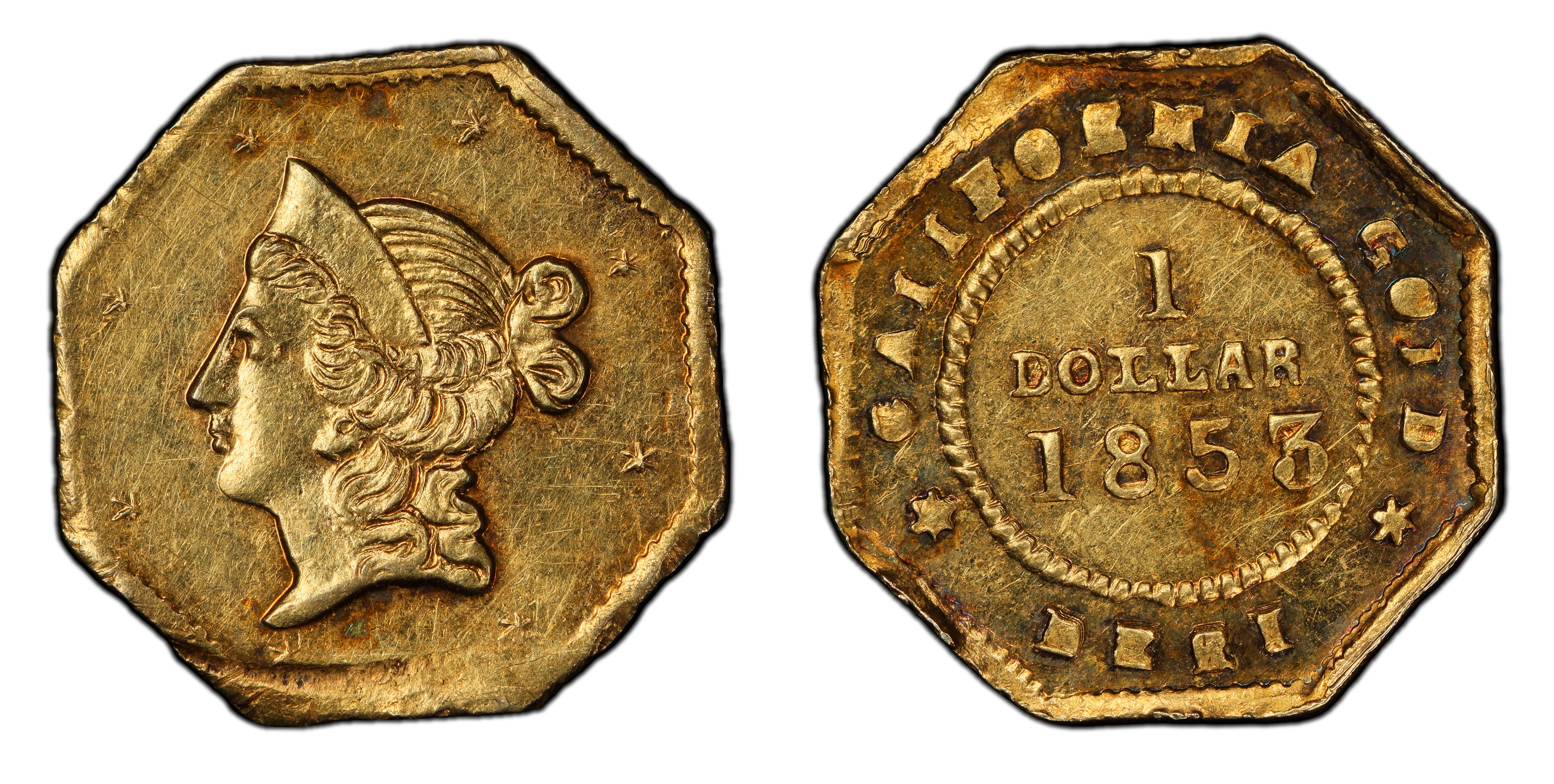
Obverse & Reverse
The 1853 BG-516 octagonal gold dollar is a numismatic artifact of staggering rarity, representing the entrepreneurial spirit and monetary necessity that defined the California Gold Rush. In the early 1850s, the massive influx of population to California created a thriving economy, but one critically hampered by a severe shortage of circulating small-denomination coinage. Gold dust, while plentiful, was impractical for daily transactions, and the nearest U.S. Mint in Philadelphia was thousands of miles away. The San Francisco Mint would not open until 1854, leaving a vacuum that private minters rushed to fill. Jewelers and metalworkers, many of French origin, like M. Deriberpie, began striking their own small gold coins in 25-cent, 50-cent, and one-dollar denominations. These 'Period One' (1852-1857) issues were not novelty items; they were intended to and did facilitate commerce, acting as a de facto currency in the region. The BG-516 was produced by M. Deriberpie, one of these San Francisco jewelers who capitalized on the monetary need. It was likely produced by the 'hammer method,' where dies were struck by hand, resulting in variations in strike quality and frequent die imperfections. This particular variety is famous for its unique die characteristics, such as the drastically overpolished obverse die which rendered the stars 'microscopic' and a reverse die with broken letter punches resulting in 'CAIIFORNIA GOID.' The coin's status as a unique specimen elevates its importance, making it a direct physical link to this specific moment in San Francisco's economic history. Its journey culminated in its inclusion in the legendary Jay Roe collection, the most complete assemblage of California Fractional Gold ever formed. The sale of Roe's collection in 2003 was a landmark event, and the BG-516, plated in the second edition of the Breen-Gillio reference work, stands as one of the ultimate prizes of the series.
Associated EventCalifornia Gold Rush
Reason For MintingTo alleviate a severe shortage of small-denomination coinage for daily commerce in Gold Rush-era San Francisco before the opening of the U.S. Mint branch.
Minter HistoryM. Deriberpie was one of several, likely French, jewelers and artisans who operated in San Francisco during the early 1850s. Little is documented about his personal history, but along with figures like Antoine Louis Nouzillet and the firm of Frontier, Deviercy & Co., he was a key producer of the earliest California Fractional Gold pieces. These minters used their skills as metalworkers to meet a pressing economic demand, creating the small-denomination gold coins that the local economy desperately needed. His name, signed on the reverse of this coin, is his primary numismatic legacy, forever associated with one of the greatest rarities in the Territorial series.
Historical SignificanceAs a unique representative of the private coinage that sustained San Francisco's early economy, the BG-516 is of immense historical importance. It embodies the era's blend of raw frontier capitalism and skilled craftsmanship, serving as a tangible solution to a critical monetary problem. Its rarity and specific die markers provide a focused case study in the production methods and challenges faced by these private minters.
K-Unlisted, Breen-Gillio 516 (BG-516)
DenominationG$1
Minting Period1853
Assayer/MinterM. Deriberpie
Geographic OriginSan Francisco, California
Obverse DescriptionLiberty head, facing left, with a coronet. The design is surrounded by thirteen stars, which are described as 'microscopic' due to excessive die polishing. The date 1853 is below the bust.
Obverse Inscription1853
Reverse DescriptionThe denomination '1 DOLLAR' is within a wreath. The legend 'CALIFORNIA GOLD' and the minter's signature 'DERI' are inscribed around the periphery. The octagonal planchet is a hallmark of this period's private issues.
Reverse InscriptionCALIFORNIA GOLD / 1 / DOLLAR / DERI
CompositionGold
Stated Fineness Actual FinenessFineness of Period One issues varied, typically using native California gold which was rich in silver, ranging from approximately 14 to 22 karats. The specific fineness for this unique piece is not documented.
EdgePlain
1
Survival Estimate1
Rarity ScaleR-9 (Unique)
The BG-516 is a 'trophy coin' of the highest order. Its appeal lies in its absolute rarity (unique), its origin during the most storied period of the Gold Rush, its connection to the legendary Jay Roe collection, and its status as the plate coin in the definitive Breen-Gillio reference. It is the ultimate objective for the advanced collector of California Fractional Gold.
Key VarietiesAs a unique variety, there are no other examples. No later-date restrikes or patterns of the BG-516 die pair are known to exist.
Authentication TipsAuthentication hinges on its unique die markers. The primary diagnostics are: 1) The 'microscopic' stars on the obverse resulting from an overpolished die. 2) The distinctive reverse legend with broken 'L' punches, resulting in the misspelling 'CAIIFORNIA GOID'. 3) The specific positioning of the date, where the '1' aims between the 'R' and 'N' of 'DERI'. Any piece purported to be a BG-516 must match the plate coin in Breen-Gillio's second edition exactly.
Shopping ConsiderationsAcquiring this coin is dependent on its singular reappearance at auction. The only known specimen was graded PCGS Genuine, Mount Removed – XF Detail. A potential buyer should focus on its provenance, tracing back through the William C. O'Connor Collection and the Jay Roe Collection. The quality is defined by its XF details, but value is overwhelmingly driven by its uniqueness. The 'mount removed' designation indicates it was once used in jewelry, a common fate for these small gold pieces, and this impairment is an integral part of its history and must be accepted by any future owner.
A coin's grade is its condition, rated on a 1-70 scale. For rare coins, this is the most critical factor in determining value, as a tiny difference in preservation can mean a huge difference in price.
Relevant Grade TypesAll original Period One California Fractional Gold pieces were struck as business strikes for circulation and are found in Circulated (1-58) and, very rarely, Mint State (MS, 60-70) grades. No Proofs from the original minting period are known to exist for this series. The unique BG-516 is a circulated business strike that was later mounted for jewelry, so it receives a 'details' grade (e.g., 'XF Detail, Mount Removed') which describes its level of wear but also notes the surface impairment.
Mint State CharacteristicsA theoretical Mint State BG-516 would be evaluated on the sharpness of the strike, particularly on the fine details of Liberty's hair and the wreath. Luster would be a key factor, likely being soft and satiny as is typical for hammered coinage on native gold planchets. However, as the only known piece is circulated, this is purely hypothetical.
Circulated Wear PatternsBased on the known XF example, wear is first evident on the highest points: Liberty's coronet, cheek, and hair strands on the obverse, and the leaves and bow of the wreath on the reverse. The 'mount removed' notation on the holder indicates damage and smoothing, typically at the 12 o'clock position on the rim, which would obscure the original wear pattern in that specific area.
Key Factors For ValueFor the BG-516, value is almost entirely a function of its uniqueness and historical importance. The 'XF Detail' provides a baseline, but traditional grade-based value steps are irrelevant. The key factors are its unimpeachable provenance (ex-Jay Roe, Breen-Gillio plate coin) and its status as the only one known. The market for such a piece is determined by the few elite collectors who desire the absolute rarest items in American numismatics.
PCGS Price Guide
| Grade | Price | Population |
|---|---|---|
| 58 | N/A | 1 |
| 61 | N/A | N/A |