1853 G50C BG-412 Eagle (Regular Strike)
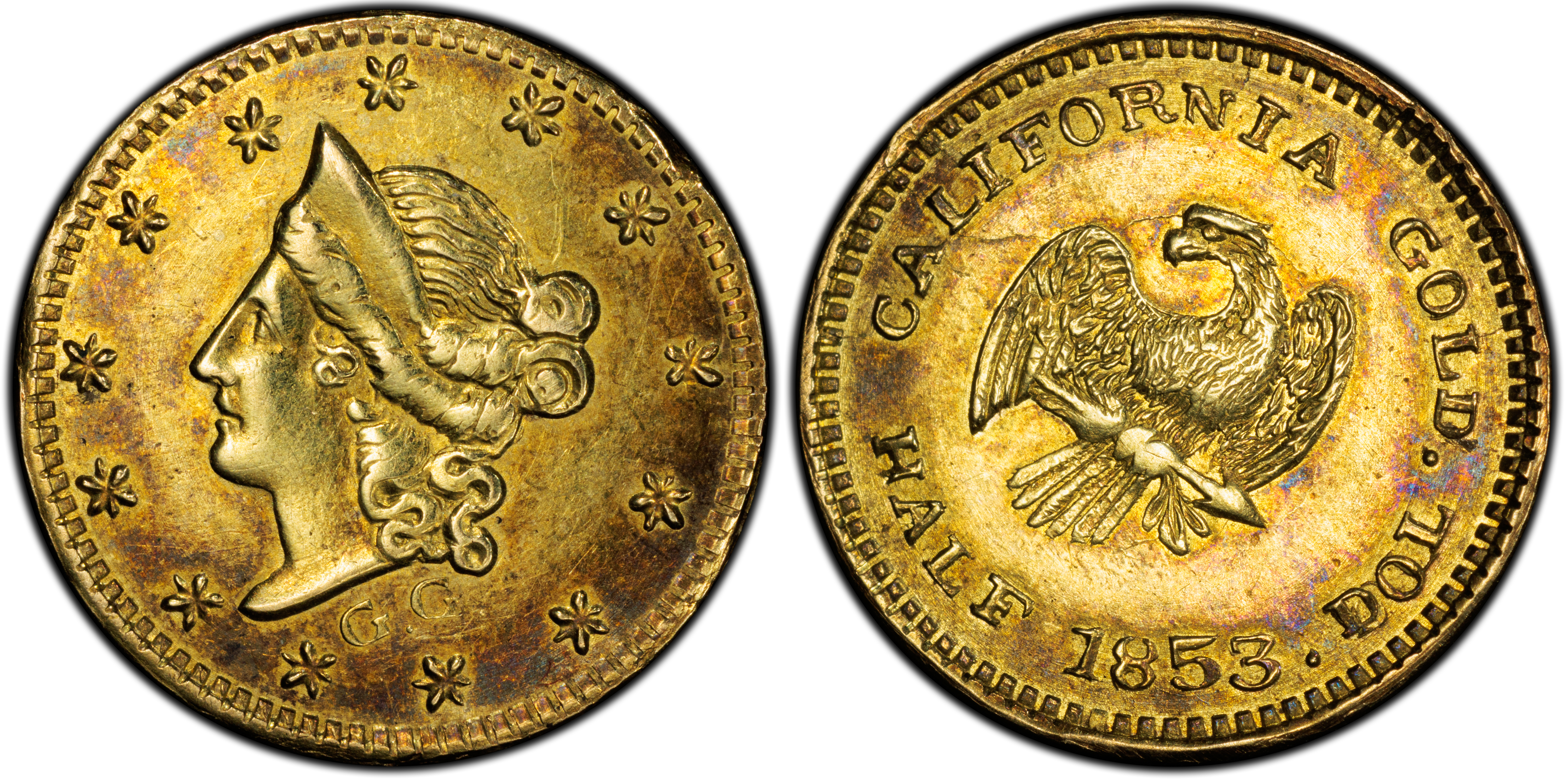
Obverse & Reverse
The 1853 BG-412 Gold 50 Cents is a numismatic artifact born directly from the chaotic and economically volatile height of the California Gold Rush. Following the discovery of gold at Sutter's Mill in 1848, a massive influx of over 300,000 people descended upon California, creating a vibrant but fundamentally flawed economy. While vast quantities of raw gold existed in the form of dust, nuggets, and large-denomination private assayer ingots, there was a crippling shortage of small-denomination coinage for daily transactions. A pinch of gold dust for a drink or a shave was a wildly inaccurate and insecure method of payment. Federal coinage was scarce on the West Coast, as the San Francisco Mint would not become fully operational until 1856. This monetary vacuum created a critical need for a reliable medium of exchange for minor commerce. Enterprising jewelers and metalsmiths, many of French origin located in San Francisco, stepped in to fill this void. Between 1852 and 1856, a period numismatists classify as 'Period One' of California Fractional Gold, these private minters produced small-denomination coins in 25 Cent, 50 Cent, and $1 sizes. The BG-412 is a prime example of these necessary and functional coins. Unlike the later 'Period Two' issues (1859-1882), which were often underweight and produced primarily as souvenirs, Period One pieces like the BG-412 were struck with the genuine intent of circulation. They were meant to be, and were, used as money. Their designs often emulated federal coinage, such as the Liberty Head motif, to inspire public confidence. These tiny gold pieces, though often crudely struck by hand-hammered methods, were vital cogs in the machinery of Gold Rush commerce, allowing for standardized payment for everyday goods and services. The passage of the private coinage act in 1864 eventually rendered their production illegal, cementing their status as a fascinating, short-lived chapter in American monetary history. The BG-412, by virtue of its extreme rarity, represents one of the most elusive survivors of this historic and entrepreneurial solution to a regional economic crisis.
Associated EventCalifornia Gold Rush
Reason For MintingTo alleviate a severe shortage of small-denomination coinage for everyday commercial transactions in Gold Rush-era California.
Minter HistoryThe specific minter of BG-412 is unconfirmed, as is common for many Period One California Fractional Gold varieties which were often unsigned. However, historical records indicate that the majority of these pieces were produced by a small community of jewelers and artisans operating in San Francisco. Prominent known makers of Period One fractionals include M. Deriberpe and Antoine Louis Nouizillet, among others. These craftsmen used their metallurgical skills to create dies and strike coins from native California gold, which characteristically contained a high percentage of silver, giving the coins a lighter color. Their operations were small-scale, using manual presses or hammer-striking methods, resulting in coins with inconsistent strike quality.
Historical SignificanceThe BG-412 is a tangible link to the daily economic life of the California Gold Rush. It represents a private, entrepreneurial response to a government failure in supplying adequate currency to a booming frontier economy. As a 'Period One' issue, it is a genuine circulating coin of the era, not a later souvenir, making it a crucial artifact for understanding the monetary solutions devised during one of America's most dynamic periods of westward expansion. Its immense rarity underscores the ephemeral nature of these issues, most of which were lost or melted over time.
BG-412
Denomination50 Cents
Minting Period1853
Assayer/MinterUnknown San Francisco Jeweler
Geographic OriginSan Francisco, California
Obverse DescriptionFeatures a Liberty Head portrait facing left, stylistically similar to contemporary federal gold coinage. The head is surrounded by thirteen six-pointed stars. The date, 1853, is positioned below the bust.
Obverse Inscription1853
Reverse DescriptionAn eagle with outstretched wings, often referred to as a 'peacock' style eagle in the Breen-Gillio reference for related varieties (BG-410-413). The eagle clutches an olive branch and arrows in its talons. The inscription is arranged around the periphery.
Reverse InscriptionCALIFORNIA GOLD HALF DOL.
CompositionGold
Stated Fineness Actual FinenessTypically .880 to .900, with a notable natural silver content from unrefined California gold.
Weight0.86 grams
Diameter11.00 mm
EdgePlain
Extremely Low
Survival Estimate2-3 known
Rarity ScaleR-8
The BG-412 is a paramount rarity in the California Fractional Gold series, appealing to the most advanced collectors. Its allure stems from its status as a circulating 'Period One' issue, its connection to the Gold Rush, and its extreme scarcity, with only 2 or 3 examples believed to exist. Acquiring a BG-412 represents the pinnacle of collecting in this specialized and historic field.
Key VarietiesThere are no known major varieties of BG-412 from the original minting period. As a Period One issue, no special collector issues, patterns, or restrikes are known to exist for this specific variety.
Authentication TipsAuthentication requires expert examination and comparison to the known genuine examples. Key diagnostics include the specific die characteristics of the Liberty portrait and the unique 'peacock' style eagle on the reverse. The fabric of the coin should be consistent with manually struck gold of the 1850s, often showing a slightly uneven strike. Counterfeits are common in the Cal Gold series, but fakes of an R-8 variety like BG-412 are less likely; more probable is a misattribution of another variety. Any example offered should be certified by a top-tier grading service like PCGS or NGC, as their experts have access to the images and data from the known genuine specimens.
Shopping ConsiderationsFor a potential buyer, the primary consideration is simply availability, as this coin appears at auction only once every few decades. A 'premium quality' example for this issue would be one that is free of significant damage such as bending, holes, or harsh cleaning. Given the rarity, even a problem-free circulated example (e.g., AU-58 as seen in a GreatCollections auction) is a world-class prize. Look for a bold strike on the date and central features of the Liberty head and eagle. Original, uncleaned surfaces with the characteristic reddish or greenish-gold hue of native California alloy are highly desirable. Any evidence of original luster would be exceptional. Due to the immense rarity, any certified example that becomes available is a major purchasing opportunity.
A coin's grade is its condition, rated on a 1-70 scale. For rare coins, this is the most critical factor in determining value, as a tiny difference in preservation can mean a huge difference in price.
Relevant Grade TypesOriginal issues of BG-412 were business strikes intended for circulation. They are found in Circulated grades (AG-3 to AU-58) and, theoretically, Mint State grades (MS-60 to 70), though it is unlikely any have survived without seeing some handling. No Proofs were struck during the original period of issue, and no later-date Proof restrikes are known to exist for this variety.
Mint State CharacteristicsA true Mint State example of this variety would be extraordinary. Quality would be judged by the sharpness of the strike; many fractionals are weakly struck in the centers, so a crisp Liberty head and fully detailed eagle would command a significant premium. Luster would be a soft, satiny texture, consistent with unrefined gold alloy. Given the softness of the metal and the crude production methods, even a Mint State coin would likely exhibit some minor planchet irregularities or handling marks from the minting and bagging process.
Circulated Wear PatternsWear first appears on the highest points of the design. On the obverse, this includes Liberty's hair above the eye and ear, and the cheekbone. On the reverse, the high points are the eagle's head, the neck, and the upper edges of the wings. On more heavily circulated examples, the stars and peripheral lettering will begin to weaken and merge with the fields.
Key Factors For ValueFor a historic rarity like the BG-412, the number one factor for value is simply its existence and authenticity. Beyond that, surface preservation is paramount; an example with original, uncleaned 'skin' is vastly superior to one that has been harshly cleaned or polished. Sharpness of the strike is also critical, as well-struck specimens are far more desirable. Eye appeal, driven by attractive original color and problem-free surfaces, will always command a premium. Given that a PCGS AU-58 example is the highest-graded known piece, any certified, problem-free coin commands an exceptionally high price, with a CAC sticker adding a further significant premium for verification of quality within the grade.
PCGS Price Guide
| Grade | Price | Population |
|---|---|---|
| 58 | N/A | 1 |
| 63 | $37,500.00 | 1 |