1859 G25C BG-705 (Regular Strike)
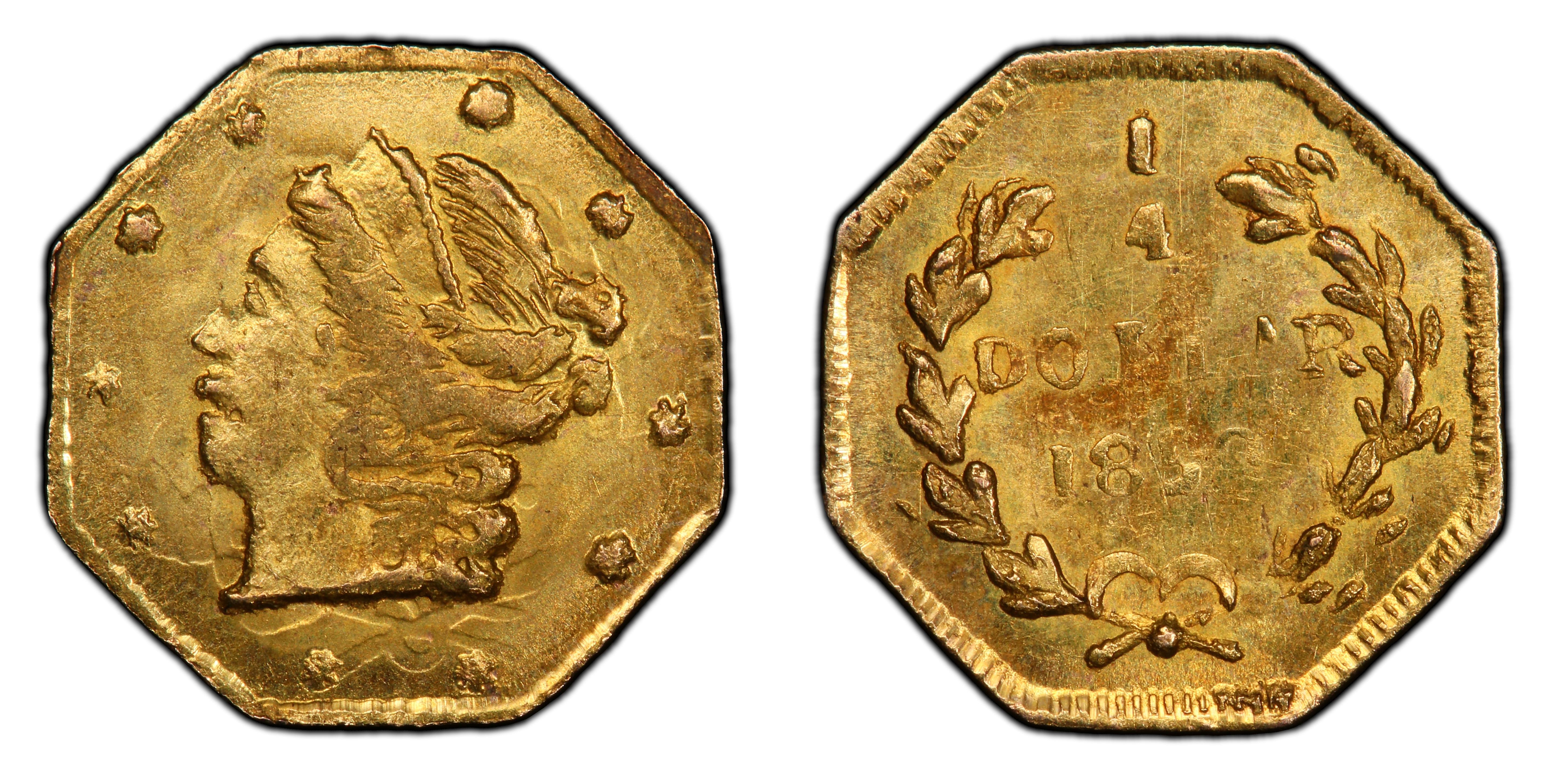
Obverse & Reverse
The 1859 BG-705 25 Cents piece emerges from the second major phase of California Fractional Gold production, a period numismatically distinct from the initial utilitarian issues of 1852-1857. Following the discovery of gold at Sutter's Mill in 1848, the massive influx of prospectors and merchants into California created a chaotic monetary landscape. With gold dust as the primary medium of exchange and a severe shortage of small-denomination federal coinage, transactions for everyday goods were cumbersome and imprecise. The first period of fractional gold, struck from 1852, was a direct response to this crisis, providing essential, albeit unofficial, pocket change. However, by 1854, the establishment of the San Francisco Mint began to alleviate this shortage with official U.S. gold and silver coins. As federal coins became more plentiful, the practical need for private fractional gold diminished. The production of these tiny gold pieces ceased in 1857, only to be revived in 1859. This revival, designated as 'Period Two' (1858-1882) by researchers Walter Breen and Ronald J. Gillio, had a fundamentally different purpose. The BG-705 is a quintessential example of these 'Suppressed Jewelers' Issues.' No longer intended to fill a crucial role in daily commerce, these pieces were manufactured primarily as souvenirs and keepsakes. Jewelers in San Francisco, many of French origin like Frontier, Deviercy & Co., recognized a burgeoning market among tourists, eastern correspondents, and even locals who wanted a memento of the great Gold Rush. These Period Two issues were often intentionally struck underweight and with lower fineness compared to their predecessors, as their value was derived from sentiment and novelty rather than intrinsic bullion content. The Coinage Act of 1864 officially outlawed private coinage, but the law was not strictly enforced against these small tokens until the Secret Service cracked down in 1883, effectively ending their production. The BG-705, therefore, is not a coin of necessity, but a commercial product of a mature Gold Rush economy, a tangible link to the romanticism and global fascination with California's golden era.
Associated EventCalifornia Gold Rush
Reason For MintingPrimarily created as a souvenir or 'pocket piece' for the tourist and memorabilia market after the initial need for circulating small change had subsided.
Minter HistoryThe exact minter of BG-705 is not definitively known, a common trait for many Period Two varieties. However, stylistic elements and punches often link these pieces to a small circle of San Francisco-based jewelers, many of whom were French immigrants. Prominent firms of this era included Frontier, Deviercy & Co., Deriberpe & Nouizillet, and others. These craftsmen used their skills to produce a wide array of die varieties, often with artistic merit but inconsistent technical standards. They operated in a legal gray area, producing denominated tokens that were technically illegal after 1864 but tolerated as novelties until federal enforcement tightened in 1883.
Historical SignificanceThe BG-705 is significant not as a circulating coin but as a cultural artifact representing the commercialization of the Gold Rush legend. It marks the transition of fractional gold from a practical monetary solution to a popular souvenir, reflecting California's growing identity as a destination. The existence of hundreds of die varieties from this period speaks to a competitive market for these keepsakes and the entrepreneurial spirit that defined post-Gold Rush San Francisco.
BG-705
Denomination25 Cents
Minting Period1859
Assayer/MinterUnknown San Francisco Jeweler (Possibly Frontier, Deviercy & Co. or related firm)
Geographic OriginSan Francisco, California
Obverse DescriptionOctagonal planchet. Features a Liberty Head, facing left, similar in style to the contemporary U.S. Gold Dollar. The head is surrounded by thirteen five-pointed stars along the border.
Obverse Inscription Reverse DescriptionOctagonal planchet. A wreath, composed of two branches tied with a bow at the bottom, encircles the denomination. The date is positioned below the bow.
Reverse Inscription1/4 DOLLAR 1859
CompositionGold
Stated Fineness Actual FinenessVariable, often debased and lower than federal standards, consistent with Period Two souvenir issues.
EdgePlain
Unknown
Survival Estimate13-30 (High R-6)
Rarity ScaleR-6
The BG-705 is sought after for its high rarity (R-6) and its status as a representative of the popular Period Two issues. The octagonal shape and classic Liberty Head design are appealing to collectors building type sets of California Fractional Gold. Its scarcity ensures that high-grade examples are prized and seldom offered for sale.
Key VarietiesThe primary variety is the regular strike BG-705. No known proof restrikes or special collector issues are recorded for this specific Breen-Gillio number. The broader series of California Fractional Gold contains over 500 distinct die varieties cataloged by Breen and Gillio, but the BG-705 itself is a unique die marriage.
Authentication TipsAuthentication requires comparison with known genuine examples, as the field is rife with counterfeits and modern replicas. Key diagnostics are in the specific positioning of the date, stars, and lettering, which are unique to the BG-705 dies. Genuine Period Two pieces often have a slightly crude, handmade feel and are struck on thin planchets. Modern copies are often brassy, have incorrect weights, mushy details, or tool marks around the design elements. Certification by a major grading service (PCGS or NGC) is highly recommended, as they attribute by BG number.
Shopping ConsiderationsA premium quality example of BG-705 will exhibit a sharp, well-centered strike, which is not always the case for these hastily produced jeweler's issues. Look for crisp details on Liberty's hair and the leaves of the wreath. Original, undisturbed surfaces with some remaining luster command significant premiums. Avoid examples that have been harshly cleaned, polished, or used as jewelry, as this is common for souvenir pieces. Toning can range from a light straw-gold to a deep reddish-orange; attractive, original color enhances eye appeal. Check for hidden planchet flaws or edge bumps, as these tiny coins were easily damaged.
A coin's grade is its condition, rated on a 1-70 scale. For rare coins, this is the most critical factor in determining value, as a tiny difference in preservation can mean a huge difference in price.
Relevant Grade TypesOriginal 1859 issues were all business strikes, although intended as souvenirs rather than for circulation. They are found in Circulated (1-58) and, more commonly for this souvenir issue, Mint State (MS, 60-70) grades. No proofs were struck during the original period of issue, and there are no known later-date proof restrikes of the BG-705 variety.
Mint State CharacteristicsUncirculated examples of BG-705 often display a soft, satiny luster rather than a hard, frosty one. The strike can be variable; a fully struck example with sharp definition on the stars and wreath is rare and desirable. Due to the nature of their production and handling as novelties, even Mint State examples may show minor planchet irregularities or small, scattered contact marks. The fields may exhibit a slightly reflective or prooflike surface, which is a desirable characteristic.
Circulated Wear PatternsWear first appears on the highest points of the design: Liberty's cheek, hair details above the eye and ear, and the highest leaves and bow of the wreath on the reverse. On moderately circulated examples, the individual hair strands will merge and the stars will begin to lose their sharp points. In lower grades, the date and legends become weak, particularly at the periphery.
Key Factors For ValueFor the BG-705, the primary value drivers are rarity and grade. An example certified by PCGS or NGC will command a significantly higher price. Within a specific grade, eye appeal is paramount. Collectors will pay a premium for a sharply struck coin with clean, original surfaces and attractive, unadulterated color. A CAC sticker, indicating premium quality for the grade, would add a substantial premium due to the coin's absolute rarity and the discerning nature of fractional gold specialists.
PCGS Price Guide
| Grade | Price | Population |
|---|---|---|
| 53 | N/A | N/A |
| 58 | $600.00 | 2 |
| 58+ | $675.00 | N/A |
| 60 | $750.00 | N/A |
| 61 | $825.00 | N/A |
| 62 | $900.00 | 10 |
| 62+ | $1,250.00 | N/A |
| 63 | $1,750.00 | 2 |
| 63+ | $2,350.00 | N/A |
| 64 | $3,150.00 | 2 |
| 64+ | $4,000.00 | N/A |
| 65 | $5,500.00 | N/A |