1853 G$1 BG-531 (Regular Strike)
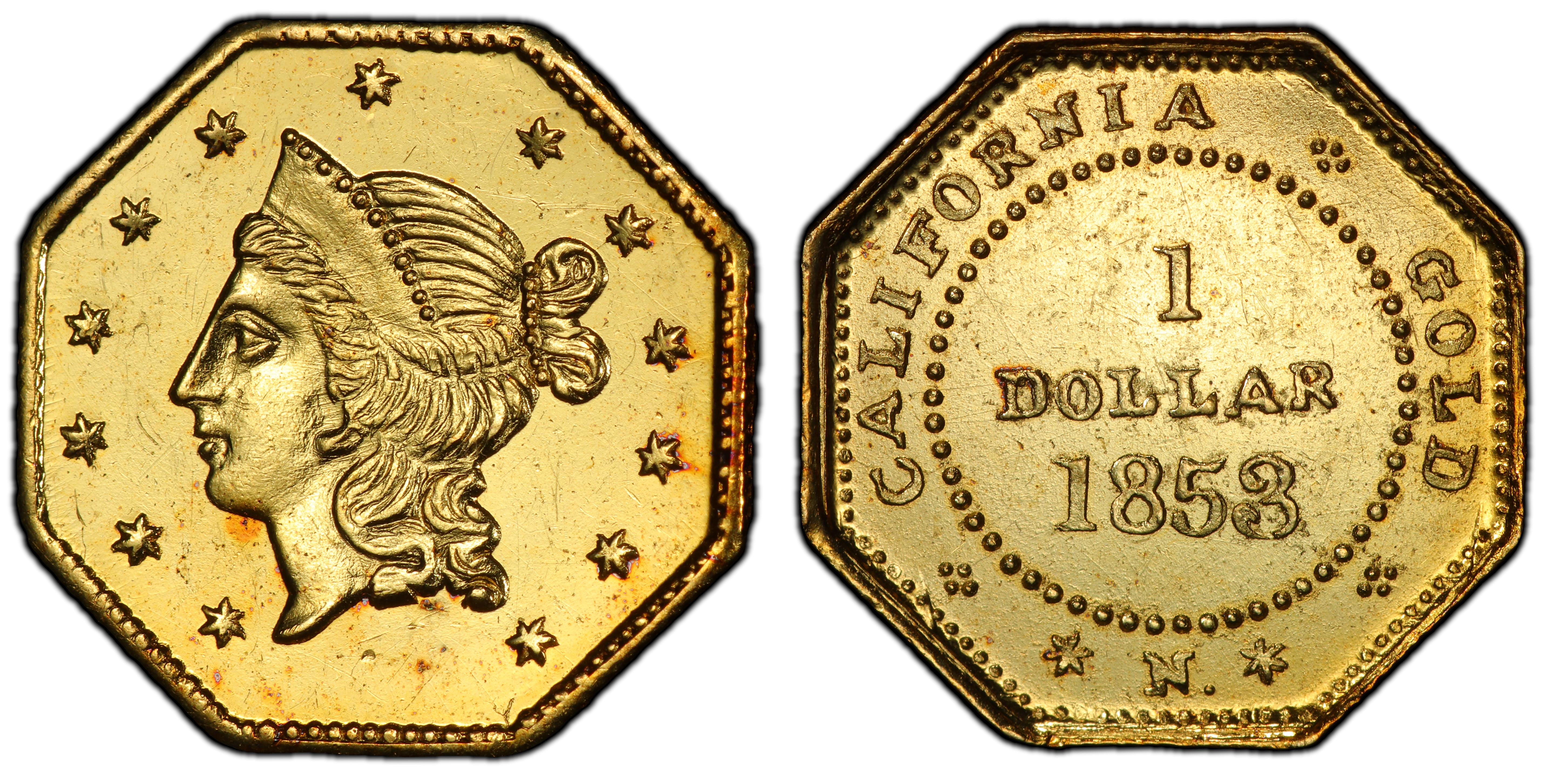
Obverse & Reverse
The 1853 Octagonal Gold Dollar, cataloged as BG-531 in the authoritative Breen-Gillio reference, is a quintessential artifact from the chaotic, formative years of the California Gold Rush. Following the 1848 discovery of gold at Sutter's Mill, a massive influx of prospectors and merchants descended upon California, creating a vibrant but unstable economy. While gold dust and nuggets were plentiful, the region suffered from a chronic and severe shortage of circulating coinage, particularly for small, everyday transactions. The nearest U.S. Mint in New Orleans was thousands of miles and months away, and private assayers like Moffat & Co. focused on larger denomination slugs and coins ($5 to $50) to convert raw gold into a tradable form. This left a void for small change, making simple purchases for food, lodging, or a drink incredibly difficult. Into this breach stepped various jewelers and metalsmiths, many of French origin, who began striking their own small-denomination gold pieces in 1852. These quarter-dollar, half-dollar, and one-dollar tokens were not official legal tender but were born of pure necessity and were accepted in local commerce. The BG-531 is a 'Period One' issue, a designation for the earliest pieces (1852-1857) believed to have been genuinely intended for circulation before the trade devolved primarily into a souvenir market. Though the specific maker is not definitively inscribed, numismatic scholarship, based on die characteristics and style, attributes this and related varieties to Gaime, Guillemot & Co., a prominent San Francisco jewelry firm. These tiny, often crudely struck coins were produced by hand, using a hammer to strike the upper die onto a planchet resting on the lower die. This resulted in inconsistent strike quality and frequent die cracks. The intrinsic value of the gold in these fractionals was almost always less than their face value, a fact not lost on the public. Coupled with their minuscule size, which made them easy to lose, they were never universally popular for commerce. By the mid-1850s, as the San Francisco Mint ramped up production of federal coinage, the practical need for these fractional pieces waned, and their production shifted to serve the growing souvenir and jewelry trade, where they became popular keepsakes for miners and tourists to send back East.
Associated EventCalifornia Gold Rush
Reason For MintingTo alleviate a severe shortage of small-denomination coinage for everyday commercial transactions in Gold Rush-era California.
Minter HistoryGaime, Guillemot & Co. was a firm of French jewelers and watchmakers operating in San Francisco during the 1850s. Like several other jewelers in the city, they recognized the critical need for small change and possessed the metallurgical and engraving skills to produce it. They are credited with striking a variety of fractional gold pieces, identified by numismatists through shared design elements and die punches. These 'jeweler's issues' were a pragmatic solution to a local economic problem, leveraging their existing business infrastructure to meet a commercial demand that the federal government had not yet addressed on the West Coast.
Historical SignificanceThe BG-531 and its contemporary 'Period One' fractional gold pieces are historically significant as they represent a grassroots, private-sector response to a failure in the money supply during one of America's most important periods of westward expansion. They are tangible relics of the chaotic, unregulated economy of the California frontier, demonstrating the ingenuity of local merchants in creating a functional medium of exchange. Their evolution from utilitarian currency to souvenir items also charts the maturation of the California economy and its integration into the broader United States monetary system.
N/A
Denomination$1
Minting Period1853
Assayer/MinterGaime, Guillemot & Co. (Attributed)
Geographic OriginSan Francisco, California
Obverse DescriptionA Liberty Head, facing left, with a diadem inscribed LIBERTY. Thirteen stars encircle the portrait.
Obverse InscriptionLIBERTY
Reverse DescriptionThe denomination '1' and the word 'DOLLAR' are enclosed within a beaded circle, which is itself surrounded by the legend 'CALIFORNIA GOLD'.
Reverse InscriptionCALIFORNIA GOLD 1 DOLLAR
CompositionGold
Stated Fineness Actual FinenessVariable, typically between .800 and .900, often containing a natural silver alloy.
Weight0.97 grams
Diameter11.50 mm
EdgePlain
Unknown; likely in the low thousands.
Survival Estimate200-300
Rarity ScaleR-4
This coin is highly sought after as a representative 'Period One' octagonal dollar, directly tied to the romanticism of the California Gold Rush. Its appeal lies in its historical importance as circulating currency, its distinctive octagonal shape, and its relative affordability compared to unique or higher-rarity territorial issues.
Key VarietiesThe BG-531 itself is a specific die marriage. There are no major varieties of this specific catalog number from the original minting period. No known special collector issues, patterns, or restrikes of the BG-531 die pair exist. Collectors should be aware of the broader California Fractional Gold series, which includes numerous die varieties and similar designs from other makers.
Authentication TipsGenuine BG-531 specimens often exhibit a somewhat crude, hand-struck appearance with imperfect centering and strike softness in areas. The planchets are typically thin. Diagnostics include the specific arrangement and shape of the letters and stars. Counterfeits are common; many are modern replicas or charms, often thicker, with a soapy or cast-like appearance, incorrect weight, and sometimes a bear on the reverse (no genuine Period One pieces have a bear). Authentication by a major third-party grading service (PCGS or NGC) is highly recommended, as they attribute by BG number.
Shopping ConsiderationsA premium quality example for its grade will show a bold, well-centered strike, especially on the Liberty portrait and the denomination on the reverse. Seek out specimens with minimal distracting marks and original, uncleaned surfaces that may exhibit a slightly reddish or mellowed gold luster. Weakness on the peripheral stars or letters is common and should be expected, but the central devices should be as sharp as possible. Avoid coins that have been used as jewelry, looking carefully for evidence of removed solder, tooling, or harsh cleaning, which are common problems for this series.
A coin's grade is its condition, rated on a 1-70 scale. For rare coins, this is the most critical factor in determining value, as a tiny difference in preservation can mean a huge difference in price.
Relevant Grade TypesOriginal issues were business strikes intended for circulation and are found in Circulated (1-58) and Mint State (MS, 60-70) grades. No Proofs (PR/PF) were struck during the original period of issue. The term 'Prooflike' (PL) may be applied to some business strikes that exhibit mirror-like surfaces from fresh, polished dies, but these are not true Proofs.
Mint State CharacteristicsAn uncirculated (MS) BG-531 typically displays a soft, satiny luster rather than a hard, frosty one. Strike quality is paramount; many are softly struck, so a sharply detailed Liberty Head and reverse legend command a significant premium. Due to the hand-hammering process, planchet quality can be inconsistent, and small, as-made flaws are not uncommon. Light adjustment marks or die cracks may be present and are part of the coin's character.
Circulated Wear PatternsWear first appears on the high points of the design: Liberty's hair above the eye and ear, her cheek, and the '1' on the reverse. On more heavily circulated examples, the word 'LIBERTY' on the diadem will become faint, and the peripheral stars and lettering will begin to merge with the fields.
Key Factors For ValueThe primary drivers of value are grade and surface preservation. An example with original, uncleaned 'skin' is far more desirable than one that has been brightened or polished. Sharpness of strike is a major consideration, with well-struck pieces fetching strong premiums. Eye appeal, encompassing attractive original color and minimal distracting marks, is crucial. For this series, a CAC sticker indicating premium quality for the grade adds a significant premium, as it provides an extra layer of confidence regarding originality and quality.
PCGS Price Guide
| Grade | Price | Population |
|---|---|---|
| 45 | $600.00 | 1 |
| 45+ | $610.00 | N/A |
| 50 | $625.00 | 3 |
| 50+ | $630.00 | N/A |
| 53 | $640.00 | 5 |
| 53+ | $650.00 | N/A |
| 55 | $675.00 | 20 |
| 55+ | $750.00 | N/A |
| 58 | $875.00 | 34 |
| 58+ | $925.00 | N/A |
| 60 | $1,000.00 | 4 |
| 61 | $1,050.00 | 11 |
| 62 | $1,100.00 | 24 |
| 62+ | $1,400.00 | N/A |
| 63 | $2,500.00 | 7 |
| 63+ | $3,000.00 | N/A |
| 64 | $4,500.00 | 1 |