1853 G50C BG-416 (Regular Strike)
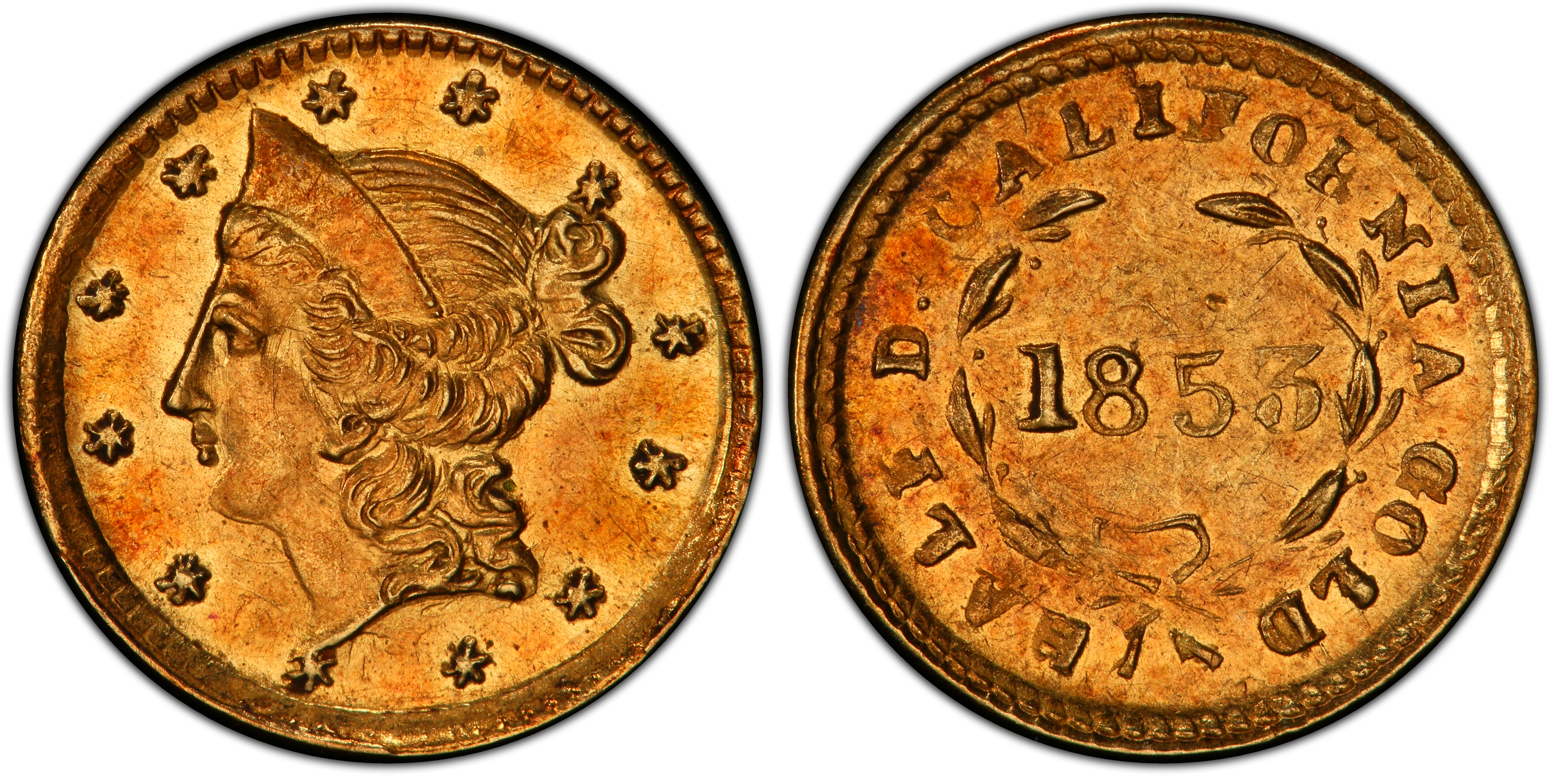
Obverse & Reverse
The 1853 Gold 50 Cents, cataloged as Breen-Gillio 416, is a tangible relic from the chaotic and economically vibrant era of the California Gold Rush. Following the discovery of gold at Sutter's Mill in 1848, a massive influx of over 300,000 people descended upon California, creating booming settlements almost overnight. This rapid population growth, however, was not matched by a commensurate supply of official United States coinage. With the nearest federal mint in Philadelphia—a perilous and months-long journey away—and the new San Francisco Mint not beginning operations until 1854, a severe shortage of small-denomination currency crippled daily commerce. Transactions for basic goods and services were often conducted with pinches of gold dust, a notoriously inaccurate and inefficient method. To fill this critical economic void, private jewelers and metallurgists in San Francisco began striking their own coinage from the plentiful local gold. These issues, known today as 'California Fractional Gold,' appeared in 25-cent, 50-cent, and one-dollar denominations. The BG-416 is a 'Period One' issue, a designation for coins struck between 1852 and 1856 that are believed to have been genuinely intended for circulation. Unlike later souvenir pieces, these early coins were a vital, if unofficial, part of the regional money supply. They were struck by hand, using a hammer and die method, resulting in variable strike quality. While often underweight compared to their stated value, the inflationary economy of Gold Rush California allowed them to be accepted in trade. The BG-416, struck by French jeweler M. Deriberpie, is a prime example of this genre—a privately issued coin born of pure necessity that facilitated the day-to-day survival of the 'forty-niners' and the merchants who served them. Its extreme rarity today speaks to the harsh conditions of circulation and the low original mintage common to these private ventures.
Associated EventCalifornia Gold Rush
Reason For MintingTo alleviate a severe shortage of small-denomination coinage for daily commerce in Gold Rush-era San Francisco.
Minter HistoryM. Deriberpie was one of several French jewelers active in San Francisco during the early 1850s who turned to private minting to meet commercial demand. Along with contemporaries like Antoine Louis Nouizillet and the firm of Frontier, Deviercy & Co., he produced several varieties of fractional gold. His issues, including the BG-416, are part of the 'Period One' series, which numismatists regard as legitimate circulating coinage of the era. Deriberpie is known for a few different die pairings in 1853, with his work being characteristic of the hand-struck, somewhat crude, yet functional private coinage of the time. These private minters operated in a legal gray area, but their products were essential until the U.S. Mint in San Francisco could produce sufficient quantities of small change, after which most of these private operations ceased.
Historical SignificanceThe BG-416 represents a critical solution to a currency crisis during one of America's most significant periods of westward expansion and economic development. As a 'Period One' issue, it stands as direct evidence of private enterprise stepping in where the federal government could not, creating a functional, albeit unofficial, medium of exchange that fueled the Gold Rush economy. Its existence highlights the unique monetary conditions of the American frontier and the ingenuity of its inhabitants.
N/A
Denomination50 Cents
Minting Period1853
Assayer/MinterM. Deriberpie
Geographic OriginSan Francisco, California
Obverse DescriptionThe obverse features a Liberty Head, facing left, modeled after the contemporary U.S. gold dollar. Her hair is tied in a bun, and she wears a coronet. The field is surrounded by thirteen six-pointed stars. A key diagnostic for the BG-416 variety is a small, misplaced star that appears to be attached to the truncation of the bust, just below the chin.
Obverse Inscription Reverse DescriptionThe reverse features the denomination '1/2' at the center, surrounded by an ornate wreath of two branches tied with a bow at the bottom. The legend 'CALIFORNIA GOLD' is inscribed around the upper periphery, and the date '1853' is below the wreath.
Reverse InscriptionCALIFORNIA GOLD 1/2 1853
CompositionGold
Stated Fineness Actual FinenessTypically varied from 14 to 22 karats for Period One issues, often containing a high percentage of native silver, giving them a lighter color.
Weight0.55 grams
Diameter10.50 mm
EdgePlain
Unknown; extremely small.
Survival Estimate10 to 12 pieces known.
Rarity ScaleR-7 (Low R.7)
The BG-416 is highly sought after for its extreme rarity, its status as a circulating 'Period One' issue, and its direct connection to the California Gold Rush. The unique and easily identifiable diagnostic of the misplaced star on the obverse adds to its appeal as a distinct die variety. It is a prized possession for specialists in pioneer gold.
Key VarietiesThe primary variety is the BG-416 regular strike. A related variety, BG-416A, is listed in numismatic references and is considered a great rarity, possibly unique. However, no confirmed image of BG-416A is widely available to researchers, making its specific attributes uncertain. No later-date restrikes or special collector issues are known for this specific die marriage.
Authentication TipsAuthentic Period One pieces like the BG-416 should show a hand-struck appearance, with potential for unevenness in the strike and planchet. The specific diagnostic is the small star attached to the truncation of Liberty's bust. The weight, diameter, and overall fabric should be consistent with known genuine examples. Counterfeits of this era are often cast or have a modern, machine-struck look. Be wary of pieces with fields that are too perfect or lettering that is mushy or ill-defined. Comparison with high-resolution images of certified examples is crucial. Many modern fantasy pieces exist, but they typically lack a denomination and have designs (like bears) not found on genuine Period One issues.
Shopping ConsiderationsFor a coin of this rarity, any example offered for sale is a major event. A 'premium quality' specimen would be one that is well-centered and sharply struck, particularly on the date and the star on the bust. Due to the softness of the gold and crude manufacturing, most examples will exhibit some degree of striking weakness, especially on the wreath. Look for glossy, original surfaces and avoid examples that have been harshly cleaned, polished, or used in jewelry. Given the rarity, even repaired or details-graded examples are considered highly significant and valuable. An attractive honey-gold or reddish-gold toning from the native alloy is highly desirable. Strike weakness is often noted near the wreath's bow.
A coin's grade is its condition, rated on a 1-70 scale. For rare coins, this is the most critical factor in determining value, as a tiny difference in preservation can mean a huge difference in price.
Relevant Grade TypesOriginal BG-416 coins were business strikes intended for circulation and are found in Circulated (1-58) and Mint State (MS, 60-70) grades. Due to their extreme rarity, most known examples are circulated, but a few Mint State specimens have survived. No Proofs were struck during the original minting period, and there are no known later-date Proof restrikes of this variety. Any coin described as a 'Proof' would be highly suspect.
Mint State CharacteristicsAn uncirculated BG-416 will exhibit original mint luster, which is typically soft and satiny rather than deeply reflective. The strike is a key factor; high-grade examples should show clear details on Liberty's hair and coronet. However, some inherent softness, especially on the lower-left portion of the reverse wreath, is characteristic of this variety and should not be overly penalized. The surfaces are expected to have some light abrasions and contact marks due to the softness of the gold and the crude production methods, but these should not be deep or distracting.
Circulated Wear PatternsWear first appears on the highest points of the design: Liberty's cheek, hair above the eye, and coronet on the obverse. On the reverse, the high points of the wreath's leaves and the numerals of the '1/2' will show the first signs of friction. On more heavily worn examples, the stars on the obverse and the letters in the legends will become soft and eventually merge with the fields.
Key Factors For ValueFor the BG-416, rarity is the paramount factor. After that, value is determined by surface preservation and strike. An example with original, uncleaned surfaces commands a significant premium over one that has been polished or cleaned. A sharp, well-centered strike that clearly shows the diagnostic star on the bust is highly desirable. Eye appeal, driven by attractive original color and minimal distracting marks, is also a major value component. Given its rarity, a CAC sticker would provide significant validation of quality for the assigned grade and would be highly prized by advanced collectors.
PCGS Price Guide
| Grade | Price | Population |
|---|---|---|
| 55 | $2,150.00 | 3 |
| 55+ | $2,250.00 | N/A |
| 58 | $2,400.00 | 4 |
| 58+ | $2,650.00 | 1 |
| 60 | $2,850.00 | 1 |
| 61 | $3,250.00 | N/A |
| 62 | $4,000.00 | 3 |
| 62+ | $4,750.00 | N/A |
| 63 | $6,250.00 | 1 |
| 63+ | $7,000.00 | N/A |
| 64 | $8,500.00 | 1 |