1854 G50C BG-308 (Regular Strike)
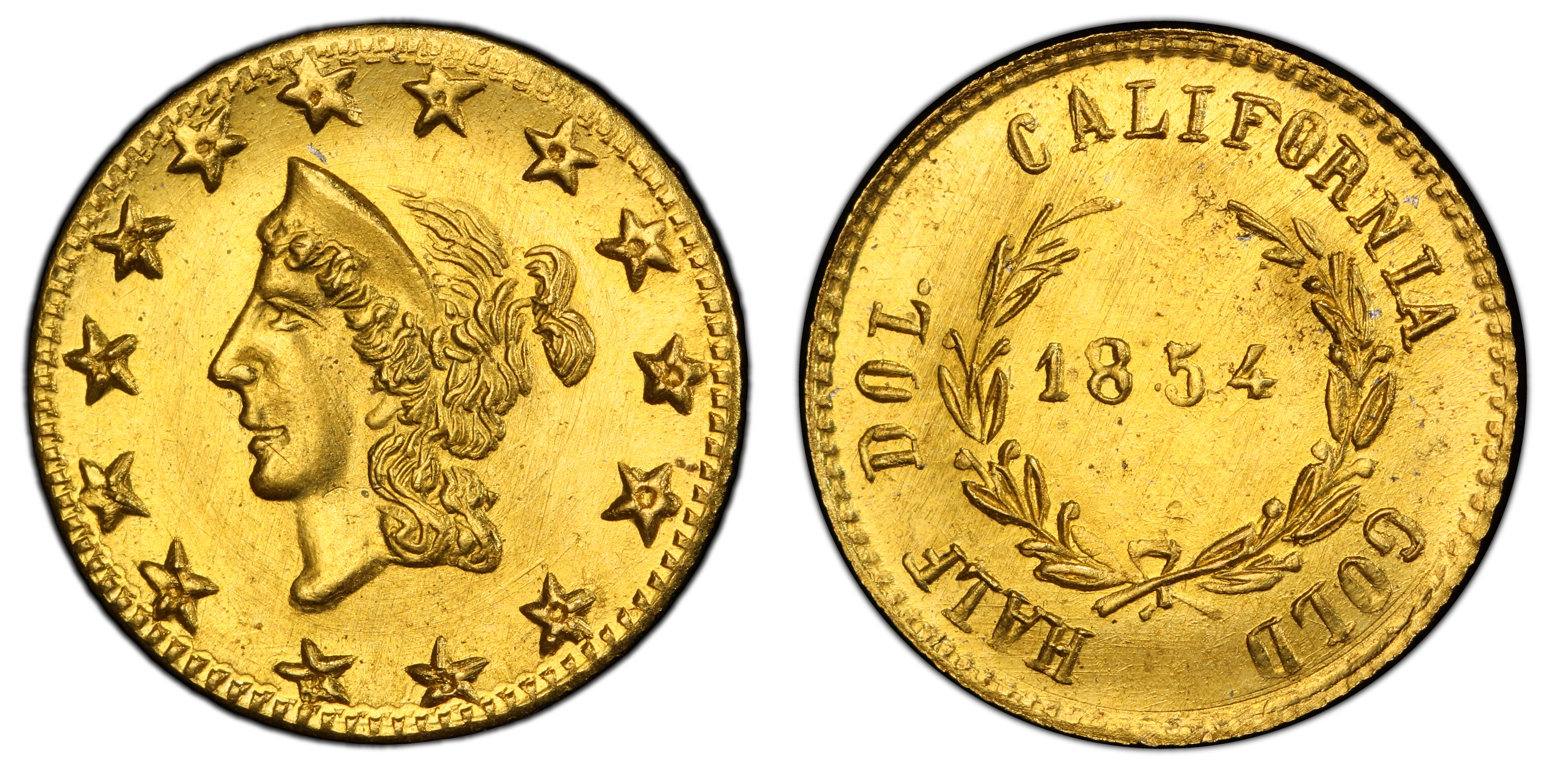
Obverse & Reverse
The 1854 Octagonal Gold 50 Cents, cataloged as BG-308, is a tangible artifact from the chaotic and economically vibrant apex of the California Gold Rush. Following the discovery of gold at Sutter's Mill in 1848, a massive influx of prospectors and merchants descended upon California, creating a booming economy almost overnight. However, this rapid growth far outpaced the supply of official United States coinage. While large private and, eventually, federal assay office gold coins ($5 to $50) handled major transactions, there was a severe, chronic shortage of small denomination coins for daily commerce. Simple purchases of food, drink, or services were often complicated, relying on imprecise measures of gold dust—a 'pinch' being a common but inconsistent unit. To fill this void, enterprising jewelers and metalsmiths in San Francisco began striking their own small-denomination gold coins in 1852. These pieces, known as 'California Fractional Gold,' were struck in quarter dollar, half dollar, and dollar denominations and came in both round and octagonal shapes. The BG-308 is a prime example of these 'Period One' (1852-1857) issues, which are believed to have been genuinely intended for and used in local commerce. Unlike later issues (Period Two and Three) which were often made as souvenirs, these early pieces served a vital economic function. They were crudely but effectively manufactured, typically by the 'hammer method,' where dies were struck by hand. This resulted in significant variations in strike quality. While not officially sanctioned, their convenience outweighed concerns about their intrinsic value, which was often slightly below their face value. The opening of the San Francisco Mint in April 1854 signaled the beginning of the end for these private issues. As official federal coinage became more plentiful, the necessity for fractional gold waned, and by 1857, their production for circulation ceased. The Coinage Act of 1864 officially made private coinage illegal, cementing the status of these early fractionals as relics of a unique and transitional period in American monetary history.
Associated EventCalifornia Gold Rush
Reason For MintingTo alleviate a severe shortage of small-denomination coinage for everyday commercial transactions in Gold Rush-era California.
Minter HistoryThe specific minter of the BG-308 variety is unknown, which is common for many California Fractional Gold issues. Production was not centralized but rather undertaken by various private jewelers and assayers located in San Francisco. These craftsmen, many of whom were of French origin, used their metallurgical skills to meet the region's pressing need for currency. Known makers of fractional gold during this period include figures like Antoine Louis Nouizillet and M. Deriberpe, though attribution of specific un-initialed varieties like BG-308 remains a subject of numismatic study. These minters operated in a semi-legal gray area, producing a product that was essential for local trade but lacked federal authorization.
Historical SignificanceThe BG-308, as a 'Period One' issue, represents a critical solution to a regional economic crisis. It is a testament to the ingenuity and laissez-faire environment of the American West, where private enterprise stepped in to fulfill a basic governmental function—the supply of currency. These tiny gold coins facilitated the day-to-day economy of the Gold Rush, enabling the pioneers and prospectors who built California to conduct their business. Their existence highlights the immense gap between the economic realities on the frontier and the slower-moving monetary policy of the federal government on the East Coast.
N/A
Denomination50 Cents
Minting Period1854
Assayer/MinterUnknown Private Jeweler
Geographic OriginSan Francisco, California
Obverse DescriptionThe obverse features a Liberty Head, facing left, modeled after the contemporary U.S. gold dollar. Her hair is tied in a bun, and she wears a coronet inscribed LIBERTY, though the inscription is often weak or incomplete. The head is surrounded by thirteen six-pointed stars arranged along the octagonal border.
Obverse InscriptionLIBERTY
Reverse DescriptionThe reverse design is relatively simple, featuring the denomination '1/2' at the center, enclosed within a delicate wreath of two olive branches tied with a bow at the bottom. The legend 'CALIFORNIA GOLD' is inscribed above the wreath, and the date '1854' appears below it.
Reverse InscriptionCALIFORNIA GOLD 1/2 1854
CompositionGold
Stated Fineness Actual FinenessTypically varied, often between .800 and .900, using native California gold which had a high natural silver content.
Weight0.80 grams
Diameter11.50 mm
EdgePlain
Unknown
Survival Estimate75-125
Rarity ScaleR-4
The BG-308 is highly sought after as a representative 'Period One' octagonal half dollar. Its appeal lies in its direct connection to the height of the Gold Rush, its distinct octagonal shape, and its status as a genuine circulating private currency. It is one of the more available, yet still challenging, varieties for collectors building sets of early fractional gold.
Key VarietiesThe primary variety is the regular business strike. No known proof strikings or official restrikes were made during the period of issue. As with all hand-struck coinage, minor die states and striking variations exist, but these are not typically cataloged as major varieties for BG-308. Later souvenir pieces and modern replicas are common, but are not considered part of the original numismatic series and are easily distinguished by experts.
Authentication TipsGenuine BG-308 coins must be denominated with '1/2'. Period One pieces like this were made for circulation and often show some wear. Be wary of pieces that appear cast, with porous surfaces or a soft, soapy feel. The strike is often weak in areas, particularly on the word 'LIBERTY' and the date, but the overall details should be sharp. Modern replicas are abundant and often have incorrect lettering styles, weights, or a brassy, unnatural color. Authentication by a major third-party grading service (PCGS or NGC) is highly recommended.
Shopping ConsiderationsA premium quality BG-308 for its grade will exhibit a sharp, well-centered strike, which is uncommon for the issue. Look for clear details on Liberty's hair and the leaves of the reverse wreath. Original, uncleaned surfaces with some remaining mint luster are highly desirable and command significant premiums. The natural gold color should be a rich yellow-gold, sometimes with greenish or reddish hues from the native alloy, not a brassy yellow. Avoid examples with significant scratches, edge bumps, or evidence of having been used in jewelry. Even on circulated examples, pleasing, honest wear is preferable to a cleaned or tooled coin with impaired surfaces.
A coin's grade is its condition, rated on a 1-70 scale. For rare coins, this is the most critical factor in determining value, as a tiny difference in preservation can mean a huge difference in price.
Relevant Grade TypesAll original 1854 BG-308 coins were struck as business strikes for circulation. They are found in Circulated grades (AG-3 to AU-58) and, more rarely, in Mint State (MS-60 to MS-70). No Proof (PR/PF) examples were struck during the original minting period, and there are no known official later-date Proof restrikes. Any piece described as a 'Proof' is almost certainly a modern replica.
Mint State CharacteristicsAn uncirculated BG-308 is rare. Quality is defined by the strength of the strike, the quality of the planchet, and the preservation of luster. Even high-grade examples often show weakness on the highest points, such as the letters in 'LIBERTY' on the coronet and the bow on the reverse wreath. The luster is typically satiny rather than frosty. Small planchet flaws or adjustment marks are common and not always considered major defects given the crude manufacturing process. Contact marks, even small ones, can significantly impact the grade of these tiny coins.
Circulated Wear PatternsWear first appears on the high points of the design. On the obverse, look for flattening on Liberty's cheek, the hair above her eye, and the coronet. On the reverse, the leaves in the wreath and the bow will show the first signs of wear. In lower grades (VG and below), the stars on the obverse will become faint and the legends, particularly the date, will start to merge with the fields.
Key Factors For ValueFor the BG-308, value is driven by three main factors: grade, surface quality, and strike. A sharply struck coin with minimal marks and original, lustrous surfaces will always command a premium. Cleaned, polished, or damaged coins are heavily penalized in the market. Eye appeal is paramount; a coin with a pleasing, original 'skin' and a strong strike will be worth significantly more than a technically identical grade that is weakly struck or has distracting marks. Certification by PCGS or NGC is standard, and a CAC sticker indicating premium quality for the grade adds a further, often substantial, premium.
PCGS Price Guide
| Grade | Price | Population |
|---|---|---|
| 30 | $180.00 | N/A |
| 35 | $185.00 | N/A |
| 40 | $215.00 | 1 |
| 45 | $225.00 | N/A |
| 45+ | $225.00 | N/A |
| 50 | $235.00 | 6 |
| 50+ | $235.00 | N/A |
| 53 | $250.00 | 1 |
| 53+ | $255.00 | N/A |
| 55 | $300.00 | 20 |
| 55+ | $305.00 | N/A |
| 58 | $315.00 | 32 |
| 58+ | $325.00 | N/A |
| 60 | $375.00 | 8 |
| 61 | $400.00 | 13 |
| 62 | $450.00 | 43 |
| 62+ | $575.00 | N/A |
| 63 | $900.00 | 17 |
| 63+ | $1,050.00 | N/A |
| 64 | $1,350.00 | 8 |
| 64+ | $1,850.00 | N/A |
| 65 | $5,500.00 | N/A |