1853 G25C BG-101 (Regular Strike)
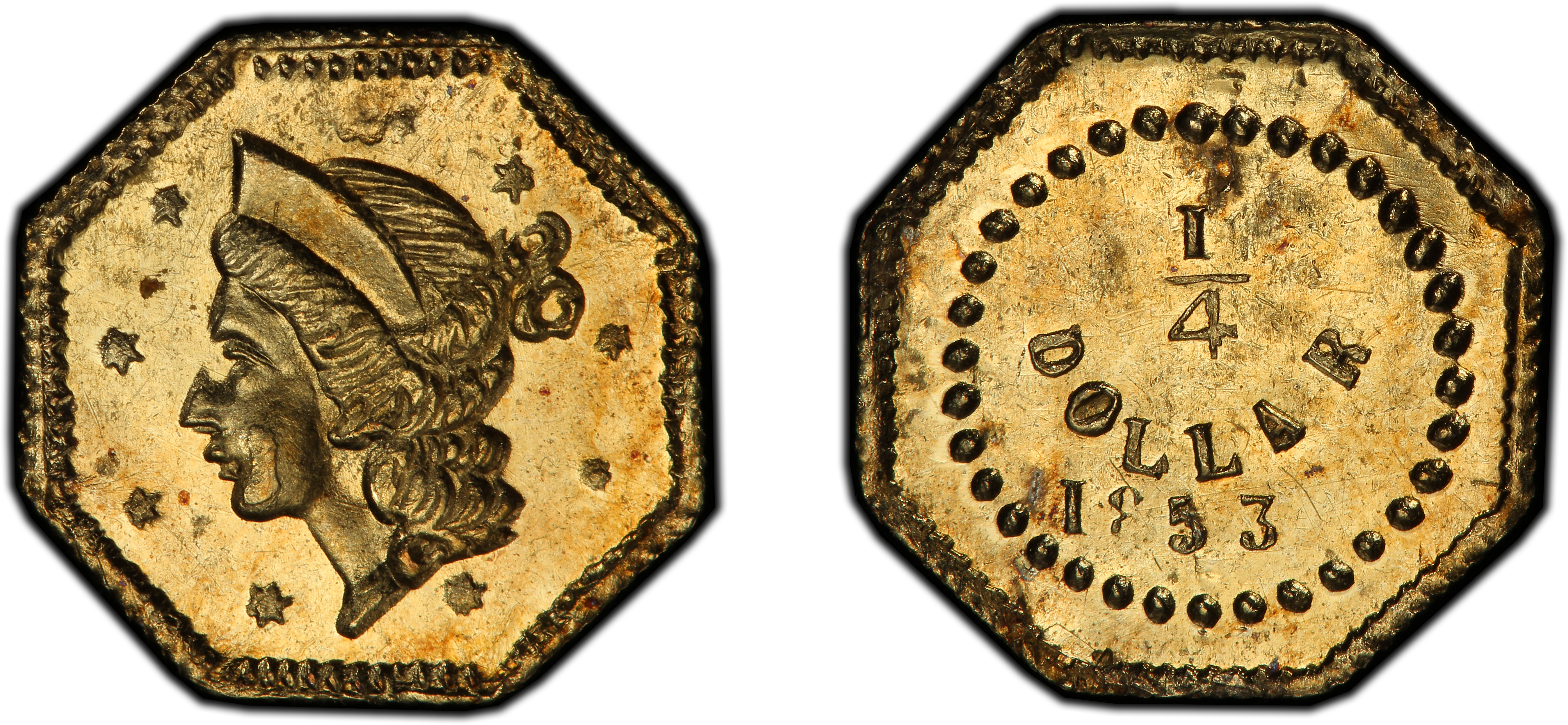
Obverse & Reverse
The 1853 BG-101 octagonal quarter-dollar is a quintessential artifact of the California Gold Rush, a period of frantic economic expansion and monetary chaos. Following the discovery of gold at Sutter's Mill in 1848, a massive influx of prospectors and merchants descended upon California, creating a population boom that the nation's underdeveloped monetary system could not support. Gold dust and nuggets became the primary medium of exchange, but this was impractical and unreliable for small, everyday transactions. A beer, a shave, or a loaf of bread could not be easily purchased with a pinch of gold dust, leading to a severe and crippling shortage of small-denomination coinage. While the U.S. government was slow to react, establishing the San Francisco Mint only in 1854, private enterprise filled the void. Jewelers and metallurgists, many of French origin, began striking their own small-denomination gold coins in 1852. These 'Period One' issues, including the BG-101, were not novelty items but essential components of regional commerce, intended to and believed to have actually circulated. Struck by hand with simple screw presses, their quality varied, but they provided a vital substitute for the federal coinage that was virtually absent on the West Coast. The BG-101 was produced in the heart of this activity in San Francisco. Its existence speaks to the ingenuity and necessity that characterized the Gold Rush economy. These tiny gold pieces facilitated trade, enabling the burgeoning cities of California to function until federal coinage became plentiful. By 1857, the need for these private issues waned as the San Francisco Mint ramped up production, rendering them obsolete and paving the way for their transition from pocket change to treasured historical relics.
Associated EventCalifornia Gold Rush
Reason For MintingTo alleviate a severe shortage of small-denomination circulating coinage for everyday commercial transactions in Gold Rush-era California.
Minter HistoryThe specific maker of the BG-101 variety remains unknown, a common fate for many Period One California Fractional Gold issuers. Production was often carried out by jewelers or artisans who did not sign their work. These individuals operated in a legally ambiguous environment, focused on meeting immediate commercial demand rather than establishing a lasting minting legacy. Firms like Gaime, Guillemot & Co. were prominent jewelers in San Francisco during 1853, but no definitive link has ever been established between them and this specific coin. The anonymity of the minter underscores the decentralized and needs-based nature of this fascinating coinage.
Historical SignificanceThe BG-101 is a tangible link to the chaotic, formative years of California's economy. As a 'Period One' issue, it represents a genuine attempt to solve a currency crisis through private minting and is believed to have truly circulated, unlike many later souvenir issues. Its existence is a testament to the resourcefulness of frontier society and the powerful economic forces unleashed by the Gold Rush, predating the establishment of sufficient federal minting capacity on the West Coast.
BG-101
Denomination25 Cents
Minting Period1853
Assayer/MinterUnknown
Geographic OriginSan Francisco, California
Obverse DescriptionA fairly crude, stylized bust of Liberty facing left, her hair tied in a bun. She is surrounded by thirteen five-pointed stars, often weakly struck or unevenly spaced. The date '1853' is positioned below the bust.
Obverse Inscription1853
Reverse DescriptionThe denomination '1/4' is in the center, encircled by the legend 'CALIFORNIA GOLD'. Thirteen five-pointed stars are typically arranged around the periphery, similar to the obverse.
Reverse InscriptionCALIFORNIA GOLD 1/4
CompositionGold
Stated Fineness Actual FinenessVariable, typically struck from native California gold which contained natural silver alloys, resulting in a fineness of approximately .800 to .880.
EdgePlain
Unknown
Survival Estimate30-50 coins
Rarity ScaleR-5
This coin is highly sought after as a genuine 'Period One' circulating issue from the heart of the Gold Rush. Its octagonal shape, historical importance, and high rarity make it a prized collectible for specialists in Territorial gold and Western Americana.
Key VarietiesThe primary variety distinction for BG-101 relates to die states. At least three die states are known, with the most prominent being 'State Three,' which is identified by the first '8' in the date '1853' being noticeably incomplete or partial. This is a key diagnostic noted in auction catalogs. No special collector issues, patterns, or official restrikes are known to exist for this specific variety.
Authentication TipsAuthentic BG-101 specimens often exhibit a somewhat crude, soft strike, particularly on the stars and the date. The planchets are thin, and surfaces may show prooflike or satiny luster. Counterfeits are common in the Cal Fractional series; many are modern novelties made of brass or are underweight. Key diagnostics for a genuine piece include the precise die characteristics of the Liberty portrait and inscriptions as cataloged in the Breen-Gillio reference. Weakly struck areas are more indicative of authenticity than a sharp, modern-looking strike. Prospective buyers should rely on third-party certification from PCGS or NGC.
Shopping ConsiderationsA premium quality BG-101 is defined by a combination of strike, surface preservation, and eye appeal. Look for examples with as much detail as possible on Liberty's portrait and the reverse legend, as these areas are often weak. Original, undisturbed luster is paramount; many examples have been cleaned or polished over the years, which drastically reduces value. Attractive, original toning, often appearing as golden-brown or deep orange hues, is highly desirable. Check carefully for evidence of having been mounted in jewelry, tooling on the surfaces, or harsh cleaning, which are common problems for this series. A sharp, well-centered strike for the grade will always command a significant premium.
A coin's grade is its condition, rated on a 1-70 scale. For rare coins, this is the most critical factor in determining value, as a tiny difference in preservation can mean a huge difference in price.
Relevant Grade TypesAll original 1853 BG-101 pieces were struck as business strikes intended for commerce. They are found in Circulated grades (AG-3 to AU-58) and, more rarely, in Mint State (MS-60 to MS-70). The term 'Proof' (PR/PF) is not applicable, as no proofs were struck during the original minting period, and no later presentation or restrike Proofs are known to exist for this variety.
Mint State CharacteristicsAn uncirculated BG-101 is rare and highly prized. Luster is typically satiny and can be somewhat prooflike in reflectivity, especially on early die state examples. The strike is a critical factor; even high-grade specimens can show weakness on the peripheral stars or the digits of the date. Due to the softness of the gold and primitive handling at the time of minting, small, shallow contact marks are common and acceptable, but large or deep abrasions will significantly impact the grade and value.
Circulated Wear PatternsWear first appears on the highest points of the design: Liberty's cheek, hair bun, and eyebrow. On the reverse, the fraction '1/4' and the letters in 'GOLD' will show initial friction and loss of detail. On more heavily worn examples, the stars will begin to merge with the fields, and the date and legends will become faint and difficult to read.
Key Factors For ValueFor the BG-101, value is driven by rarity and grade. Surface quality is paramount; an example with original, uncleaned surfaces and attractive luster will sell for a massive premium over a cleaned or damaged coin of the same technical grade. The sharpness of the strike is also a major driver; a well-struck coin showing clear details, especially the date and stars, is far more desirable. Eye appeal, enhanced by attractive original toning, plays a significant role. Given the prevalence of counterfeits and cleaned coins, certification by PCGS or NGC is virtually required for any significant transaction, and a CAC sticker will add a further premium, confirming premium quality for the grade.
PCGS Price Guide
| Grade | Price | Population |
|---|---|---|
| 53 | $775.00 | 1 |
| 53+ | $800.00 | N/A |
| 55 | $825.00 | 9 |
| 55+ | $875.00 | N/A |
| 58 | $925.00 | 10 |
| 58+ | $975.00 | N/A |
| 60 | $1,025.00 | 1 |
| 61 | $1,100.00 | 7 |
| 62 | $1,175.00 | 27 |
| 62+ | $1,400.00 | N/A |
| 63 | $2,850.00 | 13 |
| 63+ | $3,750.00 | N/A |
| 64 | $5,500.00 | 1 |