1853 G25C BG-218 (Regular Strike)
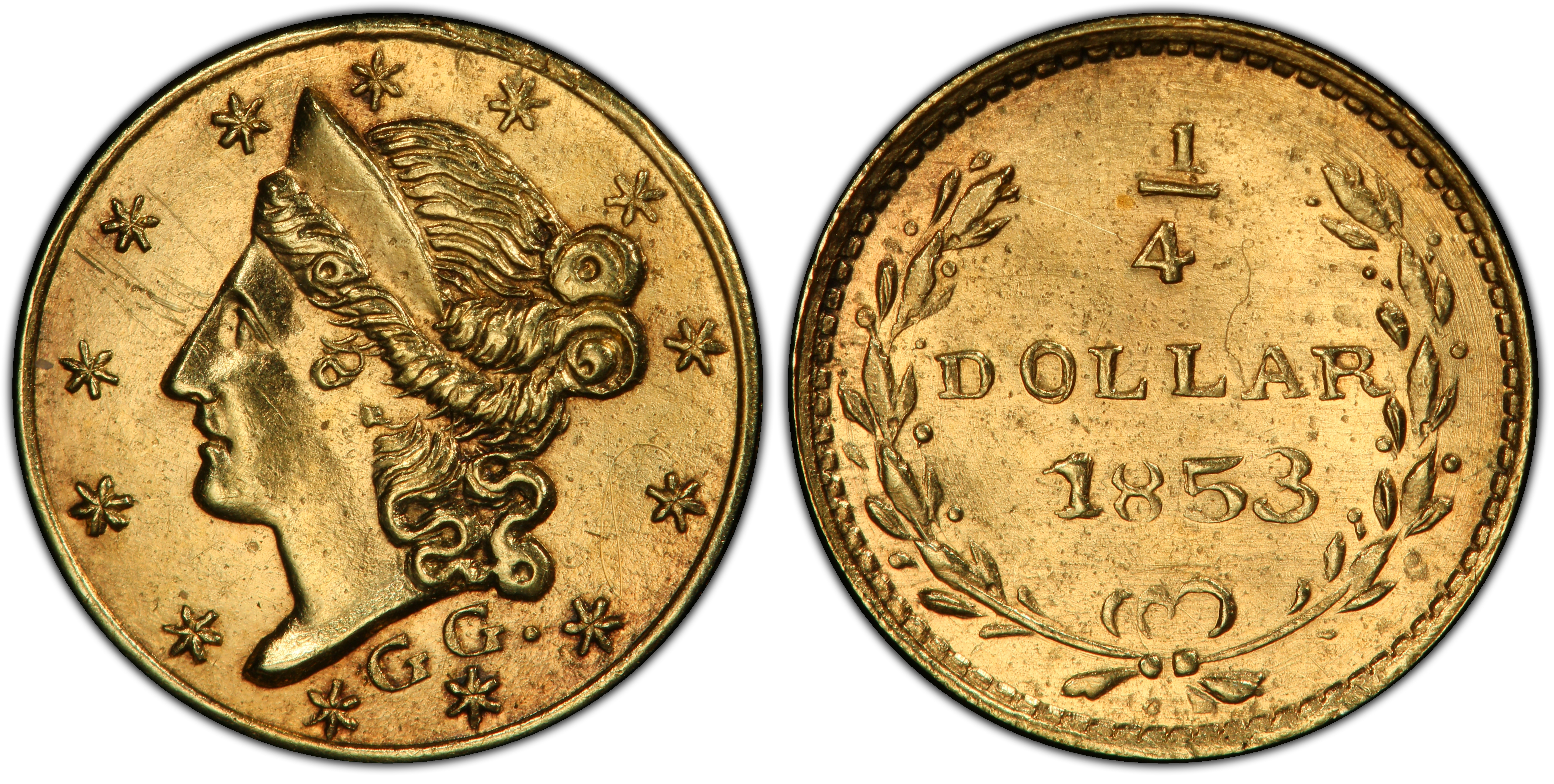
Obverse & Reverse
The 1853 G25C BG-218 quarter dollar is a tangible relic of the chaotic and economically volatile height of the California Gold Rush. By 1853, San Francisco was the epicenter of a massive, ongoing influx of prospectors, merchants, and speculators. While immense quantities of gold dust and large-denomination private ingots and coins circulated, there was a crippling shortage of small-denomination coinage for everyday transactions. A pinch of gold dust for a drink or small purchase was an imprecise and often contentious method of payment. Federal coinage was scarce on the West Coast, and the newly established San Francisco Mint would not begin operations until 1854, initially focusing on larger denominations. This monetary vacuum created a niche for private minters, often jewelers by trade, to produce fractional-denomination gold coins. These 'Cal Fracs,' as they are known, were not legal tender but were tolerated out of sheer necessity. The BG-218 belongs to what numismatists classify as 'Period One' (1852-1857) issues, which were generally intended to serve as circulating coinage and were made with a relatively honest intrinsic value, unlike the later, often debased 'Period Two' souvenir pieces. Struck by the firm of Gaime, Guillemot & Co., a company of French jewelers located at 103 Montgomery Street in San Francisco, this piece exemplifies the entrepreneurial spirit of the era. These tiny coins were typically produced using crude methods, often a hand-operated press or even a simple hammer-striking process, resulting in coins of varying strike quality. Their small size made them easily loseable, and many that did circulate saw extensive wear. The BG-218, being a Rarity-7 variety, was likely produced in minuscule quantities and had a very short circulation life before federal coinage became more plentiful, rendering them obsolete. Today, they are prized for their direct connection to the Gold Rush economy and the fascinating story of private enterprise stepping in to solve a critical problem of commerce on the American frontier.
Associated EventCalifornia Gold Rush
Reason For MintingTo alleviate a severe shortage of small-denomination coinage for daily commercial transactions in Gold Rush-era San Francisco.
Minter HistoryGaime, Guillemot & Co. was a firm of French jewelers active in San Francisco during the Gold Rush. The 1854 San Francisco City Directory lists their place of business as 103 Montgomery Street. Like many jewelers of the period, they possessed the skills and equipment necessary for working with gold and producing dies. They entered the private minting business to meet the local demand for small change, marking their issues with 'GG' initials below the bust of Liberty. Numismatic scholarship, including the work of Donald Kagin, suggests that while Gaime, Guillemot & Co. commissioned the coins, the actual striking may have been contracted out to another firm of French jewelers, Frontier, Deviercy & Co., who were known to be prolific producers of fractional gold. This arrangement highlights the collaborative and specialized nature of the private minting community in the bustling, opportunity-rich environment of 1850s San Francisco. All known 'GG' issues are extremely rare, indicating their venture into coinage was likely a small-scale, limited operation.
Historical SignificanceThis coin is a prime example of a 'Period One' California Fractional Gold piece, struck to genuinely facilitate commerce rather than to be a souvenir. Its extreme rarity and association with the identified jewelers Gaime, Guillemot & Co. provide a direct link to the private enterprise that formed a shadow monetary system in California before the federal mint could meet the region's needs. It represents a critical solution to an economic problem unique to the Gold Rush.
N/A
Denomination$0.25
Minting Period1853
Assayer/MinterGaime, Guillemot & Co.
Geographic OriginSan Francisco, California
Obverse DescriptionA small Liberty Head facing left, modeled after the contemporary U.S. federal gold dollars, surrounded by thirteen six-pointed stars. The hair is tied in a bun at the back. Below the bust are the initials 'GG' for the minters, Gaime, Guillemot & Co. This obverse die is known as a 'die marriage,' as it was also used to strike the BG-217 variety.
Obverse InscriptionGG
Reverse DescriptionA wreath composed of two branches tied with a bow at the bottom. The wreath contains the denomination '1/4' and the word 'DOLLAR'. Below the bow is the date '1853'. This reverse die is unique to the BG-218 variety and is characterized by a crudely engraved, misaligned 1/4 fraction and a date that is positioned low and distinctly to the right.
Reverse Inscription1/4 DOLLAR 1853
CompositionGold
Stated Fineness Actual FinenessApproximately .880 fine (Period One fractionals were typically made from native California gold, which naturally contained silver and other trace elements, resulting in a fineness lower than the .900 standard of federal coinage).
Weight0.44 grams
Diameter9.50 mm
EdgePlain
Extremely Low
Survival Estimate8-10 pieces known (per PCGS CoinFacts)
Rarity ScaleR-7
The BG-218 is a classic California Fractional Gold rarity. Its appeal stems from its 'Period One' status, ensuring it was made for circulation during the peak of the Gold Rush. The identifiable 'GG' mintmark, extreme rarity (R-7), and unique reverse die characteristics make it a highly coveted prize for advanced specialists in territorial and private gold.
Key VarietiesThe BG-218 itself is a key die variety. There are no known major variations struck during its original minting period. No known special collector issues, patterns, or restrikes exist for this specific variety.
Authentication TipsAuthentication requires careful die analysis. 1) Verify the obverse die is the correct state shared with BG-217, with the distinctive 'GG' initials below the bust. 2) The reverse die is unique and must match known exemplars: the '1/4' fraction is noticeably misaligned and crudely executed, and the date '1853' is positioned low and shifted to the right. 3) Genuine Period One fractionals have a distinct fabric, often with weak or uneven strikes due to hammer or crude press production. Modern fakes are often sharply struck with uniform, lifeless surfaces. 4) The gold color should be consistent with native California gold, often a slightly lighter, greenish-gold or brassy-gold hue due to the natural silver alloy.
Shopping ConsiderationsFor a Rarity-7 coin, any available example is a major acquisition. A 'premium quality' specimen would be one that is well-centered and shows as much of the design as possible, as strikes are often uneven. Look for minimal surface impairments; given their crude manufacture, some planchet roughness or adjustment marks may be acceptable. Avoid examples that have been harshly cleaned, which will appear unnaturally bright and have hairline scratches, or those that show evidence of being used in jewelry (solder, tooling, or excessive rim damage). The sharpness of the 'GG' initials and the date are key indicators of a strong strike for the grade. Semiprooflike or prooflike surfaces are sometimes encountered and command a significant premium.
A coin's grade is its condition, rated on a 1-70 scale. For rare coins, this is the most critical factor in determining value, as a tiny difference in preservation can mean a huge difference in price.
Relevant Grade TypesOriginal period issues were business strikes intended for circulation, and are found in Circulated (1-58) and Mint State (MS, 60-70) grades. Due to their extreme rarity, most known examples are circulated. No Proofs (PR/PF) were struck during the original minting period for this variety, and no later-date Proof restrikes are known to exist.
Mint State CharacteristicsAn uncirculated BG-218 will exhibit original mint luster, which is typically soft and satiny rather than deeply frosty. Due to the crude production methods, even Mint State examples may show weakness in strike, particularly on the highest points of Liberty's hair and the leaves of the wreath. Small planchet flaws or minor die cracks are common and do not preclude a Mint State grade. The fields may be semi-prooflike. The key is the absence of any wear and the presence of unbroken luster.
Circulated Wear PatternsWear first appears on the highest points of the design. On the obverse, check for flatness on Liberty's cheek, the hair just above the eye and ear, and the coronet. On the reverse, the high points of the wreath's leaves and the bow will show wear first. In lower grades (VF and below), the delicate 'GG' initials may become faint, and the digits of the date will begin to merge with the fields.
Key Factors For ValueFor the BG-218, rarity is the primary value driver. Given that, the key factors separating one example from another are surface preservation and eye appeal. An example with original, uncleaned surfaces and a sharp, well-centered strike will command a massive premium. Any evidence of cleaning, scratches, or jewelry mounting will significantly depress the value. Coins with a pleasing, honest patina and problem-free surfaces are highly sought. A CAC sticker on an already-graded coin would provide further assurance of quality for the grade and would add a considerable premium.
PCGS Price Guide
| Grade | Price | Population |
|---|---|---|
| 53 | $3,000.00 | 1 |
| 53+ | $3,100.00 | N/A |
| 55 | $3,250.00 | 1 |
| 55+ | $3,350.00 | N/A |
| 58 | $3,500.00 | 2 |
| 58+ | $3,650.00 | N/A |
| 60 | $4,000.00 | N/A |
| 61 | $4,500.00 | 1 |
| 62 | $6,000.00 | 6 |
| 62+ | $6,500.00 | N/A |
| 63 | $7,750.00 | N/A |